 2026, Vol. 47


2. 宁夏大学林业与草业学院,银川 750021;
3. 宁夏大学西北土地退化与生态恢复国家重点实验室培育基地,银川 750021
2. School of Forestry and Prataculture, Ningxia University, Yinchuan 750021, China;
3. Breeding Base for State Key Laboratory of Land Degradation and Ecological Restoration in North China, Ningxia University, Yinchuan 750021, China
土壤中存在着复杂多样化的微生物群落,以上群落对维持土壤生态系统发挥着基础性作用[1]. 微生物群落是生物地球化学过程的关键驱动因素,在全球范围内调控养分循环和生态系统功能[2]. 然而,来自同一土壤剖面表层与底层的细菌群落样本,相较于空间相距数km但处于相同土层的样本,表现出更高的相似性或更大的差异[3]. 土壤深度本身构成了一个显著的理化梯度,强烈影响土壤中的微生物[4]. 有研究发现[5],微生物动态在不同土壤深度上并不均匀,垂直分层引入了额外复杂性,因较深土壤层呈现截然不同的环境条件——碳可用性降低、养分限制,以及适应这些约束的好营养型微生物群落占主导地位[6,7]. 此外,母质、土壤类型和土地利用实践等因素影响微生物群落的生态过程[8,9].
了解细菌群落的共生模式是土壤生物地理学的一个关键方法,它为研究复杂微生物群的组装机制提供了宝贵的方法依据[10]. 通过分析群落网络拓扑特征,可以解读物种间的生态位重叠,并确定驱动生态系统功能的关键类群[11]. 为了评估微生物类群之间的相互关联,这种共现网络强调了物种间的生物学关系[12]. 群落生态学理论指出,生物群落的形成主要受选择、漂变、扩散和物种形成等关键生态过程的共同调控[13]. 近年研究表明,微生物群落的构建并非由单一机制主导,而是确定性过程与随机过程共同作用的结果[9]. 确定性过程强调物种间的相互作用(如竞争和共栖)以及环境筛选因子(如pH和温度)对群落结构的塑造[14]. 而随机过程则体现在随机的出生、死亡、扩散和灭绝对微生物群落构建的决定性作用[15]. 随着中性群落模型及多种零模型的广泛应用,对以上群落构建过程进行定量分析已经实现. 在贡嘎山,无论海拔或季节,决定性过程均占主导地位[16]. 在亚热带黄山森林中,土壤各层细菌群落组装以随机性过程为主[17]. 在稻田土壤中,0~40 cm剖面范围内随机性过程始终主导组装过程[18]. 关于高山草甸的研究发现确定性过程随土壤深度增强[19]. 然而,在干旱半干旱区不同草原生态系统这类异质环境中,微生物群落组装机制仍未得到明确的研究结论.
鉴于此,在干旱与半干旱过渡带(宁夏),从南到北降水梯度上的生态多样性,选取了4种草地类型:高山草甸(AM)、典型草地(TG)、荒漠草地(DG)和草地化荒漠(GD)为研究对象. 对66个土壤剖面中的细菌群落进行了空间和环境变异性研究. 本研究旨在揭示:①细菌群落的组成、多样性和共现网络拓扑在不同土壤层中存在的显著差异;②土壤深度是影响细菌群落组装过程的关键因素. 本研究首次对干旱半干旱草地的垂直微生物分层进行了全面研究,以期为土壤深度梯度影响土壤细菌群落的组装提供新见解.
1 材料与方法 1.1 试验区基本情况研究区域位于中国宁夏回族自治区(北纬35°14′~39°23′,东经104°17~107°39′),面积为66 400 km2,地处黄土高原与蒙古高原之间. 该区域涵盖了中国北方几乎所有主要草地类型[20]. 在黄土高原南部,以AM和TG为主,其中TG主要集中在固原附近(如云雾山草地自然保护区),属于半干旱气候,年降水量一般在300~400 mm左右,以耐旱多年生丛生草为主. AM主要分布于六盘山等山地阴坡及河谷地带,该区域水文条件较好,气候较为湿润. 年降水量一般在400~600 mm左右. 该植被类型由多年生及根茎类草本植物组成,生长于干旱带中部. DG分布于宁夏中部和北部地区,属于草原与沙漠交汇地带,气候极度干旱,年降水量一般在200~300 mm左右,植被覆盖率为40%~60%,以干旱多年生草本植物为主,伴生少量干旱灌木;GD分布于宁夏北部和西北部,毗邻腾格里沙漠和毛乌素沙地,气候极度干旱,年降水量不足200 mm,植被稀疏(< 30%),以超干旱灌木和小半灌木为主[21]. 这种植被多样性为研究不同草地生态系统如何应对气候变化提供了独特的天然实验室.
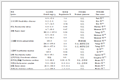
1.2 样地设置与采样对宁夏全区不同草地类型进行样品采集:AM(5个)、DG(7个)、TG(5个)和GD(5个). 每个采样点的纬度、经度和海拔高度均被记录,年平均温度(MAT)和年降水量(MAP)则从数据库中获取(http://www.worldclim.org/). 在每个采样点随机选取3个20 m×20 m的样方作为重复样本. 采用五点采样法在0~20、20~40和40~100 cm深度随机钻取5个土壤芯样. 这些土样芯随后混合形成复合样本. 每个土壤样本被分为3个子样本:其中一个保存在-80 ℃用于DNA提取,一个保存在4℃用于土壤理化性质分析,另一个用于土壤微生物测定. 此外,在每个样地内随机选取3个1 m×1 m的子样地进行植被调查(表 1).
|
表 1 不同草地类型采样点情况1) Table 1 Overview of sampling sites of grassland types |
1.3 土壤理化性质测定
土壤含水量(SWC)采用烘干称重法测定,将新鲜土壤在102℃下烘干至恒重[22]. 土壤pH值使用pH计(pHS-3C),以1∶2.5的土水比进行测定[23]. 土壤有机碳(SOC)采用K₂Cr₂O₇外部加热法测定,随后用0.1 mol·L-1 FeSO₄进行滴定. 总氮(TN)采用凯氏定氮法测定,使用Kjeltec 8400(FOSS,丹麦). 有效氮(AN)采用碱性水解扩散法测定. 总磷(TP)通过紫外分光光度计(UV3200,Shimadu Corporation,日本)测定,样品经H₂SO₄和HClO₄湿法消化. 有效磷(AP)采用碳酸氢钠提取法测定. 速效钾(AK)采用pH 7.0的1 mol·L-1醋酸铵溶液提取,随后通过发射分光光度法测定. 总碳(TC)采用重铬酸钾外加热法测定[24,25].
1.4 16S rRNA基因扩增片段的测序分析土壤样品送至上海美吉生物医药科技有限公司测序. 提取土样的总DNA,使用引物338F(5′-ACTC CTACGGGAGGCAGCA-3′)和806R(5′-GGACTACH VGGTWTCTAAT-3′)扩增16S rRNA基因的V3-V4区域. 所有样本的纯化PCR产物在测序前按等物质的量进行标准化. 高通量测序采用Illumina NovaSeq PE250测序平台(Illumina Inc.,CA,USA)完成. 序列数据通过QIIME2(版本2018.2)管道中的扩增子序列变异体方法进行处理. 为研究各样本物种组成,对所有样本的有效数据以97%的一致性进行OUT聚类,然后对OTU的序列进行物种注释.
1.5 共现网络分析将不同草地同一土层土壤样品进行混合. 本研究在每个土层中选择平均相对丰度大于1%的门,并选择相对丰度大于0.01%的OTU进行相关性计算. 这种选择策略确保了网络能够捕获生态学上相关的物种,同时尽量减少丰度较低物种的群体. 本文使用R软件(版本4.1.2)中的wgcna包[26],生成高度可靠的斯皮尔曼相关矩阵,并为每个土壤层构建共现网络. 本文实施了严格的统计阈值(调整后P < 0.05且相关系数 > 0.6),以确保关联的可靠性. 最后使用修正的随机矩阵构建网络,用Gephi可视化. 通过igraph包(http://igraph.org)计算网络拓扑属性,提供了微生物群落组织和稳定性的定量指标. 此外,通过将这一复杂的网络方法扩展到分类群与环境的关系,本文建立了将微生物群落结构与环境因素联系起来的模型.
1.6 细菌群落组装使用零模型的方法评估了确定性过程和随机过程在细菌群落组装中的相对重要性. 这些方法是在标准系统发育β多样性和分类β多样性的分析框架分析之后进行的. 首先,通过重新支配系统发育树的分类群标签999次,在每个土壤深度内的样本中产生了β平均最近分类群距离(β MNTD)的零分布. 然后通过比较观察到的β MNTD值与通过其标准偏差归一化的β MNTD零分布平均值之间的差异来计算β最近分类单元指数(β NTI). β NTI < -2表示显著低于预期的系统发育周转率,而β NTI > 2表示显著高于预期的系统发育周转率. 当β NTI < 2时,表示此过程是随机过程. 因此本研究整合了β NTI和基于Bray-Curtis的Raup-Crick指标(RC-bray)[27],以估算同质选择(β NTI < -2)、变异选择(β NTI > 2)均质扩散(RC-bray < -0.95且-2 < β NTI < 2)、扩散限制(RC-bray > 0.95且-2 < β NTI < 2)以及漂移(-0.95 < RC-bray < 0.95且-2 < β NTI < 2)对土壤细菌群落组装过程的贡献.
1.7 数据分析细菌α多样性用Vegan软件计算,通过单向方差分析和邓肯事后检验(P < 0.05)对各层进行了系统比较,从而对依赖深度的趋势进行了可靠的统计验证. 采用基于Bray-Curtis距离的非度量多维尺度(NMDS)进行β多样性分析,同时使用ANOSIM分析比较不同土层间的差异显著性[28,29].
计算了0~20、20~40和40~100 cm土层土壤深度的细菌群落距离-衰减关系斜率. 每个深度的斜率系数根据以下公式计算:
| (1) |
式中,C为群落差异性,E/G为环境距离(environmental distance)或地理距离(geographic distance),a为截距值,b为距离衰减曲线的斜率系数[3]. 地理距离由R软件geosphere包计算得出[30].
在结构模型方程(SEM)分析中,所有变量都使用Z-分数转换(Origin,2021版)进行了标准化处理,以接近正态分布并均衡方差,从而便于比较、测试和准确建模以解释信息. 使用R软件piecewise SEM包(3.6.2版)进行了结构方程建模.
为了探讨细菌群落关联距离与栖息地选择在决定每个土壤层系统发生替换模式中的相对重要性,基于距离矩阵进行了多元回归分析,以分解进化系统发生β多样性的方差[31]. β NTI被用作因变量,环境和群落关联距离作为自变量,并计算了欧几里得距离. 环境变量包括土壤的物理和化学性质. 细菌群落关联的距离矩阵是基于每个土壤样本中物种之间的关联关系计算得出.
2 结果与分析 2.1 土壤理化性质差异不同草地类型土壤不同土层大部分土壤特性存在明显的垂直差异,如表 2所示. AM和TG在0~20 cm的SWC显著高于20~40 cm和40~100 cm,而DG和GD在0~20 cm低于其它两层. SOC和TN在AM和TG的含量远高于GD和DG,且0~20 cm与20~40 cm和40~100 cm有显著差异,但DG和GD的3个土层之间没有任何显著性差异. TC和AK在4个草地中都表现出0~20 cm与40~100 cm有显著性差异,但在20~40 cm和40~100 cm土层中没有显著差异. AP在4个草地的含量相差不大. pH在4个草地中随着土层的深度变大,并且0~20 cm和40~100 cm有显著差异.
|
|
表 2 不同草地类型不同土层的土壤理化性质的变化1) Table 2 Changes in the physical and chemical properties of soil in different grassland types and soil layers |
2.2 不同草地类型土壤细菌群落组成及多样性
不同草地类型中土壤细菌门水平相对丰度如图 1所示. 不同土层的门相对丰度排序基本一致. Actinobacteriota(放线菌门)、Proteobacteria(变形菌门)、Chloroflexi(绿弯菌门)、Acidobacteriota(酸杆菌门)、Gemmatimonadota(芽单胞菌门)和Firmicutes(厚壁菌门)为优势群落,其中放线菌门的相对丰度占比最大,分别为0~20 cm:48.3%(AM)、52.6%(GD)、48.5%(TG)和49.3%(DG);20~40 cm:48.0%(AM)、50.9%(GD)、47.2%(TG)和45.6%(DG);40~100 cm:48.1%(AM)、50.5%(GD)、47.3%(TG)和46.6%(DG).

|
AM:高山草甸,TG:典型草地,DG:荒漠草地,GD:草地化荒漠;T:0~20 cm,M:20~40 cm,S:40~100 cm,下同 图 1 不同草地类型不同土层细菌相对丰度变化 Fig. 1 Changes in relative abundance of bacteria in different soil layers of different grassland types |
细菌群落多样性在表层土壤中显著高于中层和底层土壤(图 2). Chao1指数在4种草地生态系统中所有3个土层之间存在显著差异[P < 0.05,图 2(a)],但在GD的中层和底层土壤之间无显著差异. Pielou指数仅AM和TG的表层土壤与底层土壤之间存在显著差异[P < 0.05,图 2(b)]. Sobs指数显示,AM和GD的3个土壤层之间存在显著差异[P < 0.05,图 2(c)],而TG和DG的中层与底层之间无明显区别. 香农指数与Chao1指数呈现相似趋势:表层土壤与中层土壤及底层土壤存在显著差异[P < 0.05,图 2(d)],但中层土壤与底层土壤在4个草地间无显著差异.

|
图 2 不同草地类型不同土层细菌α多样性变化 Fig. 2 Changes in α diversity of bacteria in different soil layers of different grassland types |
根据基于Bray-Curtis距离的NMDS分析结果显示,3个土层之间存在明显分离(P < 0.05,图 3). 特别是,表层土与较深土层(20~40 cm和40~100 cm)之间存在显著差异,而20~40 cm和40~100 cm土层之间则无显著差异.

|
图 3 不同草地类型不同土层细菌群落相异性 Fig. 3 Dissimilarity of bacterial communities in different soil layers of different grassland types |
为探究不同土层土壤细菌群落共现性特征和细菌群落与环境之间互作关系,构建了基于门水平的土壤细菌共现网络[图 4(a)],统计了网络拓扑性质(表 3). 不同土层网络分析表明,细菌网络的连接性、边数、平均度、类聚系数和路径长度均随着土壤深度增加而明显下降. 相反,模块化指数随着土壤深度增加而变大,而正相关边数随着土壤深度的增加而下降,表明物种更倾向于共存而非竞争.

|
(a)细菌群落共现性特征;(b)细菌群落与环境互作关系;节点颜色和大小表示物种类型和重要程度;线条颜色表示正负相关,绿正相关红负相关;线条数量表示物种间联系是否密切 图 4 不同土层细菌群落共现网络特性及其与环境相互作用 Fig. 4 Network characteristics of bacterial communities in different soil layers and their interaction with the environment |
|
|
表 3 不同土层网络拓扑性质 Table 3 Different soil layer network topology properties |
细菌群落-环境分析揭示了各土壤层中环境变量与微生物群落之间的显著关系[图 4(b)]. 在表层土壤的细菌分类群中,TP和SWC是0~20 cm最显著影响因素(P < 0.001). TC和SOC也是显著影响因素(P < 0.05). 对于20~40 cm,AN是主要影响因素(P < 0.001),随后是pH(P < 0.05). 在40~100 cm,影响细菌群落的最主要因素和0~20 cm相同,但TC、AP和AN也是影响40~100 cm的关键因素(P < 0.05).
2.4 细菌群落组装过程各土层取样点之间细菌群落的差异随着地理距离和环境特征的差异而增加[图5(a)和5(b)],表明在每个土层都出现了显著的发育信号. 0~20 cm土层和20~40 cm土层有相当大比例的β NTI值低于-2[图 5(c)],这表明确定性过程,尤其是同质选择起着主导作用. 而40~100 cm土层在-2 < β NTI < 2的范围内,表明随机过程占主导地位,尤其是扩散限制. 随着土层的加深,细菌群落组装过程由确定性过程逐渐向随机过程过渡. 3个土层的细菌微生物群落都能很好拟合中性模型(图 6),拟合优度分别为R2=0.51、R2=0.42和R2=0.31,表明中性群落模型在0~20 cm土层的拟合效果最佳,确定性过程占主导地位,随着土壤深度增加,随机性过程对细菌群落组装过程的影响逐渐增加. 同时,迁移率(m)值在逐渐增大,在40~100 cm土层达到最高值(m=0.504 8),进一步支持了深层土壤受随机过程影响更大的结论,并且零模型的分析结构和中性模型分析的结果一致.

|
(a)物种β多样性和环境距离,(b)地理距离衰减关系,(c)系统发育周转的分布,(d)组装过程;T:0~20 cm,M:20~40 cm,S:40~100 cm 图 5 不同土层细菌群落组装过程 Fig. 5 Bacterial community assembly processes in different soil layers |

|
连续的蓝色实线表示最佳拟合中性模型;蓝色虚线表示最佳拟合中性模型的95%置信区间;蓝色圆点表示出现频率高于中性群落模型预测的OTU;黑色圆点表示出现频率在中性模型的95%置信区间内中性群落模型预测的OTU;红色圆点表示出现频率低于中性群落模型预测的OUT;m表示迁移率 图 6 不同土层细菌群落的组装模式 Fig. 6 Assembly patterns of soil bacterial communities in different soil layers |
结构方程模型分析见图 7,显著影响0~20 cm土层的β NTI的因素包括气候(MAT和MAP)、土壤性质(TN、AP、SOC和SWC)、空间距离以及细菌群落关联[图 7(a)]. 对于中层土壤,土壤性质(pH、TC、SOC和AK)影响β NTI. MAT对细菌群落种间关系有直接影响,并间接影响β NTI[图 7(b)]. 在底层土壤中,MAP、土壤性质(AN和TC)、空间距离和细菌群落关联是影响β NTI的主要因素. TC、AN和MAP是直接影响分类关联的关键因素[图 7(c)].

|
箭头上的数字表示路径系数;R2值表示每个变量解释的方差比例;实心红色和实心蓝色箭头分别表示正相关和负相关关系,而虚线黑色箭头表示无显著关系 图 7 环境变量、空间距离、细菌群落关联及其对不同土层系统发育周转的间接和直接影响 Fig. 7 Direct effects of environmental variables, spatial distance, bacterial community associations and their indirect effects on phylogenetic turnover within each soil layer |
从群落组成来看,放线菌门、变形菌门、绿弯菌门和酸杆菌门能够在各种生境中广泛分布,与农田、森林以及湖泊沉积物的土壤细菌类群相似[32,33]. 好氧的放线菌门在营养丰富的有氧环境中占主导地位[34],其相对丰度随土壤深度增加和营养可用性降低而下降. 这与青藏高原土壤形成对比,并且放线菌门在亚表层土壤中占主导地位[35]. 由于酸杆菌门对土壤酸度更为敏感,且4个草地类型中pH值随土壤深度增加(表 1),因此其相对丰度在表层土壤中更高,这解释了其在表层土壤中的优势丰度. 变形菌门具有高度的形态和代谢多样性,使其能够轻松利用SOC和氮源,而且能够利用多种底物,并在从酸性、资源匮乏条件到碱性条件的广泛环境中生存[36].
4种草地类型中3个土层的细菌群落α多样性随着土壤深度的增加而降低(图 2),这一结果在各种生态系统中均有相似结论[5,37],反映了高度梯度所带来的基本限制. 观察到的α多样性趋势与土壤物理化学性质的深度依赖性变化密切相关,尤其在中层土壤中出现明显下降,与此前在温带森林和高海拔沙漠中得到的结果一致[38,39]. 凸显了土壤微生物多样性在森林和草地系统中均遵循可预测的深度依赖性衰减规律. 可用性资源作为关键的生态过滤器[40],随深度变化的养分含量变化和酶活性水平,共同作用形成一种产物,使得某些细菌类群难以在较深土壤中生存[41],这就解释了α多样性随深度加速下降的现象. 此外,微生物群落的空间异质性(β多样性)也受到土壤性质垂直梯度的显著影响. 这种分层模式并非草地系统所独有,而是农业生态系统中的常见特征[42,43]. 综上所述,这些发现表明微生物群落的变化主要由土壤深度驱动.
3.2 共现网络随土壤深度梯度的变化微生物生态网络的研究揭示了其结构在不同环境中的显著差异[38,44],强调了土壤环境背景在塑造微生物相互作用中的重要性. 网络的复杂性随土层深度降低是因为表层土壤含有更多植物根系和根际分泌物,这些物质释放大量有机碳[45,46]. 而且养分供应的不均匀性和频繁的外部扰动,这些都促进了生态位分化,减少了竞争排斥,并促进了物种共存,最终增强了网络复杂性[47,48]. 相反,深层土壤呈现出更均匀的栖息地,有限的生态位分化加剧了物种间的竞争,从而降低了网络复杂性[49]. 深层土壤中氧气的消耗可能限制了用于生态位特化的代谢能量,进一步限制了复杂微生物网络链接的形成[50]. 表层土壤中的细菌网络显示出更强的正相关性,表明生态位重叠更大,且群落之间的正相关性更强[51].
有研究者得出,pH通过可获得养分或SOC特性从而影响细菌群落结构[52]. 作为微生物活动的基质,SOC是塑造0~20 cm细菌群落分布的关键影响因素. 营养丰富的土层中的土壤质地通过调节营养、水分和氧气等必需资源,间接塑造了微生物群落,这与强调土壤营养、pH值和SOC是塑造微生物生物地理学的关键因素一致[53].
3.3 不同土层细菌群落装配过程及其影响因素干旱半干旱区分布着高山草甸和荒漠草地,导致生态景观变化较大,环境异质性强[54]. 当强烈的环境异质性或长距离扩散不受限制时,确定性过程往往会发生[55]. 有研究表明确定性过程的贡献在60 cm土壤层以内普遍高于随机过程[56]. 这是因为较深的土壤层与环境过滤因素(交替的洪水和干燥)直接影响隔离,且受昼夜温度动态的影响较小[57]. 表层土壤中的细菌群可通过土壤孔隙迁移至底层土壤[58],而底层土壤的隔热性能优于表层土壤[18]. 另外,底层土壤受外部因素干扰和物理扰动较少,这抑制了细菌的扩散. 由于环境异质性导致土壤养分有限,从而造成低扩散率. 这些就解释了为何随机过程(扩散限制和漂移)在较深层土壤中占更大比例.
只有4%~15%的细菌群落的系统发育周转率可以用环境因素、空间距离和种间相互关联来解释(图 6). Li等[18]研究得出只有5%~17%的细菌群落系统发育可以用环境因素、空间距离和种间相互作用来解释,这与本研究结果相似. 此外,Wang等[59]研究得出空间距离和土壤特性共同解释了岛屿内细菌群落系统发育周转的16%,但不同的是对高山陡坡的研究,细菌群落组成和贡献的变化更受空间因素而非环境变量的影响[47];还有研究认为微生物群落的大部分变异并不能真正用环境和距离效应来解释(至少61%)[60],这可能是因为不可估量的环境因素或者空间距离,难以完全分离它们[19]. 正如之前的众多研究[61,62],使用分段结构方程模型可理清空间距离和环境因素对细菌群落组装的贡献. 在本研究中,对群落组装过程的分析证实,确定性和随机过程的相对重要性取决于土壤深度.
4 结论(1)不同土壤深度梯度中细菌群落的差异在很大程度上可归因于环境异质性,而非单纯的空间隔离. TP和SWC是0~20和40~100 cm土层的最显著影响因素(P < 0.001),AN是20~40 cm的主要影响因素(P < 0.001),AP和AN对40~100 cm土层的影响也较为显著(P < 0.01).
(2)细菌多样性、网络复杂性和物种相互作用随着土壤深度的增加而显著下降.
(3)细菌的确定性过程(如同质选择)在土壤深度增加时逐渐减弱,而随机过程(如扩散限制)则增强. 0~20 cm由确定性过程主导(63.2%),随机过程(36.8%);20~40 cm确定性过程(60.6%),随机过程(39.4%);40~100 cm则由随机过程主导(76.6%),确定性过程(23.4%).
(4)SEM分析证实了空间距离和环境因素对细菌群落组装的贡献.
| [1] | Wei X M, Hu Y J, Peng P Q, et al. Effect of P stoichiometry on the abundance of nitrogen-cycle genes in phosphorus-limited paddy soil[J]. Biology and Fertility of Soils, 2017, 53(7): 767-776. DOI:10.1007/s00374-017-1221-1 |
| [2] | Bahram M, Hildebrand F, Forslund S K, et al. Structure and function of the global topsoil microbiome[J]. Nature, 2018, 560(7717): 233-237. DOI:10.1038/s41586-018-0386-6 |
| [3] |
钟卓妍, 郭子成, 李雪儿, 等. 喀斯特地区稻田土壤剖面微生物群落对土壤深度的响应[J]. 中国土壤与肥料, 2025(8): 119-130. Zhong Z Y, Guo Z C, Li X E, et al. Microbial response to soil depth in rice paddy soil profiles in karst areas[J]. Soil and Fertilizer Sciences in China, 2025(8): 119-130. |
| [4] |
梁雪丽, 梁晓霞, 毛晓雅, 等. 芦芽山鬼箭锦鸡儿灌丛不同深度土壤细菌群落分布格局及其影响因素[J]. 应用生态学报, 2024, 35(2): 381-389. Liang X L, Liang X X, Mao X Y, et al. Distribution pattern and influencing factors of bacterial communities in different soil depths of Caragana jubata shurb in Luya Mountain, China[J]. Chinese Journal of Applied Ecology, 2024, 35(2): 381-389. |
| [5] | Mantri S S, Negri T, Sales-Ortells H, et al. Metagenomic sequencing of multiple soil horizons and sites in close vicinity revealed novel secondary metabolite diversity[J]. mSystems, 2021, 6(5). DOI:10.1128/mSystems.01018-21 |
| [6] | Elul M, Rubin-Blum M, Ronen Z, et al. Metagenomic insights into the metabolism of microbial communities that mediate iron and methane cycling in Lake Kinneret iron-rich methanic sediments[J]. Biogeosciences, 2021, 18(6): 2091-2106. DOI:10.5194/bg-18-2091-2021 |
| [7] | Liu G Y, Chen L L, Deng Q, et al. Vertical changes in bacterial community composition down to a depth of 20 m on the degraded Loess Plateau in China[J]. Land Degradation & Development, 2020, 31(10): 1300-1313. |
| [8] | Gu Y F, Wang Y Y, Lu S E, et al. Long-term fertilization structures bacterial and archaeal communities along soil depth gradient in a paddy soil[J]. Frontiers in Microbiology, 2017, 8. DOI:10.3389/fmicb.2017.01516 |
| [9] | Sheng R, Qin H L, O'Donnell A G, et al. Bacterial succession in paddy soils derived from different parent materials[J]. Journal of Soils and Sediments, 2015, 15(4): 982-992. DOI:10.1007/s11368-014-1058-2 |
| [10] |
徐欢, 丁明军, 张华, 等. 高寒草原退化过程中植被和土壤因子对微生物群落的交互影响[J]. 环境科学, 2024, 45(7): 4251-4265. Xu H, Ding M J, Zhang H, et al. Interaction effects of vegetation and soil factors on microbial communities in alpine steppe under degradation[J]. Environmental Science, 2024, 45(7): 4251-4265. DOI:10.13227/j.hjkx.202307217 |
| [11] | Yang Q S, Peng J, Ni S M, et al. Erosion and deposition significantly affect the microbial diversity, co-occurrence network, and multifunctionality in agricultural soils of Northeast China[J]. Journal of Soils and Sediments, 2024, 24(2): 888-900. DOI:10.1007/s11368-023-03687-5 |
| [12] |
朱永泰, 任笑添. 新乡黄河故道两种恢复年限的人工刺槐林土壤细菌群落特征[J]. 东北林业大学学报, 2025, 53(8): 98-105. Zhu Y T, Ren X T. Soil bacterial community characteristics of Robinia Pseudoacacia plantation under two restoration ages in the yellow river old course of Xinxiang[J]. Journal of Northeast Forestry University, 2025, 53(8): 98-105. |
| [13] | Song L Y, Yang T, Xia S G, et al. Soil depth exerts stronger impact on bacterial community than elevation in subtropical forests of Huangshan Mountain[J]. Science of the Total Environment, 2022, 852. DOI:10.1016/j.scitotenv.2022.158438 |
| [14] |
高鹏飞, 王鹏, 黄祎, 等. 南昌市湖泊丰水期浮游细菌群落结构及影响因素[J]. 环境科学, 2023, 44(3): 1475-1483. Gao P F, Wang P, Huang W, et al. Bacterioplankton communities and assembly mechanisms in wet season of lakes, Nanchang[J]. Environmental Science, 2023, 44(3): 1475-1483. DOI:10.13227/j.hjkx.202203277 |
| [15] |
王曦晗, 王蕾, 刘铠铭, 等. 高程梯度下岩质海岸群落组装的确定性和随机性[J]. 生态学报, 2025, 45(21): 10748-10756. Wang X H, Wang L, Liu K M, et al. Deterministic and stochastic processes in the assembly of coastal rocky shore communities along an elevation gradient[J]. Acta Ecologica Sinica, 2025, 45(21): 10748-10756. |
| [16] | Zhu B J, Li C N, Wang J M, et al. Elevation rather than season determines the assembly and co-occurrence patterns of soil bacterial communities in forest ecosystems of Mount Gongga[J]. Applied Microbiology and Biotechnology, 2020, 104(17): 7589-7602. DOI:10.1007/s00253-020-10783-w |
| [17] | Xu L, Cheng D, Feng L, et al. Bacterial community composition is an important predictor of surface soil fertility across different land use types: a case study in the Three Gorges Reservoir area[J]. PeerJ, 2025, 13. DOI:10.7717/peerj.18959 |
| [18] | Li W T, Kuzyakov Y, Zheng Y L, et al. Depth effects on bacterial community assembly processes in paddy soils[J]. Soil Biology and Biochemistry, 2022, 165. DOI:10.1016/j.soilbio.2021.108517 |
| [19] | Du X F, Deng Y, Li S Z, et al. Steeper spatial scaling patterns of subsoil microbiota are shaped by deterministic assembly process[J]. Molecular Ecology, 2021, 30(4): 1072-1085. DOI:10.1111/mec.15777 |
| [20] |
马珂昕, 王瑞泾, 唐荣, 等. 宁夏天然草地的空间分布与类型特征[J]. 草业科学, 2023, 40(4): 837-847. Ma K X, Wang R J, Tang R, et al. Spatial distribution and type characteristics of a natural grassland in Ningxia[J]. Pratacultural Science, 2023, 40(4): 837-847. |
| [21] |
马进鹏, 吴梦瑶, 张雅琪, 等. 宁夏不同草地类型土壤微生物残体碳积累特征及其影响因素[J]. 生态学报, 2024, 44(20): 9300-9313. Ma J P, Wu M Y, Zhang Y Q, et al. Accumulation and influencing factors of soil microbial necromass carbon in different grassland types of Ningxia, China[J]. Acta Ecologica Sinica, 2024, 44(20): 9300-9313. |
| [22] | Guasconi D, Juhanson J, Clemmensen K E, et al. Vegetation, topography, and soil depth drive microbial community structure in two Swedish grasslands[J]. FEMS Microbiology Ecology, 2023, 99(8). DOI:10.1093/femsec/fiad080 |
| [23] | Roy K, Ghosh D, DeBruyn J M, et al. Temporal dynamics of soil virus and bacterial populations in agricultural and early plant successional soils[J]. Frontiers in Microbiology, 2020, 11. DOI:10.3389/fmicb.2020.01494 |
| [24] | Chai J, Ling Z B, Wang Y, et al. A method for measuring soil water content based on principal component analysis[J]. Review of Scientific Instruments, 2024, 95(2). DOI:10.1063/5.0178324 |
| [25] | Zhang M, Dong L G, Wang Y, et al. The response of soil microbial communities to soil erodibility depends on the plant and soil properties in semiarid regions[J]. Land Degradation & Development, 2021, 32(11): 3180-3193. |
| [26] |
郭倩, 王博, 王平芳, 等. 坡向对高寒草甸植被特征和群落构建的影响[J]. 草业科学, 2025, 42(5): 1152-1161. Guo Q, Wang B, Wang P F, et al. Effects of slope aspect on vegetation characteristics and community assembly of alpine meadows[J]. Pratacultural Science, 2025, 42(5): 1152-1161. |
| [27] |
石子菊, 王晓瑶, 程雪菲, 等. 随机过程在盐城滨海滩涂湿地土壤细菌群落构建中的作用[J]. 生态学报, 2025, 45(15): 7593-7602. Shi Z J, Wang X Y, Cheng X F, et al. The role of stochastic processes in shaping soil bacterial community assembly in Yancheng coastal wetlands[J]. Acta Ecologica Sinica, 2025, 45(15): 7593-7602. |
| [28] | Tian L Q, Deng Y, Jiang H L. Comparing the benthic nitrogenase activity and diazotrophic community assembly of three large river-connected freshwater lakes in eastern China[J]. Journal of Environmental Sciences, 2025, 150: 134-148. DOI:10.1016/j.jes.2024.01.041 |
| [29] | Somerfield P J, Clarke K R, Gorley R N. A generalised analysis of similarities (ANOSIM) statistic for designs with ordered factors[J]. Austral Ecology, 2021, 46(6): 901-910. DOI:10.1111/aec.13043 |
| [30] |
鲁莹, 李启研, 王梓翔, 等. 毛乌素沙地不同林龄樟子松人工林土壤真菌组成与群落构建过程[J]. 北京林业大学学报, 2025, 47(5): 83-91. Lu Y, Li Q Y, Wang Z X, et al. Soil fungal composition and community construction process of different aged Pinus sylvestris var. mongolica plantations in the Mu Us Desert, Shaanxi Province of northwestern China[J]. Journal of Beijing Forestry University, 2025, 47(5): 83-91. |
| [31] | Chalmandrier L, Pansu J, Zinger L, et al. Environmental and biotic drivers of soil microbial β-diversity across spatial and phylogenetic scales[J]. Ecography, 2019, 42(12): 2144-2156. |
| [32] | Wang C, Wang X, Zhang Y, et al. Integrating microbial community properties, biomass and necromass to predict cropland soil organic carbon[J]. ISME Communications, 2023, 3(1). DOI:10.1038/s43705-023-00300-1 |
| [33] | Zhang M, Bai X X, Wang Y, et al. Soil microbial trait-based strategies drive the storage and stability of the soil carbon pool in Robinia pseudoacacia plantations[J]. CATENA, 2023, 222. DOI:10.1016/j.catena.2022.106894 |
| [34] | Zhang C, Liu G B, Xue S, et al. Soil bacterial community dynamics reflect changes in plant community and soil properties during the secondary succession of abandoned farmland in the Loess Plateau[J]. Soil Biology and Biochemistry, 2016, 97: 40-49. DOI:10.1016/j.soilbio.2016.02.013 |
| [35] | Chu H Y, Sun H B, Tripathi B M, et al. Bacterial community dissimilarity between the surface and subsurface soils equals horizontal differences over several kilometers in the western Tibetan Plateau[J]. Environmental Microbiology, 2016, 18(5): 1523-1533. DOI:10.1111/1462-2920.13236 |
| [36] | Kang E Z, Li Y, Zhang X D, et al. Soil pH and nutrients shape the vertical distribution of microbial communities in an alpine wetland[J]. Science of the Total Environment, 2021, 774. DOI:10.1016/j.scitotenv.2021.145780 |
| [37] | Tripathi B M, Kim M, Kim Y, et al. Variations in bacterial and archaeal communities along depth profiles of Alaskan soil cores[J]. Scientific Reports, 2018, 8(1). DOI:10.1038/s41598-017-18777-x |
| [38] | Yang Y, Shi Y, Kerfahi D, et al. Elevation-related climate trends dominate fungal co-occurrence network structure and the abundance of keystone taxa on Mt. Norikura, Japan[J]. Science of the Total Environment, 2021, 799. DOI:10.1016/j.scitotenv.2021.149368 |
| [39] | Zhao B H, Jiao C C, Wang S R, et al. Contrasting assembly mechanisms explain the biogeographic patterns of benthic bacterial and fungal communities on the Tibetan Plateau[J]. Environmental Research, 2022, 214. DOI:10.1016/j.envres.2022.113836 |
| [40] | He L B, Sun X Y, Li S Y, et al. Depth effects on bacterial community altitudinal patterns and assembly processes in the warm-temperate montane forests of China[J]. Science of the Total Environment, 2024, 914. DOI:10.1016/j.scitotenv.2024.169905 |
| [41] | Wang J, Liao L R, Wang G L, et al. N-induced root exudates mediate the rhizosphere fungal assembly and affect species coexistence[J]. Science of the Total Environment, 2022, 804. DOI:10.1016/j.scitotenv.2021.150148 |
| [42] | Hao J J, Chai Y N, Lopes L D, et al. The effects of soil depth on the structure of microbial communities in agricultural soils in Iowa (United States)[J]. Applied and Environmental Microbiology, 2021, 87(4). DOI:10.1128/AEM.02673-20 |
| [43] | Li X, Wang H H, Li X, et al. Shifts in bacterial community composition increase with depth in three soil types from paddy fields in China[J]. Pedobiologia, 2019, 77. DOI:10.1016/j.pedobi.2019.150589 |
| [44] | Huo X Y, Ren C J, Wang D X, et al. Microbial community assembly and its influencing factors of secondary forests in Qinling Mountains[J]. Soil Biology and Biochemistry, 2023, 184. DOI:10.1016/j.soilbio.2023.109075 |
| [45] | Wang Y H, Li S F, Lang X D, et al. Effects of microtopography on soil fungal community diversity, composition, and assembly in a subtropical monsoon evergreen broadleaf forest of Southwest China[J]. CATENA, 2022, 211. DOI:10.1016/j.catena.2022.106025 |
| [46] | Zhalnina K, Louie K B, Hao Z, et al. Dynamic root exudate chemistry and microbial substrate preferences drive patterns in rhizosphere microbial community assembly[J]. Nature Microbiology, 2018, 3(4): 470-480. DOI:10.1038/s41564-018-0129-3 |
| [47] | Ma B, Wang H Z, Dsouza M, et al. Geographic patterns of co-occurrence network topological features for soil microbiota at continental scale in eastern China[J]. The ISME Journal, 2016, 10(8): 1891-1901. |
| [48] | Xu T L, Chen X, Hou Y H, et al. Changes in microbial biomass, community composition and diversity, and functioning with soil depth in two alpine ecosystems on the Tibetan Plateau[J]. Plant and Soil, 2021, 459(1-2): 137-153. DOI:10.1007/s11104-020-04712-z |
| [49] | Berry D, Widder S. Deciphering microbial interactions and detecting keystone species with co-occurrence networks[J]. Frontiers in Microbiology, 2014, 5. DOI:10.3389/fmicb.2014.00219 |
| [50] | Srinivasan S, Jnana A, Murali T S. Modeling microbial community networks: methods and tools for studying microbial interactions[J]. Microbial Ecology, 2024, 87(1). DOI:10.1007/s00248-024-02370-7 |
| [51] | He L B, Sun X Y, Li S Y, et al. Biogeographic and co-occurrence network differentiation of fungal communities in warm-temperate montane soils[J]. Science of the Total Environment, 2024, 948. DOI:10.1016/j.scitotenv.2024.174911 |
| [52] | He Q, Wang S, Hou W G, et al. Temperature and microbial interactions drive the deterministic assembly processes in sediments of hot springs[J]. Science of the Total Environment, 2021, 772. DOI:10.1016/j.scitotenv.2021.145465 |
| [53] | Karimi B, Villerd J, Dequiedt S, et al. Biogeography of soil microbial habitats across France[J]. Global Ecology and Biogeography, 2020, 29(8): 1399-1411. DOI:10.1111/geb.13118 |
| [54] | Wu B B, Ding M J, Zhang H, et al. Reduced soil multifunctionality and microbial network complexity in degraded and revegetated alpine meadows[J]. Journal of Environmental Management, 2023, 343. DOI:10.1016/j.jenvman.2023.118182 |
| [55] | Li H, Pan X D, Washakh R M A, et al. A new method of diagnosing the historical and projected changes in permafrost on the Tibetan plateau[J]. Earth's Future, 2024, 12(1). DOI:10.1029/2023EF003897 |
| [56] | Xu J S, Gao W, Zhao B Z, et al. Bacterial community composition and assembly along a natural sodicity/salinity gradient in surface and subsurface soils[J]. Applied Soil Ecology, 2021, 157. DOI:10.1016/j.apsoil.2020.103731 |
| [57] | Bay S K, McGeoch M A, Gillor O, et al. Soil Bacterial communities exhibit strong biogeographic patterns at fine taxonomic resolution[J]. mSystems, 2020, 5(4). DOI:10.1128/mSystems.00540-20 |
| [58] | Zhao Y, Zhang N, Chen J, et al. Interpretation of bacterial composition patterns and community assembly processes in the rhizosphere soil of tea trees in karst areas[J]. BMC Microbiol, 2024, 24(1). DOI:10.1186/s12866-024-03658-x |
| [59] | Wang P D, Li S P, Yang X, et al. Mechanisms of soil bacterial and fungal community assembly differ among and within islands[J]. Environmental Microbiology, 2020, 22(4): 1559-1571. DOI:10.1111/1462-2920.14864 |
| [60] | Huang J Q, Qi Y J, Chen D, et al. Land use types and soil pH co-mediate bacterial community assembly processes: application of the neutral community model and null model to determine stochastic and deterministic processes in a subtropical basin, China[J]. Ecological Indicators, 2025, 175. DOI:10.1016/j.ecolind.2025.113561 |
| [61] | Zhang Q, Goberna M, Liu Y G, et al. Competition and habitat filtering jointly explain phylogenetic structure of soil bacterial communities across elevational gradients[J]. Environmental Microbiology, 2018, 20(7): 2386-2396. DOI:10.1111/1462-2920.14247 |
| [62] | Wang X B, Lü X T, Yao J, et al. Habitat-specific patterns and drivers of bacterial β-diversity in China's drylands[J]. The ISME Journal, 2017, 11(6): 1345-1358. |