 2026, Vol. 47


2. 云南省地质环境监测院,昆明 650216
2. Yunnan Institute of Geological Environment Monitoring, Kunming 650216, China
地下水作为全球饮用水、生活用水及农业灌溉水的核心资源,对维系人类生存与发展具有不可替代的作用[1],多种污染源正持续威胁地下水安全与人体健康. 相较于传统污染物(如重金属、有机污染物),对地下水中以微塑料(microplastics,MPs)为代表的新污染物的关注度正在持续升高[2]. 有研究表明,微塑料难以被生物降解,且能吸附携带其他持久性有毒污染物[3~6],穿透土壤层进入含水层后,对地下水质量、生态平衡及人类健康构成潜在威胁[7].
目前针对地下水微塑料的研究主要关注其赋存特征,研究区涉及胶东半岛、南海大万山岛地区、华北平原饮用水源地及桂林遇龙河流域等典型区域,有研究表明,其丰度、粒径分布和聚合物组成呈现显著地域差异. 在受人类活动影响大的胶东半岛工业及农业区,微塑料丰度最高可达6.832×10⁶ n·m-3,主要成分为PET和PU[8];而在南海大万山岛地区,丰度则显著降低至3.4×10⁴ n·m-3,主要成分以PES为主[9];华北平原饮用水源地丰度范围为4.0×10³~7.2×10⁴ n·m-3,含多种聚合物(PA、PP、PS、PE和PVC)[10];桂林遇龙河流域则呈现更低的微塑料丰度(0~4.0×10³ n·m-3)[11]. 相关学者评估了桂林遇龙河流域[11]、内蒙古河套灌区等地区[12]和广西桂林会仙国家湿地公园[13]的地下水微塑料生态环境风险,发现聚合物风险指数(PHI)为Ⅱ类(中风险)及以上,而地下水微塑料污染负荷指数(PLI)差异较大,表现为低风险或极高风险.
云南高原湖泊多分布于独立的山间盆地(坝子)中,其水文地质单元边界清晰,地下水系统相对封闭,湖盆内地下水赋存于第四系孔隙含水层中,最终向湖盆中心湖泊排泄,这一特性导致进入湖泊的微塑料难以扩散和输出,易在水体与沉积物中长期累积,形成潜在的污染源. 目前,对高原湖泊流域微塑料的研究多集中于滇池[14]、洱海[15]、杞麓湖[16]和程海[17]等湖泊表层水体和沉积物,而对高原湖泊流域地下水微塑料的研究鲜见报道,其赋存特征、来源解析与生态风险均不明晰. 星云湖做作为云南九大高原湖泊之一,人类活动强度指数高[18],其流域周边地下水类型为松散层孔隙水,主要接受大气降水补给,并以星云湖为最低侵蚀基准面,地下水沿湖岸线呈放射状向星云湖排泄,具有潜在微塑料污染风险. 为此,本文以高原湖泊星云湖流域典型农业和村镇聚集区域地下水为研究对象,针对地下水系统面临农业面源污染和生活污水排放的双重压力,通过分析区域微塑料的丰度、粒径、形状、颜色和聚合物类型,初步揭示地下水微塑料污染特征的空间分布格局,进一步探究地下水微塑料来源、利用污染负荷指数和聚合物风险指数方法评估其风险,以期为我国西南高原湖泊流域地下水微塑料污染评估和管控提供科学依据.
1 材料与方法 1.1 研究区概况星云湖流域地处亚热带湿润高原季风气候区,干湿季节分明. 年均气温为15.6℃,年均降水量为863 mm,其中5~10月为雨季,降水量约占全年总量的81.4%;年平均相对湿度为74%;年均日照时数2 264 h,日照率51%;多年平均无霜期为245 d,平均有霜期为111 d. 该流域位于低纬度高海拔地带,平均海拔超过1 700 m,周边以低山丘陵地貌为主,属典型农业主导型流域;土壤类型以红壤为主,兼有紫色土和水稻土. 本研究聚焦于星云湖西岸的前卫镇区域,该区域位于云南省玉溪市江川区中部,总面积约为56.15 km2,其中耕地占45.34%,建设用地占54.66%,属星云湖盆地的重要组成部分. 地势总体呈现西高东低特征,由西部的山区与丘陵逐渐过渡至东部湖滨平坝地带,是该流域内农业活动和人口分布的核心区域. 前卫镇现辖多个行政村和自然村,总人口约为4.2万人. 农业以经济作物种植为主,主要包括烤烟(Nicotiana tabacum)、花菜(Brassica oleracea var. botrytis)、小葱(Allium schoenoprasum)、香菜(Coriandrum sativum)、土豆(Solanum tuberosum)和大蒜(Allium sativum)等,农田内设有地下水井,灌溉主要依赖地下水.
1.2 样点布设与样品采集根据研究区地形条件、农田分布以及村庄聚集状况,结合地下水流向,并综合考虑样点的代表性,按照上、中、下游布点,共选取16个灌溉水井作为样点(图 1),其中,上游3个(U1~U3),靠近林地和人为活动影响较小区域;中游7个(M4~M10),位于研究区中部农田与村镇集中分布区;下游6个(D11~D16),距离星云湖约200~700 m. 于2024年9月,使用不锈钢桶采集各样点的5 L水样,现场过滤于200 μm不锈钢筛网,设置3个平行,锡箔纸包裹带回实验室待处理. 同时使用便携式多参数水质分析仪(Hanna,HI98194,意大利)现场检测水样的pH、溶解氧(DO,mg·L-1)和氧化还原电位(ORP,mV)等理化指标. 结果显示,星云湖西岸地下水总体呈弱酸性,pH为6.63±0.52,DO为(2.7±0.3)mg·L-1,ORP为(145.0±57.6)mV. 监测水井平均埋深(1.4±0.9)m,属于浅层地下水.

|
(a)采样点位,(b)代表性采样现场 图 1 星云湖西岸地下水采样点分布 Fig. 1 Distribution of groundwater sampling sites in the western lakeshore of Xingyun Lake |
样品处理方法参照文献 [19]的方法进行. 将不锈钢筛网中的样品冲洗进500 mL烧杯,用体积分数30%的H2O2和0.05 mol·L-1的FeSO4各20 mL对样品中的杂质消解,按每20 mL溶液6 g的比例在消解液中加入NaCl并溶解,冷却后转移至漏斗中静置浮选24 h,使微塑料浮于上清液中,最后用0.45 μm玻璃纤维滤膜真空抽滤上清液. 将滤膜放在洁净的玻璃培养皿中自然晾干,待分析. 为防止外源微塑料干扰,所有实验器材和实验用具均在使用前用超纯水冲洗3遍,实验容器用锡箔纸覆盖,实验人员穿戴棉质白大褂和丁腈手套,同时设置空白对照组,在干净空烧杯中进行上述实验步骤,3次空白实验滤膜上检出微塑料平均数量为(3±2)n,在计算水样微塑料数量丰度时扣除,确保实验的准确性.
借助体视显微镜观察微塑料数量、形状和颜色,Nano measure 1.2软件测量微塑料粒径. 显微红外光谱仪(μ-FTIR,ThermoScientificNicolet10,美国)定性分析疑似微塑料,根据样品实际情况选择合适的采集模式,如透射模式/反射模式/衰减全反射(ATR)模式;扫描次数设置为16次;采集时间设置3 s;光谱分辨率设置为8 cm-1;根据标准图谱比对结果确定聚合物类型,样品与标准谱图的相似度均高于70%. 本研究微塑料数量丰度单位以每立方水中微塑料个数(n·m-3)表示.
1.4 污染风险评估采用污染负荷指数(PLI)和聚合物风险指数(PHI)评价研究区域的污染水平,计算方法见式(1)~(4). 污染负荷分为4个等级:< 10(低)、10~20(中)、21~30(高)和 > 30(极高),聚合物风险指数也分为4个等级:Ⅰ类(< 10,低风险)、Ⅱ类(10~100,中风险)、Ⅲ类(100~1 000,高风险)和Ⅳ类(> 1 000,极高风险)[20].
| (1) |
| (2) |
| (3) |
| (4) |
式中,CFi为各样点微塑料的污染系数;Ci各样点微塑料的实测丰度,n·m-3;C0为水体中微塑料丰度参考值,本研究选择国内外研究中地下水微塑料检出的最低丰度1 n·m-³[21];PLI和PLIzone分别为样点和研究区水体微塑料的污染负荷指数;PHI为聚合物风险指数,Pi为各样点每种聚合物的百分比,Si为对应塑料聚合物的危害评分(表 1).
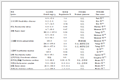
|
表 1 微塑料聚合物危害评分1) Table 1 Hazard score of microplastics polymers |
1.5 微塑料质量丰度计算
根据各样点水体中每种微塑料聚合物类型的密度(
| (5) |
式中,xi为聚合物类型占比,%.
| (6) |
| (7) |
式中,li为纤维状微塑料在0.2~0.5、0.5~1、1~2和2~5 mm粒径范围内的平均长度,mm;xi为对应粒径范围微塑料的占比,%;n为各采样点微塑料数量丰度,n·m-3.
1.6 数据处理和统计分析所有数据使用Excel 2021进行处理和统计,使用Origin 2021对数据结果进行绘图,ArcGIS Pro 3.0.2绘制采样地图,SPSS 27进行皮尔逊相关性分析(P < 0.05). 采用主成分分析(PCA)对研究区内微塑料丰度、粒径、形状和颜色之间的关系进行分析,对微塑料特征变量进行了Z-score标准化处理.
2 结果与分析 2.1 星云湖流域地下水微塑料的丰度和聚合物类型研究区地下水的微塑料丰度特征如图 2所示,其数量丰度范围为3 330~7 660 n·m-3,平均丰度为(5 371±1 039)n·m-3,其中上、中、下游地下水微塑料丰度分别为(3 977±567)、(5 219±624)和(6 244±865)n·m-3. 微塑料质量平均丰度为(2.19±0.58)mg·m-3,其中上游(1.51±0.31)mg·m-3,中游(2.15±0.39)mg·m-3,下游(2.56±0.59)mg·m-3. 研究区内微塑料丰度(尤其是数量丰度)表现出沿地下水流方向显著升高的趋势(P < 0.05).

|
(a)和(c)数量丰度,(b)和(d)质量丰度;不同小写字母表示不同区域微塑料丰度有显著差异(P < 0.05) 图 2 星云湖西岸地下水微塑料丰度 Fig. 2 Abundance of microplastics in groundwater of the western lakeshore of Xingyun Lake |
使用显微红外光谱仪对微塑料进行定性分析,共检测出人造丝(RY)、聚丙烯-聚乙烯共混物(PP+PE)、聚酯(PES)、聚苯乙烯(PS)、聚乙烯(PE)和聚乙烯醇(PVA)等6种聚合物类型. 如图 3所示,占比最高的聚合物类型为RY(66.1%),其次为PES(15.25%),2种聚合物在研究区上、中、下游占比之和均超过70%.

|
图 3 星云湖西岸地下水微塑料聚合物类型 Fig. 3 Microplastic polymer types in groundwater of the western lakeshore of Xingyun Lake |
研究区地下水微塑料粒径、颜色和形状的占比特征如图 4所示,由图 4(a)可知,粒径在0.2~0.5 mm范围的微塑料占比最高(46.47%~54.48%),其次为0.5~1、1~2和2~5 mm. 研究区地下水微塑料粒径分布有粒径越小丰度越高的趋势,同一粒径微塑料在上、中、下游地下水中占比无明显差异.

|
(a)粒径,(b)颜色,(c)形状,(d)代表性镜检图片 图 4 星云湖西岸地下水微塑料形态特征 Fig. 4 Morphological characteristics of microplastics in groundwater of the western lakeshore of Xingyun Lake |
微塑料颜色的划分有助于识别微塑料的可能来源以及分析可能的危害[26]. 由图 4(b)可知,黑色(37.57%~42.83%)和蓝色(28.72%~29.36%)在所有样品中占据主导地位,二者在上、中、下游区域的占比之和均超过65%.
研究区内观测到纤维、颗粒、碎片和薄膜这4种形状微塑料[图 4(d)],纤维是星云湖西岸地下水最常见的微塑料形状[图 4(c)],其占比高达93.06%,薄膜占比则低至0.86%,从上游到下游地下水中纤维状微塑料占比由95.08%降至90.10%,颗粒状由0%增至4.4%,其它形状占比相近.
根据污染负荷指数法和聚合物风险指数对研究区地下水中微塑料生态风险进行评估(图 5),星云湖西岸地下水微塑料PLIzone为72.6,处于极高风险水平(> 30),U3为最低点,D13为最高点,PLI值分别为57.7和87.6,所有样点均处于极高风险水平. PHI平均值为3.2±2.5,评价结果显示研究区整体处于Ⅰ类低风险水平(< 10).

|
图 5 星云湖西岸地下水微塑料PLI与PHI Fig. 5 PLI and PHI for groundwater in the western lakeshore of Xingyun Lake |
主成分研究结果见图 6,总贡献率为61.7%,其中PC1的贡献率为46.6%,以丰度、纤维和0.2~0.5 mm占主导地位,PC2的贡献率为15.1%,以1~2 mm和2~5 mm为主. 结合相关性分析,微塑料丰度与纤维、0.2~0.5 mm、黑色、蓝色和透明显著相关(P < 0.05),形态特征之间,黑色、纤维和0.2~0.5 mm之间存在显著相关性,表明这些特征的微塑料可能具有相似的污染来源和分布趋势. 黑色同时也与大粒径(1~5 mm)显著相关,反映其在全粒径范围内的广泛分布,而透明仅与0.2~0.5 mm相关.

|
(a)主成分分析,红色数据点表示样本在主成分空间中的位置,(b)相关性分析,红色表示正相关性,蓝色表示负相关性,颜色由浅至深表示相关性由小到大,*表示P < 0.05 图 6 微塑料形态特征分析结果 Fig. 6 Analysis results of the morphological characteristics of microplastics |
星云湖西岸地下水微塑料的分布具有空间异质性. 地下水微塑料平均数量丰度为(5 371±1 039)n·m-3,与国内其他区域地下水中微塑料丰度值相比(表 2),高于桂林遇龙河区域[11],低于广东省东南部垃圾填埋场地下水[27]、大万山岛[9]、胶东半岛[8]和华北平原北部[10]等地区. 与国外某些地区相比,本研究区丰度高于韩国东部农村地区[28]、韩国济州岛[29]和伊朗西南部[30],但低于澳大利亚维多利亚州[31]、捷克共和国矿区[32]及墨西哥西北部地区[33],相较于国内外典型区域,研究区地下水中微塑料丰度在全球范围内处于中等偏下水平. 研究区内微塑料丰度存在明显空间差异,表现为自上游至下游逐渐递增的趋势. 上游区域丰度较低,与其毗邻林地、村庄分布稀疏以及人类活动强度较弱有关;中游区域受农田及居民聚集等农业与生活活动影响,微塑料输入途径增多,导致丰度显著上升[11];下游作为地下水径流的汇集区,微塑料持续累积,表现出全区最高丰度,该分布特征与人类活动强度及水文汇集作用密切相关.
|
|
表 2 地下水微塑料污染现状1) Table 2 Status of microplastic pollution in groundwater |
研究区地下水微塑料以小粒径(0.2~0.5 mm)和纤维状形态为主要特征,薄膜状占比最低. 这一分布特征与伊朗西南部(< 0.5 mm为主)[30]、捷克矿区(0.1~0.5 mm为主)[32]、中国遇龙河流域[11]以及美国伊利诺斯州岩溶系统(纤维状为主)[34]的研究结果一致. 需要指出的是,本研究采用200 μm滤网进行样品筛分,可能导致更小粒径的微塑料丰度被低估,受目视计数和人工挑样的限制,高原湖泊流域地下水中是否存在更小粒径的微塑料有待进一步探索. 在形状组成方面,本研究结果与韩国济州岛(91%碎片状)[29]和印度尼西亚(85.93%碎片状)[35]等地区存在显著差异,这种差异可能是地下水所处功能区及污染来源特征有关[21]. 颜色以蓝色和黑色为主,与He等[21]在农业区地下水中观察到的颜色特征一致. 小粒径微塑料的富集可能与土壤介质的过滤筛选有关[36]:大粒径颗粒易被表层土壤截留[37],而小粒径微塑料更易随水流向下迁移至含水层[38];黑色和蓝色纤维状微塑料的高频出现,指示其可能源于生活污水中的含有合成纤维的洗涤废水[39]以及农业活动产生的塑料残留物[21]. 此外,进入环境中的微塑料在老化过程中表面羧基含量增加,使其表面电负性增强,与多孔介质间的静电排斥力相应增大,导致其粘附效率降低、迁移能力增强,更易在水相中稳定存在并随之迁移[40]. 其次,样品采集于雨季,降雨可促进大气沉降的纤维类微塑料通过淋滤与径流作用进入地下水[13,41],这也可能是本研究采集样品中该类微塑料占比较高的原因之一.
从上游至下游,地下水微塑料的粒径、颜色和形状占比呈现一定变化规律. 小粒径(0.2~0.5 mm)占比由50.33%增至54.48%,黑色微塑料由37.57%增至42.83%,而纤维状占比由95.08%降至90.10%,颗粒状微塑料从0%增至4.4%. 这种变化可能与下游区域作为污染汇合区有关,一方面,小粒径微塑料迁移性更强[42],导致下游富集;另一方面,下游接收了更多本地农业活动和地表径流输入的微塑料(如颗粒状微塑料),使得形状组成更加多样化[43~45]. 这些规律说明,研究区地下水微塑料的分布特征受迁移能力和区域污染输入的共同影响.
3.2 星云湖西岸地下水微塑料聚合物特征及来源研究区地下水微塑料类型多为RY和PES. 这与墨西哥北部含水层地下水微塑料以iPP为主[33]、印度南部地下水以PP和PS为主[46]以及加那利群岛地下水微塑料以PP和PE为主[47]等研究结果存在明显差异,但与大多数地表水中微塑料聚合物类型分布较为一致,如河北入海河口[48]及莱州湾海水[49]均以RY为主要组分. 这一相似性表明,研究区地下水微塑料可能来源与地表水相似的输入途径,即生活污水排放. RY是一种由纤维素制成的人造纤维,主要来源于纺织品、衣物及渔网等材料的磨损和分解,PES多来源于纺织纤维及绳索[50],日常洗涤行为可释放大量RY和PES纤维至生活污水[51],研究区地处村镇聚集区域,生活污水排放强度高且分布分散,成为地下水RY与PES微塑料的重要来源. 从空间分布来看,上游区域虽远离核心集镇,但仍存在散居村庄,该区域检出3类聚合物,以RY为主. 中下游农田与乡镇密集分布,微塑料聚合物种类较上游更为丰富,新增PE、PVA及PS,占比约为17%,RY仍为优势聚合物. PE是农田覆膜的主要成分[52],PS是露天堆放的农产品外包装降解形成的产物[53],多项研究表明,这些聚合物在农业区的地下水中广泛存在,例如,遇龙河流域农业区地下水中以PE、PP和PS为主要聚合物类型[11],广西会仙湿地公园地下水中亦检出PE、PP和PS,其来源被证实与农业活动密切相关[13],韩国东部农村地区地下水中同样检出PE、PP和PS等聚合物[28],以上结果表明,农业活动是地下水微塑料的潜在来源.
3.3 星云湖流域地下水微塑料风险评价星云湖西岸地下水PLI总体处于极高风险水平,这一评估结果与既有研究存在差异. 广西桂林会仙国家湿地公园地区旱季地下水[13]与内蒙古巴彦淖尔市五原县地下水[12]呈现低风险特征,这种区域差异可能源于不同研究区污染强度以及背景值选取标准的不同[54],本研究与采用相同背景值的He等[21]的研究结果一致,其结果表明中国多数地下水样本均处于极高风险水平. 星云湖西岸地下水微塑料PHI总体处于低风险水平,主要原因是未检出具有极高危害指数的聚合物类型. 中游PHI值为研究区内最高,原因是该区域检出具有相对较高危害指数的聚合物PS,PS对生物具有一定的毒性,Lu等[55]研究表明PS暴露可诱导肉鸡肺部氧化应激、内质网应激、细胞焦亡和炎症反应,王琳等[56]研究也证实高丰度PS对小球藻生长具有明显抑制效应.
研究区内PLI呈现极高风险水平而PHI显示低风险的综合评估结果,揭示了微塑料污染特征与风险之间的复杂关系. 这种差异主要源于两个指数的不同评估维度:PLI反映微塑料的绝对丰度水平,其极高风险等级表明研究区地下水微塑料污染已达到亟需采取管控与修复措施的水平,且上游至下游,PLI呈现递增趋势,表明越靠近湖岸的区域微塑料污染风险越高;而PHI侧重评估聚合物类型的潜在毒性,其低风险等级说明当前检出的微塑料以危害性较低的RY和PES为主. 这种“高PLI-低PHI”的组合模式揭示了研究区的微塑料污染具有量大但毒性低的特征. 主要归因于生活污水输入的大量低危害性纤维(RY/PES)构成了污染主体,虽然中游农业活动带来的PE和PS等聚合物增加了污染负荷,但其占比(27%)和毒性尚不足以显著提升整体风险水平.
4 结论(1)研究区地下水微塑料数量平均丰度为(5 371±1 039)n·m-3,质量平均丰度为(2.19±0.58)mg·m-3. 微塑料主要以粒径0.2~0.5 mm的黑色和蓝色纤维为主,聚合物类型以RY和PES占主导,表明生活污水排放是其主要来源.
(2)微塑料的空间分布呈现自上游至下游丰度递增的分布趋势. 沿此梯度,小粒径和黑色微塑料占比逐渐增加,纤维状微塑料比例下降,颗粒状微塑料比例上升,表明下游人类活动影响加剧及输入途径的多样化.
(3)研究区地下水微塑料污染负荷指数(PLIzone)为72.6,表明研究区整体处于极高污染风险水平;聚合物风险指数(PHI)平均值为3.2±2.5,属于Ⅰ类低风险水平.
| [1] | Mihai F C, Markley L A T, Khan F R, et al. Microplastics in freshwater environments[A]. In: Vithanage M, Prasad M N V (Eds.). Microplastics in the Ecosphere: Air, Water, Soil, and Food[M]. Hoboken: John Wiley & Sons, Inc., 2023. 163-175, doi: 10.1002/9781119879534.ch10. |
| [2] | Khant N A, Kim H. Review of current issues and management strategies of microplastics in groundwater environments[J]. Water, 2022, 14(7). DOI:10.3390/w14071020 |
| [3] | Godoy V, Blázquez G, Calero M, et al. The potential of microplastics as carriers of metals[J]. Environmental Pollution, 2019, 255. DOI:10.1016/j.envpol.2019.113363 |
| [4] | Li X W, Mei Q Q, Chen L B, et al. Enhancement in adsorption potential of microplastics in sewage sludge for metal pollutants after the wastewater treatment process[J]. Water Research, 2019, 157: 228-237. DOI:10.1016/j.watres.2019.03.069 |
| [5] | Wu P F, Cai Z W, Jin H B, et al. Adsorption mechanisms of five bisphenol analogues on PVC microplastics[J]. Science of the Total Environment, 2019, 650: 671-678. DOI:10.1016/j.scitotenv.2018.09.049 |
| [6] | Selvam S, Jesuraja K, Venkatramanan S, et al. Hazardous microplastic characteristics and its role as a vector of heavy metal in groundwater and surface water of coastal south India[J]. Journal of Hazardous Materials, 2021, 402. DOI:10.1016/j.jhazmat.2020.123786 |
| [7] | Sangkham S, Islam M A, Adhikari S, et al. Evidence of microplastics in groundwater: a growing risk for human health[J]. Groundwater for Sustainable Development, 2023, 23. DOI:10.1016/j.gsd.2023.100981 |
| [8] | Mu H Y, Wang Y P, Zhang H N, et al. High abundance of microplastics in groundwater in Jiaodong Peninsula, China[J]. Science of the Total Environment, 2022, 839. DOI:10.1016/j.scitotenv.2022.156318 |
| [9] | Gong X, Tian L N, Wang P, et al. Microplastic pollution in the groundwater under a bedrock island in the South China sea[J]. Environmental Research, 2023, 239. DOI:10.1016/j.envres.2023.117277 |
| [10] | Shi J Y, Dong Y B, Shi Y Y, et al. Groundwater antibiotics and microplastics in a drinking-water source area, northern China: occurrence, spatial distribution, risk assessment, and correlation[J]. Environmental Research, 2022, 210. DOI:10.1016/j.envres.2022.112855 |
| [11] | Shu X H, Xu L Z, Yang M H, et al. Spatial distribution characteristics and migration of microplastics in surface water, groundwater and sediment in karst areas: the case of Yulong River in Guilin, Southwest China[J]. Science of the Total Environment, 2023, 868. DOI:10.1016/j.scitotenv.2023.161578 |
| [12] |
邓梓懿, 刘琳, 白艺涵, 等. 河套灌区地表水与地下水中微塑料的污染特征、来源及风险评估[J]. 环境科学, 2026, 47(2): 1160-1167. Deng Z Y, Liu L, Bai Y H, et al. Characterization, sources and risk assessment of microplastic pollution in surface water and groundwater of the Hetao irrigation area[J]. Environmental Science, 2026, 47(2): 1160-1167. DOI:10.13227/j.hjkx.202412078 |
| [13] | Wei Z X, Wei T, Chen Y, et al. Seasonal dynamics and typology of microplastic pollution in Huixian karst wetland groundwater: implications for ecosystem health[J]. Journal of Environmental Management, 2024, 358. DOI:10.1016/j.jenvman.2024.120882 |
| [14] | Deng C N, Huang Y J, Hu Y, et al. Factors influencing the spatial distribution of microplastics in lakes with the example of Dianchi lake[J]. Water, 2025, 17(16). DOI:10.3390/w17162377 |
| [15] |
戴柳云, 侯磊, 王化, 等. 汇流对洱海罗时江小流域水体微塑料污染的影响[J]. 环境科学, 2025, 46(5): 2708-2718. Dai L Y, Hou L, Wang H, et al. Effects of flow concentration on water microplastic pollution in the luoshijiang sub-watershed of Erhai Lake basin[J]. Environmental Science, 2025, 46(5): 2708-2718. DOI:10.13227/j.hjkx.202404309 |
| [16] |
段立曾, 张虎才, 李东林, 等. 杞麓湖表层沉积物微塑料污染特征[J]. 环境科学与技术, 2024, 47(S1): 140-149. Duan L Z, Zhang H C, Li D L, et al. Pollution characteristics of microplastics in surface sediments from Lake Qilu[J]. Environmental Science & Technology, 2024, 47(S1): 140-149. |
| [17] | Duan L Z, Luo L C, Zhang L W, et al. The occurrence of microplastics pollution in the surface water and sediment of Lake Chenghai in southwestern China[J]. Water, 2024, 16(18). DOI:10.3390/w16182672 |
| [18] |
张洪森, 角媛梅, 陈凡, 等. 云南九大高原湖泊流域人类活动强度对水质的多尺度影响[J]. 湖泊科学, 2024, 36(2): 430-442. Zhang H S, Jiao Y M, Chen F, et al. Multi-scale impacts of human activity intensity on water quality in nine plateau lake basins in Yunnan Province[J]. Journal of Lake Sciences, 2024, 36(2): 430-442. |
| [19] |
王化, 梁启斌, 戴柳云, 等. 洱海上游表流人工湿地对水体微塑料赋存特征的影响[J]. 环境科学, 2024, 45(11): 6616-6624. Wang H, Liang Q B, Dai L Y, et al. Effect of free water surface constructed wetland on the occurrence characteristics of microplastics in water in the upper reaches of the Erhai lake[J]. Environmental Science, 2024, 45(11): 6616-6624. DOI:10.13227/j.hjkx.202312273 |
| [20] | Guo Z F, Boeing W J, Xu Y Y, et al. Global meta-analysis of microplastic contamination in reservoirs with a novel framework[J]. Water Research, 2021, 207. DOI:10.1016/j.watres.2021.117828 |
| [21] | He Y Q, McDonough L K, Zainab S M, et al. Microplastic accumulation in groundwater: data-scaled insights and future research[J]. Water Research, 2024, 258. DOI:10.1016/j.watres.2024.121808 |
| [22] | Lithner D, Larsson Å, Dave G. Environmental and health hazard ranking and assessment of plastic polymers based on chemical composition[J]. Science of the Total Environment, 2011, 409(18): 3309-3324. DOI:10.1016/j.scitotenv.2011.04.038 |
| [23] | Ren P J, Dou M, Wang C, et al. Abundance and removal characteristics of microplastics at a wastewater treatment plant in Zhengzhou[J]. Environmental Science and Pollution Research, 2020, 27(29): 36295-36305. DOI:10.1007/s11356-020-09611-5 |
| [24] |
李心童. 上海市典型城市河道多环境介质中微塑料赋存特征与风险评估研究[D]. 上海: 华东师范大学, 2024. Li X T. Occurrence characteristics and risk assessment of microplastics in multi-environmental mediums in typical urban rivers in Shanghai[D]. Shanghai: East China Normal University, 2024. |
| [25] | Eo S, Hong S H, Song Y K, et al. Spatiotemporal distribution and annual load of microplastics in the Nakdong River, South Korea[J]. Water Research, 2019, 160: 228-237. DOI:10.1016/j.watres.2019.05.053 |
| [26] | Li R L, Wang J M, Deng J, et al. Selective enrichments for color microplastics loading of marine lipophilic phycotoxins[J]. Journal of Hazardous Materials, 2023, 459. DOI:10.1016/j.jhazmat.2023.132137 |
| [27] | Wan Y, Chen X, Liu Q, et al. Informal landfill contributes to the pollution of microplastics in the surrounding environment[J]. Environmental Pollution, 2022, 293. DOI:10.1016/j.envpol.2021.118586 |
| [28] | Jeong E, Kim Y I, Lee J Y, et al. Microplastic contamination in groundwater of rural area, eastern part of Korea[J]. Science of the Total Environment, 2023, 895. DOI:10.1016/j.scitotenv.2023.165006 |
| [29] | Kim Y I, Jeong E, Lee J Y, et al. Microplastic contamination in groundwater on a volcanic Jeju Island of Korea[J]. Environmental Research, 2023, 226. DOI:10.1016/j.envres.2023.115682 |
| [30] | Esfandiari A, Abbasi S, Peely A B, et al. Distribution and transport of microplastics in groundwater (Shiraz aquifer, southwest Iran)[J]. Water Research, 2022, 220. DOI:10.1016/j.watres.2022.118622 |
| [31] | Samandra S, Johnston J M, Jaeger J E, et al. Microplastic contamination of an unconfined groundwater aquifer in Victoria, Australia[J]. Science of the Total Environment, 2022, 802. DOI:10.1016/j.scitotenv.2021.149727 |
| [32] | Brožová K, Halfar J, Čabanová K, et al. The first evidence of microplastic occurrence in mine water: the largest black coal mining area in the Czech Republic[J]. Water Research, 2023, 244. DOI:10.1016/j.watres.2023.120538 |
| [33] | Alvarado-Zambrano D, Rivera-Hernández J R, Green-Ruiz C. First insight into microplastic groundwater pollution in Latin America: the case of a coastal aquifer in Northwest Mexico[J]. Environmental Science and Pollution Research, 2023, 30(29): 73600-73611. DOI:10.1007/s11356-023-27461-9 |
| [34] | Panno S V, Kelly W R, Scott J, et al. Microplastic contamination in karst groundwater systems[J]. Groundwater, 2019, 57(2): 189-196. DOI:10.1111/gwat.12862 |
| [35] | Wilyalodia H C, Moersidik S S, Pratama M A. Microplastic contamination in urban groundwater: a case study from Jakarta Megacity, Indonesia[J]. The Scientific World Journal, 2024, 2024(1). DOI:10.1155/tswj/1870706 |
| [36] |
曹文庚, 王妍妍, 张亚南, 等. 含微塑料地下水的污染现状、环境风险及其发展趋势[J]. 中国地质, 2024, 51(6): 1895-1916. Cao W G, Wang Y Y, Zhang Y N, et al. Pollution status, environmental risk and development trend of groundwater containing microplastics[J]. Geology in China, 2024, 51(6): 1895-1916. |
| [37] |
张颖, 杨硕, 曾瑜苹, 等. 土壤-地下水中微塑料的转化行为及环境效应[J]. 环境科学, 2024, 45(11): 6632-6644. Zhang Y, Yang S, Zeng Y P, et al. Transformation behavior and environmental effects of microplastics in soil-groundwater[J]. Environmental Science, 2024, 45(11): 6632-6644. |
| [38] |
王长远, 马啸驰, 郭德杰, 等. 长期施用有机肥对土壤微塑料赋存及迁移特征的影响[J]. 环境科学, 2024, 45(4): 2304-2312. Wang C Y, Ma X C, Guo D J, et al. Effects of long-term application of organic fertilizer on the occurrence and migration characteristics of soil microplastics[J]. Environmental Science, 2024, 45(4): 2304-2312. DOI:10.13227/j.hjkx.202304174 |
| [39] | Christensen N D, Wisinger C E, Maynard L A, et al. Transport and characterization of microplastics in inland waterways[J]. Journal of Water Process Engineering, 2020, 38. DOI:10.1016/j.jwpe.2020.101640 |
| [40] | Ren Z F, Gui X Y, Wei Y Q, et al. Chemical and photo-initiated aging enhances transport risk of microplastics in saturated soils: key factors, mechanisms, and modeling[J]. Water Research, 2021, 202. DOI:10.1016/j.watres.2021.117407 |
| [41] |
乐永宣, 史正涛, 罗淘源, 等. 昆明市大气微塑料的沉降特性及呼吸暴露风险[J]. 环境化学, 2024, 43(9): 3114-3127. Le Y X, Shi Z T, Luo T Y, et al. The settlement characteristics and respiratory exposure risk of atmospheric microplastics in Kunming City[J]. Environmental Chemistry, 2024, 43(9): 3114-3127. |
| [42] |
李运晴, 谭雨青, 陈垚, 等. 雨水径流中微塑料的赋存迁移与控制研究进展[J]. 环境科学与技术, 2023, 46(2): 215-224. Li Y Q, Tan Y Q, Chen Y, et al. Research progress on the occurrence, migration and control of microplastics in stormwater runoff[J]. Environmental Science & Technology, 2023, 46(2): 215-224. |
| [43] |
王昱丹, 桂维振, 邵天杰, 等. 无定河上游流域水体微塑料污染现状与分布特征[J]. 中国环境科学, 2023, 43(10): 5583-5590. Wang Y D, Gui W Z, Shao T J, et al. Water microplastics pollution and distribution characteristics in the upper Wuding River Basin[J]. China Environmental Science, 2023, 43(10): 5583-5590. |
| [44] | Re V. Shedding light on the invisible: addressing the potential for groundwater contamination by plastic microfibers[J]. Hydrogeology Journal, 2019, 27(7): 2719-2727. DOI:10.1007/s10040-019-01998-x |
| [45] | Wang Z C, Li W L, Li W P, et al. Effects of microplastics on the water characteristic curve of soils with different textures[J]. Chemosphere, 2023, 317. DOI:10.1016/j.chemosphere.2023.137762 |
| [46] | Bharath K M, Natesan U, Vaikunth R, et al. Spatial distribution of microplastic concentration around landfill sites and its potential risk on groundwater[J]. Chemosphere, 2021, 277. DOI:10.1016/j.chemosphere.2021.130263 |
| [47] | Rodríguez-Alcántara J S, Contreras-Llin A, Cruz-Pérez N, et al. Presence of microplastics in the groundwater of volcanic islands, El Hierro and La Palma (Canary Islands)[J]. Journal of Contaminant Hydrology, 2024, 263. DOI:10.1016/j.jconhyd.2024.104340 |
| [48] |
刘有才, 张蒨, 李林强, 等. 河北典型入海河口丰水期微塑料赋存特征及来源分析[J]. 海洋环境科学, 2024, 43(4): 612-618. Liu Y C, Zhang Q, Li L Q, et al. Occurrence characteristics and sources analysis of microplastics during high-flow period in typical estuarine areas of Hebei province[J]. Marine Environmental Science, 2024, 43(4): 612-618. |
| [49] | Chen H, Jiang F H, Li J X, et al. Interlinked water and sediment microplastics in the Laizhou Bay of China[J]. Journal of Oceanology and Limnology, 2025, 43(2): 446-458. DOI:10.1007/s00343-024-4032-x |
| [50] | Zhou B Y, Wang J Q, Zhang H B, et al. Microplastics in agricultural soils on the coastal plain of Hangzhou Bay, east China: multiple sources other than plastic mulching film[J]. Journal of Hazardous Materials, 2020, 388. DOI:10.1016/j.jhazmat.2019.121814 |
| [51] | Browne M A, Crump P, Niven S J, et al. Accumulation of microplastic on shorelines woldwide: sources and sinks[J]. Environmental Science & Technology, 2011, 45(21): 9175-9179. |
| [52] |
莫孙伟, 吴思怡, 熊曾恒, 等. 南渡江入海河口水体中微塑料污染特征及风险评估[J]. 环境污染与防治, 2024, 46(5): 714-720. Mo S W, Wu S Y, Xiong Z H, et al. Pollution characteristics and risk assessment of microplastics in estuary water of Nandu River[J]. Environmental Pollution and Control, 2024, 46(5): 714-720. |
| [53] |
吴磊石, 洪鸣, 彭梦微, 等. 北部湾海域表层水体中微塑料分布特征[J]. 环境科学研究, 2021, 34(11): 2556-2562. Wu L S, Hong M, Peng M W, et al. Distribution characteristics of microplastics in surface water of Beibu Gulf[J]. Research of Environmental Sciences, 2021, 34(11): 2556-2562. |
| [54] |
郝松泽, 王国豪, 黄金, 等. 伊洛河流域水体和沉积物中微塑料污染特征及其生态环境风险评估[J]. 环境科学, 2025, 46(9): 5961-5974. Hao S Z, Wang G H, Huang J, et al. Microplastic pollution characteristics and ecological environmental risk assessment in water and sediments of the Yiluo River Basin[J]. Environmental Science, 2025, 46(9): 5961-5974. DOI:10.13227/j.hjkx.202408005 |
| [55] | Lu H M, Guo T T, Zhang Y, et al. Endoplasmic reticulum stress-induced NLRP3 inflammasome activation as a novel mechanism of polystyrene microplastics (PS-MPs)-induced pulmonary inflammation in chickens[J]. Journal of Zhejiang University-SCIENCE B, 2024, 25(3): 233-243. DOI:10.1631/jzus.B2300409 |
| [56] |
王琳, 马旖旎, 季荣. PS和PVC微塑料对小球藻的生长抑制效应及其影响途径[J]. 环境科学学报, 2021, 41(4): 1538-1544. Wang L, Ma Y N, Ji R. Effects of PS and PVC microplastics on the growth of Chlorella sp.[J]. Acta Scientiae Circumstantiae, 2021, 41(4): 1538-1544. |