 2026, Vol. 47


2. 华北作物改良与调控国家重点实验室,保定 071000;
3. 农业农村部华北节水农业重点实验室,保定 071000
 , WANG Pei-ye1,2,3 , ZHANG Si-jia1 , ZHANG Jian-heng1,2,3 , LU Hai-tao1,2,3 , YOU Fu-ying1 , ZHAO Mai1 , WANG Gui-yan1,2,3
2. State Key Laboratory of North China Crop Improvement and Regulation, Baoding 071000, China;
3. Key Laboratory of Water-Saving Agriculture in North China, Ministry of Agriculture and Rural Affairs, Baoding 071000, China
全球气候变化背景下,土壤作为陆地生态系统中最大的有机碳(SOC)库,其固碳潜力对实现“双碳”目标具有关键作用[1,2]. 土壤团聚体是土壤的基本结构单元,通过粒级分布与稳定性直接调控SOC的物理保护(空间隔离)与化学固定(矿物吸附)[3],并在保持土壤养分有效性过程中发挥至关重要的作用. 然而,长期单一化种植导致土壤结构退化和碳流失严重[4],影响了粮食可持续生产. 因此,如何通过种植制度优化同步提升土壤结构稳定性和固碳能力,成为本区域粮食生产可持续发展的重要议题.
SOC在农业生态系统中扮演着重要角色[5]. 有机碳的储存与稳定性受环境和管理因素的共同调控,这些因素通过调节SOC稳定与矿化过程的动态平衡影响其赋存状态[4]. 土壤团聚体是SOC储存的主要场所[6,7],其复杂的孔隙结构和矿物表面,为SOC提供了物理隔绝(将碳与微生物活动隔绝)与化学吸附(通过矿质颗粒的吸附作用)的双重保护机制,使SOC免于快速矿化分解. 这种保护作用使土壤能够长期封存大规模有机碳[8]. 有研究表明,玉米-豆科作物轮作后能够增加土壤大团聚体比例及提高团聚体稳定性,从而促进土壤碳固存[9]. 不同粒级团聚体碳固存机制与效应明显不同[10],大团聚体(> 0.25 mm)因其物理空间优势,具有更高的碳负载容量,是颗粒有机碳(POC)的主要归宿,微团聚体(< 0.25 mm)则因其紧密的矿物结合和细小空间特征,对其内的矿物结合有机碳(MAOC)提供了更强的化学抗损性和稳定性[11]. 前人研究表明,豆科作物分泌的类黄酮、有机酸等独特活性物质,可促进大团聚体形成并提高其结构稳定性,团聚体物理结构的优化,显著增强了对POC的物理保护效能,使其更持久地封存在大团聚体空间中[12];深根类作物的深根系特征则有利于MAOC在土壤中的累积[13]. 不同SOC组分的功能特性及其与团聚体结构的相互作用,同时受到气候条件、土壤质地和农艺措施的多重调控[14,15]. 尽管表层SOC含量较高,但因其具有较高的碳矿化率和较短的碳停留时间,导致进一步固碳的潜力受限[16,17]. 与之相对,深层土壤储存着全球碳库的主体[18],其对环境扰动(如耕作)与作物种植(如深根作物)的敏感性远超既往认知[19]. 值得关注的是,深根作物与豆科作物通过根系沉积物与凋落物输入,可向深层土壤输入外源有机碳,显著改变深层SOC含量[20]. 然而,轮作如何通过影响深层土壤团聚体结构,进而调控大团聚体主导的物理保护与微团聚体结合态碳的化学稳定,仍认识不足.
因此,本研究以华北平原小麦-玉米两熟为对照,设置花生、高粱与小麦-玉米组成两年三熟轮作,基于6 a田间试验,通过团聚体分级及各粒级结合态碳组分的多维评价,系统分析不同轮作模式对土壤团聚体稳定性及其结合态碳组分分布的总体影响,揭示大团聚体(> 2 mm)对土壤有机碳积累的调控机制. 本研究阐明了不同作物与禾本科作物轮作通过优化土壤团聚体结构促进碳固存的调控路径,旨在为提升华北平原粮田土壤固碳潜力提供科学理论依据.
1 材料与方法 1.1 试验地概况田间长期定位试验地位于河北省曲周县(37°51′46″N,115°00′59″E,图 1),该地区平均海拔为39.6 m,属暖温带大陆性半干旱季风气候,夏季炎热多雨,春季干旱多风,冬季寒冷. 该区域多年(1960~2024年)平均降水量511.8 mm,降水主要集中在7~9月,年平均气温为14.1 ℃,试验期间的平均气温和降水量如图 1.根据美国农业部土壤分类法[21],质地为粉质壤土(砂粒占比为10.00%、粉粒占比为78.00%和黏粒占比为12.00%)[22]. 试验土壤耕层(0~20 cm)基础养分如下:容重为1.31 g·m-3,全氮含量为1.25 g·kg-1,有机质含量为14.12 g·kg-1,有效磷含量为11.61 mg·kg-1,速效钾含量为138.04 mg·kg-1,无机态氮含量为24.14 mg·kg-1,pH为7.81.

|
图 1 试验地位置与试验期间的日平均气温和降水量 Fig. 1 Location of the experimental site and daily average temperature and precipitation during the experimental period |
本试验于2018年10月开始,共设3种模式,冬小麦-夏玉米两熟为对照(WM-WM,小麦品种鲁原502,玉米品种沃玉3号)、春花生→冬小麦-夏玉米(Pns-WM,花生品种冀花11),高粱→冬小麦-夏玉米(Sor-WM,高粱品种红1号)两年三熟轮作. “→”表示隔年种植,“-”表示年内平播复种. 各处理均设3次重复,小区面积42 m2(6 m×7 m),完全随机排列. 各处理中作物播种和收获时间、施肥和灌溉管理参照Yang等[23]和Wang等[24]的研究. 在试验过程中,冬小麦秸秆直接还田,夏玉米秸秆粉碎后旋耕与土壤混合还田,花生和高粱秸秆收获后离田作饲料. 每种作物均按照当地高产田常规技术进行病虫草害等田间管理.
1.3 样品采集与处理本研究于2024年6月初冬小麦成熟期采集各个土层(0~10、10~20和20~40 cm)土壤原状土,按“S型”路线每小区共5个点采集子样本并混合成一个样本,每个处理3个混合样本,采样时去除土壤表面作物凋落物后,采集土壤原状土,采集过程中避免挤压,采后将土样带回实验室备用. 土壤团聚体采用干湿筛结合的方法进行测定[25~28],将筛分后的团聚体收集备用,进行团聚体有机碳及组分的测定. 土壤样本一部分沿自然结构掰开,过5 mm筛,进行彻底均质并去除石块和植物碎屑,随后进行干筛,以测定土壤团聚体有机碳;另一部分保持湿润,用湿筛法测定土壤团聚体稳定性. 具体操作如下.
机械稳定性团聚体测定[25]:采用干筛法测定,先将风干土样进行称重,然后将土样置于孔径为2 mm和0.25 mm的套筛顶部,加筛盖和底盒后,用不锈钢套筛振荡进行干筛,直至各筛上的土体不再下漏为止,从而将土样分成 > 2、0.25~2和 < 0.25 mm这3个粒级,分别称重,计算各粒级机械稳定性团聚体的百分比. 然后再将上述干筛分的各粒级团聚体按其质量比例充分混匀,取一部分进行湿筛.
土壤水稳性团聚体测定[26~28]:将取回土样放置阴凉通风处自然风干,称取约50 g风干土,润湿5 min后将其置于套筛上,然后放入桶中浸泡10 min,采用TPF-100型土壤团聚体/团粒分析仪(浙江托普仪器有限公司)上下振动5 min(振幅4 cm,频率40次·min-1),分筛(上下筛动时套筛不能露出水面),最后收集各级筛子上的团聚体并分别转移至铝盒中,60℃烘干,称重.
1.4 样品测定SOC采用重铬酸钾-H2SO4外加热法进行测定[29],采用六偏磷酸钠分散法测定颗粒有机碳(POC)和矿物结合有机碳(MAOC)[3],用333 mol·L-1 KMnO4测定易氧化有机碳(ROC)和难氧化有机碳(NOC)[30].
1.5 指标计算 1.5.1 土壤团聚体稳定性团聚体平均质量直径(MWD,mm)计算公式[31,32]如下:
几何平均直径(GMD,mm)计算公式[33]如下:
> 0.25 mm团聚体含量(R> 0.25)计算公式[33]如下:
式中,
不同粒级团聚体SOC贡献率(Ci,%)计算公式[32]如下:
式中,Ci为i粒级土壤团聚体SOC贡献率(%);WSOC,i为i粒级土壤团聚体SOC含量(g·kg-1);Mi为i粒级团聚体质量(g);WSOC为团聚体SOC含量(g·kg-1),它是各团聚体粒级SOC含量加权求和的结果. 不同粒级团聚体对SOC组分的贡献率也用上述公式进行计算.
1.6 数据处理使用Microsoft Excel 2016进行数据整理. 运用SPSS 23.0(SPSS,Inc.)进行单因素方差分析(ANOVA),以确定同一土层不同轮作模式和不同土层同一轮作模式之间土壤团聚体有机碳的差异是否具有统计学意义. 数据分析使用R和Tutools平台(https://www.cloudtutu.com/#/login),进行Pearson相关性分析,以明确土壤团聚体稳定性与其结合态碳组分的相关关系,Origin用于作图. 使用Smart PLS(Smart PLS 4.0,USA)进行偏最小二乘法结构方程(PLS-SEM)建模,以探究土壤不同因子之间的相互关系进而明确土壤结构和SOC变化之间的直接和间接关系.
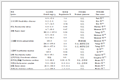
2 结果与分析 2.1 不同轮作模式土壤团聚体分布特征及稳定性 2.1.1 土壤团聚体分布特征0~10 cm,与WM-WM相比,Pns-WM和Sor-WM > 2 mm粒级团聚体占比分别显著提高21.35%和14.00%(表 1);Pns-WM显著降低了 < 0.25 mm粒级团聚体占比,而Sor-WM明显提高 < 0.25 mm粒级微团聚体占比. 10~20 cm,Sor-WM显著提高了 > 2 mm粒级团聚体占比,显著降低0.25~2 mm粒级团聚体占比. 20~40 cm,Sor-WM显著提高 < 0.25 mm粒级团聚体占比.
|
表 1 不同轮作模式土壤团聚体分布特征1) Table 1 Distribution characteristics of soil aggregates in different crop rotation systems |
2.1.2 土壤团聚体稳定性
MWD、GMD和R> 0.25是反映团聚体大小分布特征的指标,土壤大团聚体越多,其值越大,团聚体稳定性越强. 轮作后以大团聚体(> 0.25 mm粒级)为主,其含量显著高于微团聚体(< 0.25 mm粒级)(表 2). 与WM-WM相比,Pns-WM分别提高了0~10 cm和10~20 cm土层R> 0.25 8.90%和5.73%;Sor-WM降低了0~10 cm土层R> 0.25,而对下层R> 0.25没有显著影响. 与WM-WM相比,Pns-WM提高了0~10 cm土层的MWD和GMD,分别显著提高了9.99%和4.51%;Sor-WM提高了10~20 cm土层MWD和GMD.
|
|
表 2 不同轮作模式土壤团聚体稳定性 Table 2 Stability of soil aggregates in different crop rotation systems |
2.2 不同轮作模式土壤团聚体有机碳及碳组分 2.2.1 土壤团聚体有机碳
不同作物与小麦-玉米轮作后对不同粒级团聚体SOC含量均影响显著(图 2). 0~10 cm土层,与WM-WM相比,Sor-WM显著提高了 > 2 mm粒级团聚体的SOC含量24.97%,Pns-WM显著提高了0.25~2 mm粒级团聚体的SOC含量,提高了15.48%. 10~20 cm土层,Pns-WM提高了 < 0.25 mm粒级团聚体SOC含量,Sor-WM降低了 > 2 mm和0.25~2 mm粒级SOC含量. 20~40 cm土层,与WM-WM相比,Pns-WM显著提高 > 2 mm粒级团聚体SOC含量,Sor-WM降低了 < 0.25 mm粒级SOC含量.

|
不同小写字母表示同一土层不同轮作模式差异显著(P < 0.05);不同大写字母表示不同土层同一轮作模式差异显著(P < 0.05);WM-WM:冬小麦-夏玉米,Pns-WM:春花生→冬小麦-夏玉米,Sor-WM:高粱→冬小麦-夏玉米,下同 图 2 不同轮作模式各土层土壤团聚体有机碳含量的变化 Fig. 2 Changes in soil aggregate organic carbon contents in different soil layers under crop rotations |
与WM-WM相比,Pns-WM显著提高了0~40 cm土层各粒级团聚体ROC含量(图 3);Sor-WM显著提高了 < 0.25 mm(10~20 cm)和 > 2 mm(20~40 cm)团聚体ROC含量,分别提高了15.80%和71.83%,但降低了0.25~2 mm(0~10 cm和10~20 cm)团聚体ROC含量. 与WM-WM相比,Pns-WM对土壤团聚体NOC影响不显著,Sor-WM显著降低了0.25~2 mm(0~10 cm)、> 2 mm和 < 0.25 mm(10~20 cm)团聚体的NOC含量. 总体来说,Pns-WM提高了各土层不同粒级团聚体ROC含量,但对0~10 cm和10~20 cm土层NOC无显著影响.

|
图 3 不同轮作模式各土层土壤团聚体易氧化有机碳和难氧化有机碳含量的变化 Fig. 3 Changes in soil aggregate oxidizable carbon and non-oxidizable carbon contents in different soil layers under crop rotations |
POC表示土壤中较活跃的有机碳,MAOC则为土壤中较为稳定的有机碳. 0~10 cm土层,与WM-WM相比,Pns-WM提高了 > 2 mm粒级POC含量,提高了21.3%(图 4);Sor-WM降低了0.25~2 mm粒级MAOC含量. 10~20 cm土层,Pns-WM降低了0.25~2 mm粒级的POC含量,提高了 < 0.25 mm粒级MAOC含量;Sor-WM显著降低了 > 2 mm和0.25~2 mm粒级MAOC含量. 20~40 cm土层,Pns-WM增加了 < 0.25 mm粒级POC含量,提高了 > 2 mm粒级MAOC含量.

|
图 4 不同轮作模式各土层土壤团聚体颗粒有机碳和矿物结合有机碳含量的变化 Fig. 4 Changes in soil aggregate particulate organic carbon and mineral-associated organic carbon contents in different soil layers under crop rotations |
与WM-WM相比,Pns-WM提高了 > 2 mm(20~40 cm)SOC贡献率,降低了0.25~2 mm(20~40 cm)SOC贡献率;Sor-WM提高了 > 2 mm(0~10 cm)和 < 0.25 mm(10~20 cm)SOC贡献率(图 5). 随着土壤深度不断加深,> 2 mm ROC的贡献率逐渐增加. 与WM-WM相比,Pns-WM和Sor-WM提高了 > 2 mm(0~10 cm)NOC贡献率;Pns-WM提高了 > 2 mm(20~40 cm)NOC贡献率,Sor-WM提高了0.25~2 mm(20~40 cm)NOC贡献率. 与WM-WM相比,Pns-WM和Sor-WM提高了 > 2 mm(0~10 cm)POC贡献率,Pns-WM降低了 > 2 mm(20~40 cm)POC贡献率. 随着土壤深度不断加深,< 0.25 mm MAOC的贡献率逐渐下降.

|
1. WM-WM,2. Pns-WM,3. Sor-WM;(a)SOC,(b)ROC,(c)NOC,(d)POC,(e)MAOC 图 5 不同轮作模式各土层土壤团聚体对有机碳及其组分贡献率的变化 Fig. 5 Changes in the contribution rates of soil aggregates to organic carbon and its fractions in different soil layers under different crop rotations |
Spearman相关性分析表明(图 6),GMD和SOCR> 0.25、SOCR< 0.25、MAOCR< 0.25和NOCR< 0.25呈极显著负相关;SOCR> 0.25与MAOCR> 0.25、ROCR> 0.25和POCR< 0.25呈极显著正相关,表明团聚体有机碳组分能够相应的表示团聚体SOC的变化;POCR> 0.25与SOCR< 0.25、MAOCR< 0.25和NOCR< 0.25呈极显著正相关;MAOCR> 0.25与ROCR> 0.25和POCR< 0.25呈极显著正相关;ROCR> 0.25与POCR< 0.25呈极显著正相关;SOCR< 0.25与MAOCR< 0.25和NOCR< 0.25呈极显著正相关;MAOCR< 0.25与NOCR< 0.25呈极显著正相关.

|
1. MWD,2. GMD,3. R> 0.25,4. SOC |
结构方程模型可进一步分析团聚体稳定性及各碳组分对有机碳的影响. 结果表明(图 7),轮作后,R> 0.25对团聚体SOC含量影响显著,R> 0.25通过显著影响大团聚体活性有机碳(0.351;P < 0.05)和化学稳定有机碳(0.391;P < 0.01)提高了大团聚体SOC含量;此外,微团聚体活性有机碳主要受R> 0.25(0.495;P < 0.05)的影响,进而调控微团聚体SOC含量. 大团聚体和微团聚体SOC含量(0.686,P < 0.001;0.728,P < 0.001)共同提高了团聚体SOC含量.

|
箭头宽度与路径系数成正比(*表示P < 0.05,**表示P < 0.01,***表示P < 0.001);绿线表示显著正相关,橙线表示显著负相关;R2表示所有路径所解释的变异量 图 7 团聚体稳定性与有机碳及碳组分的结构方程模型 Fig. 7 Structural equation model of aggregate stability with soil organic carbon and its fractions |
土壤团聚体作为矿物质-有机质复合体的基本结构单元,其粒级分布特征(如大团聚体比例)和力学稳定性(如MWD)是评估土壤结构健康度的核心指标,直接影响水分渗透、抗侵蚀能力及养分固持功能[3,34,35]. 本研究表明,Pns-WM提高了R> 0.25团聚体比例,增强了土壤团聚体稳定性(MWD和GMD),这与Wang等[9]在玉米-豆科轮作体系及Sánchez等[36]在蔬菜多熟系统中的研究结果一致,证实了豆科作物和禾本科等轮作后能够增加大团聚体比例,提高土壤团聚体稳定性,在改良土壤结构方面具有独特优势. 研究表明,豆科作物轮作产生的地上残体[24]与发达根系[37]为土壤微生物活动提供了丰富的有机碳源,通过微生物介导的胶结作用可促进微团聚体(< 0.25 mm)向大团聚体(> 2 mm)转化[3],从而进一步提高团聚体稳定性. 另外,豆科植物根系分泌的类黄酮、有机酸等特异性活性物质,可刺激菌根真菌(AMF)的菌丝网络发育[31],促进其与铁铝氧化物形成的有机-矿物复合体,进而增强团聚体的水稳性[14]. 此外,豆科残体分解产生的富里酸与胡敏酸可通过Ca²⁺/Fe³⁺等阳离子桥键,既直接胶结矿物颗粒,又可通过疏水作用保护易降解碳组分,形成的胶结物质促使大团聚体比例提高[32,38]. 这些过程共同构成了豆科轮作优化土壤结构的级联效应,为“生物-物理-化学”协同固碳提供了直接证据[3,15].
3.2 不同轮作模式对土壤团聚体有机碳及碳组分的影响作物轮作和种植方式与SOC含量密切相关[39],适当的轮作能够改善SOC组分,增强农业生态系统的稳定性[40]. SOC是土壤团聚体的重要黏合剂,对土壤团聚体形成至关重要,同时,土壤团聚体在一定程度上保护了土壤有机碳[41]. 本研究表明,Pns-WM能够提高土壤团聚体有机碳含量,这与魏艳春等[42]发现玉米与豆科作物轮作可明显提高土壤团聚体有机碳含量研究结果一致. 轮作后增加了生物多样性,不同作物分泌的特异物质刺激根际土壤微生物多样性增加[24,37],促进土壤有机碳转化与积累[43];同时,本研究也发现各粒级团聚体SOC含量随土层加深而下降,可能与表层的作物残留物高于深层有关[44].
土壤颗粒有机碳(POC)、易氧化有机碳(ROC)等活性有机碳组分是土壤质量状况的有效表征,对环境变化十分敏感[43,45]. 本研究结果表明,与WM-WM相比,Pns-WM使 > 2 mm(0~10 cm)的POC增加21.3%. 根据Virk等[14]的研究结果,由于作物轮作促使土壤大团聚体比例增加,可以保护土壤有机碳不被微生物降解. 同时,本研究表明,与WM-WM相比,Pns-WM显著提高了团聚体的ROC含量,Sor-WM也显著提高了 < 0.25 mm(10~20 cm)和 > 2 mm(20~40 cm)团聚体的ROC含量,木质素和复合多糖是ROC的主要来源,花生和高粱与小麦玉米轮作后根系分泌物引起的木质素含量增加以及高氧水平[36,46]导致的根际木质素加速分解可能与Pns-WM和Sor-WM中ROC的升高有关.
本研究表明,SOC与POC、MAOC、ROC和NOC呈显著正相关,在早期的研究中也发现了SOC与土壤有机碳组分之间有类似的关系[31,47],说明土壤有机碳组分能够反映SOC的变化. SOC主要来源于植物残体和根系分泌物,作物轮作通过增加作物多样性与外源有机物[48],提高了作物-土壤微生物的相互作用,促进了SOC的转化,进而提升土壤肥力[49]. 结构方程模型表明,团聚体稳定性调节SOC变化的不同路径,大团聚体比例提高显著调控了活性SOC和化学稳定SOC含量,进而增加了大团聚体SOC(R2=0.686)和微团聚体SOC(R2=0.728)含量,这两个途径共同解释了团聚体SOC变化的53.0%,表明了不同粒级团聚体对SOC的分异机制,表现为大团聚体的物理保护和微团聚体的生化保护[8,50],同时本研究还发现微团聚体SOC对团聚体SOC的调控要大于大团聚体SOC,这与Jiang等[51]研究结果类似,这可能是由于微团聚体通过活性成分促进矿物-有机复合体的形成,从而增加了SOC[52~54].
4 结论豆科作物(花生)和禾本科(高粱)与小麦-玉米轮作对土壤团聚体稳定性及其结合态碳组分影响显著. 花生与小麦-玉米轮作显著提高了团聚体稳定性和大团聚体活性有机碳组分含量;高粱与小麦-玉米轮作提高了微团聚体易氧化有机碳含量. 综合分析表明,大团聚体比例是驱动团聚体有机碳提高的重要因子,对提高团聚体活性有机碳和大团聚体化学稳定有机碳具有显著直接正效应,进而调控大团聚体和微团聚体有机碳积累,从而提高了土壤有机碳含量. 因此,轮作提升了团聚体稳定性,有效改善了土壤结构,增强了有机碳物理保护能力,提高了土壤固碳潜力.
| [1] | Muqaddas B, Zhou X Q, Lewis T, et al. Long-term frequent prescribed fire decreases surface soil carbon and nitrogen pools in a wet sclerophyll forest of Southeast Queensland, Australia[J]. Science of the Total Environment, 2015, 536: 39-47. DOI:10.1016/j.scitotenv.2015.07.023 |
| [2] | IPCC. Climate change 2023: The IPCC finalized the synthesis report for the sixth assessment report during the panel's 58th session held in Interlaken, Switzerland from 13 - 19 March 2023[M]. Cambridge: Cambridge University Press, 2023. |
| [3] | Six J, Paustian K. Aggregate-associated soil organic matter as an ecosystem property and a measurement tool[J]. Soil Biology and Biochemistry, 2014, 68: A4-A9. DOI:10.1016/j.soilbio.2013.06.014 |
| [4] | Kan Z R, Liu W X, Liu W S, et al. Mechanisms of soil organic carbon stability and its response to no-till: a global synthesis and perspective[J]. Global Change Biology, 2022, 28(3): 693-710. DOI:10.1111/gcb.15968 |
| [5] | Haynes R J. Labile organic matter fractions as central components of the quality of agricultural soils: an overview[J]. Advances in Agronomy, 2005, 85: 221-268. |
| [6] | Chen Y, Li Y Q, Zhou G Z, et al. Soil organic carbon content and stability of different cropping patterns depends on the distribution and stability of aggregates in the hilly area of central Sichuan basin[J]. Agriculture, 2025, 390. DOI:10.1016/j.agee.2025.109714 |
| [7] |
宋红梅, 高玉, 员明鑫, 等. 长期施肥对旱塬麦田土壤大团聚体有机碳组分及冬小麦产量的影响[J]. 环境科学, 2024, 45(7): 4187-4195. Song H M, Gao Y, Yun M X, et al. Effects of long-term fertilizations on the organic carbon components of soil macroaggregates and the yield of wheat in wheat fields on the Loess Plateau[J]. Environmental Science, 2024, 45(7): 4187-4195. DOI:10.13227/j.hjkx.202308046 |
| [8] | Liu X K, Li R X, Lv Y, et al. Two pathways for reducing soil aggregate organic carbon mineralisation via minimum tillage under a long-term field experiment[J]. Journal of Environmental Management, 2025, 381. DOI:10.1016/j.jenvman.2025.125195 |
| [9] | Wang Y L, Wu P N, Qiao Y B, et al. The potential for soil C sequestration and N fixation under different planting patterns depends on the carbon and nitrogen content and stability of soil aggregates[J]. Science of the Total Environment, 2023, 897. DOI:10.1016/j.scitotenv.2023.165430 |
| [10] | Lehmann J, Kleber M. The contentious nature of soil organic matter[J]. Nature, 2015, 528(7580): 60-68. DOI:10.1038/nature16069 |
| [11] | Cotrufo M F, Ranalli M G, Haddix M L, et al. Soil carbon storage informed by particulate and mineral-associated organic matter[J]. Nature Geoscience, 2019, 12(12): 989-994. DOI:10.1038/s41561-019-0484-6 |
| [12] | Yan Z J, Zhou J, Liu C Y, et al. Legume-based crop diversification reinforces soil health and carbon storage driven by microbial biomass and aggregates[J]. Soil and Tillage Research, 2023, 234. DOI:10.1016/j.still.2023.105848 |
| [13] | Zhang X, Chang F D, Zhang H Y, et al. Divergent responses of particulate and mineral-associated organic carbon with soil depth under straw interlayer in saline-alkali soil[J]. Agriculture, 2024, 371. DOI:10.1016/j.agee.2024.109073 |
| [14] | Virk A L, Lin B J, Kan Z R, et al. Simultaneous effects of legume cultivation on carbon and nitrogen accumulation in soil[J]. Advances in Agronomy, 2022, 171: 75-110. |
| [15] |
鲁泽让, 陈佳钰, 李智贤, 等. 冬绿肥覆盖对土壤团聚体及有机碳和AMF多样性的影响[J]. 环境科学, 2024, 45(4): 2363-2372. Lu Z R, Chen J Y, Li Z X, et al. Effects of winter green manure mulching on soil aggregates, organic carbon, and AMF diversity[J]. Environmental Science, 2024, 45(4): 2363-2372. DOI:10.13227/j.hjkx.202306227 |
| [16] | Salomé C, Nunan N, Pouteau V, et al. Carbon dynamics in topsoil and in subsoil may be controlled by different regulatory mechanisms[J]. Global Change Biology, 2010, 16(1): 416-426. DOI:10.1111/j.1365-2486.2009.01884.x |
| [17] | Bernal B, McKinley D C, Hungate B A, et al. Limits to soil carbon stability; Deep, ancient soil carbon decomposition stimulated by new labile organic inputs[J]. Soil Biology and Biochemistry, 2016, 98: 85-94. DOI:10.1016/j.soilbio.2016.04.007 |
| [18] | Slessarev E W, Nuccio E E, McFarlane K J, et al. Quantifying the effects of switchgrass (Panicum virgatum) on deep organic C stocks using natural abundance 14C in three marginal soils[J]. GCB Bioenergy, 2020, 12(10): 834-847. DOI:10.1111/gcbb.12729 |
| [19] | Hobley E, Baldock J, Hua Q, et al. Land-use contrasts reveal instability of subsoil organic carbon[J]. Global Change Biology, 2017, 23(2): 955-965. DOI:10.1111/gcb.13379 |
| [20] | Jobbágy E G, Jackson R B. The vertical distribution of soil organic carbon and its relation to climate and vegetation[J]. Ecological Applications, 2000, 10(2): 423-436. DOI:10.1890/1051-0761(2000)010[0423:TVDOSO]2.0.CO;2 |
| [21] | Shi X Z, Yu D S, Yang G X, et al. Cross-reference benchmarks for translating the Genetic Soil Classification of China into the Chinese Soil Taxonomy[J]. Pedosphere, 2006, 16(2): 147-153. DOI:10.1016/S1002-0160(06)60037-4 |
| [22] | Ludwig B, Hu K L, Niu L G, et al. Erratum to: Modelling the dynamics of organic carbon in fertilization and tillage experiments in the North China Plain using the Rothamsted Carbon Model—initialization and calculation of C inputs[J]. Plant and Soil, 2012, 355(1-2): 417. DOI:10.1007/s11104-012-1189-4 |
| [23] | Yang J, Zhang S J, Zhang J H, et al. Incorporating crop rotation into the winter wheat-summer maize system to enhance soil multifunctionality and sustainable grain production in the North China Plain[J]. Field Crops Research, 2025, 325. DOI:10.1016/j.fcr.2025.109834 |
| [24] | Wang B, Wang G Y, van Dam J, et al. Diversified crop rotations improve crop water use and subsequent cereal crop yield through soil moisture compensation[J]. Agricultural Water Management, 2024, 294. DOI:10.1016/j.agwat.2024.108721 |
| [25] |
江春玉, 刘萍, 刘明, 等. 不同肥力红壤水稻土根际团聚体组成和碳氮分布动态[J]. 土壤学报, 2017, 54(1): 138-149. Jiang C Y, Liu P, Liu M, et al. Dynamics of aggregates composition and C, N distribution in rhizosphere of rice plants in red paddy soils different in soil fertility[J]. Acta Pedologica Sinica, 2017, 54(1): 138-149. |
| [26] |
李娅丽, 何国兴, 柳小妮, 等. 陇中黄土高原温性荒漠不同草地型土壤团聚体稳定性及有机碳分布特征[J]. 环境科学, 2024, 45(9): 5431-5440. Li Y L, He G X, Liu X N, et al. Distribution characteristics of soil aggregate stability and organic carbon of different grassland types in the temperate desert of Longzhong Loess Plateau[J]. Environmental Science, 2024, 45(9): 5431-5440. DOI:10.13227/j.hjkx.202309164 |
| [27] |
卢国伟, 王琦璇, 杨继松, 等. 黄河三角洲稻田退耕还湿对土壤团聚体组成及稳定性的影响[J]. 应用生态学报, 2024, 35(3): 705-712. Lu G W, Wang Q X, Yang J S, et al. Effects of returning paddy field to wetland on composition and stability of soil aggregates in the Yellow River Delta[J]. Chinese Journal of Applied Ecology, 2024, 35(3): 705-712. |
| [28] | Elliott E T. Aggregate structure and carbon, nitrogen, and phosphorus in native and cultivated soils[J]. Soil Science Society of America Journal, 1986, 50(3): 627-633. DOI:10.2136/sssaj1986.03615995005000030017x |
| [29] | Yeomans J C, Bremner J M. A rapid and precise method for routine determination of organic carbon in soil[J]. Communications in Soil Science and Plant Analysis, 1988, 19(13): 1467-1476. DOI:10.1080/00103628809368027 |
| [30] | Liu B, Xia H, Jiang C C, et al. 14 year applications of chemical fertilizers and crop straw effects on soil labile organic carbon fractions, enzyme activities and microbial community in rice-wheat rotation of middle China[J]. Science of the Total Environment, 2022, 841. DOI:10.1016/j.scitotenv.2022.156608 |
| [31] |
常玥昕, 王俊, 杨彩迪, 等. 秸秆还田对黄土高原典型农田土壤团聚体组成及其碳组分的影响[J]. 环境科学, 2025, 46(10): 6531-6538. Chang Y X, Wang J, Yang C D, et al. Effect of straw return on soil aggregate composition and carbon fractions in typical farmland of the Loess Plateau[J]. Environmental Science, 2025, 46(10): 6531-6538. DOI:10.13227/j.hjkx.202408279 |
| [32] |
闫桂菀, 董文斌, 李忠义, 等. 绿肥覆盖对果园土壤团聚体及有机碳组分的影响[J]. 应用生态学报, 2024, 35(12): 3427-3434. Yan G W, Dong W B, Li Z Y, et al. Effects of green manure mulching on soil aggregates and organic carbon fractions in orchards[J]. Chinese Journal of Applied Ecology, 2024, 35(12): 3427-3434. |
| [33] |
张斯佳, 杨杰, 赵帅, 等. 华北平原多样化作物与小麦-玉米轮作对土壤质量的影响[J]. 中国农业科学, 2025, 58(2): 238-251. Zhang S J, Yang J, Zhao S, et al. The impact of diversified crops and wheat-maize rotations on soil quality in the North China Plain[J]. Scientia Agricultura Sinica, 2025, 58(2): 238-251. |
| [34] | Li C H, Li Y, Xie J B, et al. Accumulation of organic carbon and its association with macro-aggregates during 100 years of oasis formation[J]. CATENA, 2019, 172: 770-780. DOI:10.1016/j.catena.2018.09.044 |
| [35] | Wang Y L, Wu P N, Qiao Y B, et al. The potential for soil C sequestration and N fixation under different planting patterns depends on the carbon and nitrogen content and stability of soil aggregates[J]. Science of the Total Environment, 2023, 897. DOI:10.1016/j.scitotenv.2023.165430 |
| [36] | Sánchez-Navarro V, Zornoza R, Faz Á, et al. Comparison of soil organic carbon pools, microbial activity and crop yield and quality in two vegetable multiple cropping systems under mediterranean conditions[J]. Scientia Horticulturae, 2020, 261. DOI:10.1016/j.scienta.2019.109025 |
| [37] | Jia Y F, Zhai G Q, Zhu S S, et al. Plant and microbial pathways driving plant diversity effects on soil carbon accumulation in subtropical forest[J]. Soil Biology and Biochemistry, 2021, 161. DOI:10.1016/j.soilbio.2021.108375 |
| [38] |
谭文峰, 许运, 史志华, 等. 胶结物质驱动的土壤团聚体形成过程与稳定机制[J]. 土壤学报, 2023, 60(5): 1297-1308. Tan W F, Xu Y, Shi Z H, et al. The formation process and stabilization mechanism of soil aggregates driven by binding materials[J]. Acta Pedologica Sinica, 2023, 60(5): 1297-1308. |
| [39] |
郭金瑞, 宋振伟, 彭宪现, 等. 东北黑土区长期不同种植模式下土壤碳氮特征评价[J]. 农业工程学报, 2015, 31(6): 178-185. Guo J R, Song Z W, Peng X X, et al. Evaluation in soil carbon and nitrogen characteristics under long-term cropping regimes in black soil region of Northeast China[J]. Transactions of the Chinese Society of Agricultural Engineering, 2015, 31(6): 178-185. |
| [40] |
李菁, 张广彩, 杨力剑, 等. 不同花生轮作模式对土壤团聚体碳组分的影响[J]. 中国油料作物学报, 2024, 46(3): 613-624. Li J, Zhang G C, Yang L J, et al. Effects of different peanut rotations modes on carbon fractions in soil aggregates[J]. Chinese Journal of Oil Crop Sciences, 2024, 46(3): 613-624. |
| [41] |
邱晓蕾, 宗良纲, 刘一凡, 等. 不同种植模式对土壤团聚体及有机碳组分的影响[J]. 环境科学, 2015, 36(3): 1045-1052. Qiu X L, Zong L G, Liu Y F, et al. Effects of different cultivation patterns on soil aggregates and organic carbon fractions[J]. Environmental Science, 2015, 36(3): 1045-1052. DOI:10.13227/j.hjkx.2015.03.038 |
| [42] |
魏艳春, 马天娥, 魏孝荣, 等. 黄土高原旱地不同种植系统对土壤水稳性团聚体及碳氮分布的影响[J]. 农业环境科学学报, 2016, 35(2): 305-313. Wei Y C, Ma T E, Wei X R, et al. Effects of cropping systems on distribution of water-stable aggregates and organic carbon and nitrogen in soils in semiarid farmland of the Loess Plateau[J]. Journal of Agro-Environment Science, 2016, 35(2): 305-313. |
| [43] |
杨艳华, 苏瑶, 何振超, 等. 还田秸秆碳在土壤中的转化分配及对土壤有机碳库影响的研究进展[J]. 应用生态学报, 2019, 30(2): 668-676. Yang Y H, Su Y, He Z C, et al. Transformation and distribution of straw-derived carbon in soil and the effects on soil organic carbon pool: a review[J]. Chinese Journal of Applied Ecology, 2019, 30(2): 668-676. |
| [44] |
杨桦, 彭小瑜, 杨淑琪, 等. 滇南喀斯特断陷盆地土地利用方式对土壤有机碳及其活性组分的影响[J]. 生态学报, 2022, 42(17): 7105-7117. Yang Y, Peng X Y, Yang S Q, et al. Effects of land use types on soil organic carbon and soil labile organic carbon in karst faulted basin of southern Yunnan[J]. Acta Ecologica Sinica, 2022, 42(17): 7105-7117. |
| [45] | Jia J Y, Zhang J Z, Li Y Z, et al. Relationships between soil biodiversity and multifunctionality in croplands depend on salinity and organic matter[J]. Geoderma, 2023, 429. DOI:10.1016/j.geoderma.2022.116273 |
| [46] | Bongiorno G, Bünemann E K, Oguejiofor C U, et al. Sensitivity of labile carbon fractions to tillage and organic matter management and their potential as comprehensive soil quality indicators across pedoclimatic conditions in Europe[J]. Ecological Indicators, 2019, 99: 38-50. DOI:10.1016/j.ecolind.2018.12.008 |
| [47] | Bonfanti N, Choler P, Khedim N, et al. Drivers of soil organic carbon stocks and stability along elevation gradients[J]. Geoderma, 2025, 461. DOI:10.1016/j.geoderma.2025.117452 |
| [48] | Chen S, Xu C M, Yan J X, et al. The influence of the type of crop residue on soil organic carbon fractions: an 11-year field study of rice-based cropping systems in southeast China[J]. Agriculture, 2016, 223: 261-269. |
| [49] | Ma Y Q, Woolf D, Fan M S, et al. Global crop production increase by soil organic carbon[J]. Nature Geoscience, 2023, 16(12): 1159-1165. DOI:10.1038/s41561-023-01302-3 |
| [50] | Li Y H, Feng X J, Huai Y B, et al. Enhancing crop productivity and resilience by promoting soil organic carbon and moisture in wheat and maize rotation[J]. Agriculture, 2024, 368. DOI:10.1016/j.agee.2024.109021 |
| [51] | Jiang W T, Li T T, Ma J F, et al. Organic materials input promotes the soil aggregate sequestration through changing soil aggregates structure and stability[J]. Journal of Environmental Management, 2025, 393. DOI:10.1016/j.jenvman.2025.127027 |
| [52] | Qi J Y, Yao X B, Lu J, et al. A 40 % paddy surface soil organic carbon increase after 5-year no-tillage is linked with shifts in soil bacterial composition and functions[J]. Science of the Total Environment, 2023, 859. DOI:10.1016/j.scitotenv.2022.160206 |
| [53] | Rieke E L, Bagnall D K, Morgan C L S, et al. Evaluation of aggregate stability methods for soil health[J]. Geoderma, 2022, 428. DOI:10.1016/j.geoderma.2022.116156 |
| [54] |
鲁泽让, 李永梅, 杨春怀, 等. 连续周年轮作休耕对土壤团聚体稳定性及有机碳的影响[J]. 环境科学, 2024, 45(3): 1644-1654. Lu Z R, Li Y M, Yang C H, et al. Effects of continuous annual crop rotation and fallow on soil aggregate stability and organic carbon[J]. Environmental Science, 2024, 45(3): 1644-1654. DOI:10.13227/j.hjkx.202304166 |