 2026, Vol. 47


2. 上海市环境科学研究院生态环境部新污染物环境健康影响评价重点实验室,上海 200233
 , XING Ya-nan2 , HU Shuang-qing2 , GUO Chun-xia2 , ZHANG Hong-chang2 , LI Zhen-jin2 , SHEN Gen-xiang2
2. Key Laboratory of Environmental Health Impact Assessment of Emerging Contaminants, Ministry of Ecology and Environment, Shanghai Academy of Environmental Sciences, Shanghai 200233, China
全氟及多氟烷基化合物(per- and polyfluoroalkyl substances,PFAS)是一类人工合成的持久性有机污染物,因其具备优异的疏水疏油性、高表面活性及热稳定性,被广泛应用于工业生产和消费品制造中[1]. 有研究表明,PFAS在环境中难以降解,具有显著的生物累积性和多种生物毒性[2,3],目前已广泛分布于全球多种环境介质[4,5]、生物体[6,7]以及人体血清[8,9]中,对生态系统和人体健康的潜在风险引起了国际社会的广泛关注. 全氟辛烷磺酸(perfluorooctane sulfonate,PFOS)、全氟辛酸(perfluorooctanoic acid,PFOA)和全氟己烷磺酸(perfluorohexanesulfonic acid,PFHxS)已被陆续列入《斯德哥尔摩公约》持久性有机污染物管控清单[10]. 随着对传统PFAS的监管日趋严格,许多新型PFAS被不断开发和使用[11,12],其在环境中的检出频率逐年上升,污染水平甚至与传统PFAS相当或更高[13~15]. 与传统PFAS不同,新型PFAS分子结构中还包含醚键、CH基团和磷酸根基团等,其在水生生物体内的吸收、分布、代谢和排泄机制与传统PFAS可能存在显著差异,表现出独特的生物累积特征和健康风险[16,17].
饮食摄入被认为是人体暴露PFAS最主要的途径,由于水产品富含蛋白质和脂质,对PFAS具有较强的富集能力,已成为备受关注的暴露源[18,19]. 自2022年欧盟要求加强对食品特别是水产品中PFAS的监测以来,多个国家及地区报道了水产品中普遍存在PFAS污染,含量可达103~104 ng·g-1[20~23],其中,我国太湖流域水生生物中PFOS含量(以ww计)高达468 ng·g-1[24]. 有研究表明,不同种类水产品对PFAS的蓄积能力存在显著差异,例如,我国小清河[22]和黄渤海沿岸[25]水产品中∑PFAS含量为:贝类 > 甲壳类 > 鱼类. 鱼类不同组织器官中PFAS的累积分布也存在差异,且食性会影响其蓄积模式[26~28]. 每日摄入量估值(estimated daily intake,EDI)是评估膳食健康风险的关键指标,太湖梅梁湾地区PFOS的EDI[以bw计,16.4 ng·(kg·d)-1]已远超参考剂量,提示存在潜在的健康风险[13]. 随着新型PFAS的广泛使用,6∶2氯代全氟聚醚磺酸(6∶2 chlorinated polyfluoroalkyl ether sulfonate,6∶2 Cl-PFESA)和全氟辛烷磺酰胺(perfluorooctane sulfonamide,FOSA)等物质在多地水产品中频繁检出[29,30]. 有研究发现新型PFAS的生物累积潜力可能高于PFOS等传统PFAS,并且可能通过生物转化增加其暴露的复杂性[31,32],因此亟需关注新型PFAS的潜在健康风险.
河口作为连接陆海的关键地带,其复杂的水文条件和陆源PFAS的不断输入,会影响PFAS的环境行为和生物可利用性[33,34],已有研究调查了长江[35]、东海[36]和欧洲莱茵河[37]等河口水环境中PFAS的污染情况. 太湖流域作为我国长三角一体化发展战略的核心区域,也是全国重要的水产养殖基地之一. 该区域氟化工产业高度集中,近年来频繁检出高水平PFAS污染[13,38,39]. 现有研究多关注于流域水体和生物普遍污染状况,而对污染物向下游的迁移及其在河口-近岸系统中的累积效应关注不足. 特别是随着新型PFAS的广泛使用,其在河口-近岸系统中的环境行为可能与传统PFAS存在显著差异,亟需开展长期、系统地观测研究. 太湖流域下游水产品中PFAS的生物富集行为及健康风险,目前仍缺乏清晰、系统的评估. 因此,本研究以太湖流域下游典型水产品为研究对象,旨在:①基于HPLC-MS/MS分析24种PFAS的赋存水平,探究其在水产品中的种间分布差异;②探究PFAS在鱼类不同组织中的分布特征,以及食性对蓄积情况的影响;以及③通过估算EDI和危害商(hazard quotient,HQ),评估经水产品摄入PFAS所带来的健康风险. 本研究结果有助于完善太湖流域下游水产品中PFAS污染特征和膳食健康风险评估体系,以期为PFAS污染防控治理以及水产品安全监管提供科学依据和数据支撑.
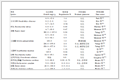
1 材料与方法 1.1 样品的采集与预处理研究区域位于太湖流域下游的淀山湖水域,该区域是重要的水产养殖区与水网交汇处,其东侧邻近黄浦江上游水源地,受太湖主干流、周边支流来水及潮汐顶托的多重影响,是反映流域下游污染物迁移与累积效应的关键区域. 于2024~2025年间,在该区域采用随机采样方法,采集了4类水产品(包括鱼类、日本沼虾、中华绒螯蟹和方形环棱螺),具体采样点位、生物种类及相关信息见表 1. 使用不锈钢采水器同步采集表层水样,贮存于1 L聚丙烯(PP)瓶中. 所有样本在运输过程中低温保存,返回实验室后置于-20℃冰箱中冷冻保存. 生物样本经解剖分离目标组织. 具体而言,每条鱼按1∶1质量比取其左右完整鳃丝,剔除鳃耙等杂质,混合后冷冻干燥;肌肉组织取背脊两侧无骨肌肉,避开皮肤与脂肪层. 日本沼虾不解剖进行整体分析. 中华绒螯蟹取可食用的肌肉和膏黄进行分析,肌肉组织包括步足与腹甲肌肉,膏黄包括性腺和肝胰腺,均按1∶1质量比混合. 方形环棱螺开壳后取全部软体组织(含内脏). 所有组织样本的采集均模拟实际食用习惯. 生物样本经冷冻干燥后研磨成均匀粉末,于-20℃保存. 记录样本冻干前后的质量以计算含水率,用于干湿质量含量换算.
|
表 1 太湖流域下游水产品样本的采集信息 Table 1 Collection information of aquatic product samples from the Taihu Lake downriver |
1.2 标准品与试剂
本研究共分析了24种PFAS,包括C4~C14的全氟烷基羧酸(perfluorinated carboxylic acids,PFCA)、C4~C9的全氟烷基磺酸(perfluorinated sulfonic acid,PFSA)以及7种新型PFAS,同时使用15种PFAS同位素标记物进行定量(表 2). 所有标准品(> 99%)均购买于加拿大Wellington Laboratories. 实验过程中使用的甲醇、乙腈(色谱纯)购买于德国Merck公司,乙酸铵(色谱纯)购买于美国ANPEL公司,氨水(> 25%)购买于上海易恩化学技术有限公司.
|
|
表 2 24种目标PFAS的英文名称、缩写、内标和仪器定量限 Table 2 English name, abbreviation, internal standard, and LOQ of 24 target PFAS |
1.3 实验方法 1.3.1 前处理方法
水样前处理参考已有方法[40]并略作优化:取200 mL水样经0.7 μm GF/F玻璃纤维滤膜(Whatman,英国)过滤,加入0.5 ng内标混匀. 采用Oasis-WAX固相萃取柱(500 mg,6 mL),依次用8 mL氨化甲醇(0.5%)、4 mL甲醇和4 mL超纯水活化柱床. 水样以3 mL·min-1的流速过柱,再用4 mL 25 mmol·L-1乙酸铵缓冲液(pH=4)和4 mL甲醇淋洗,最终用12 mL氨化甲醇(0.5%)洗脱. 生物样本前处理采用甲醇萃取法:称取0.2 g冻干均质后的样本于15 mL PP离心管中,加入0.5 ng内标和2 mL甲醇,涡旋混匀后于30 ℃下水浴超声15 min,振荡15 min(300 r·min-1),离心10 min(10 000 r·min-1),转移上清液至50 mL PP离心管中. 重复提取2次,合并上清液. 萃取液在45 ℃水浴中氮吹至干,用2 mmol·L-1乙酸铵水溶液-甲醇溶剂(3∶7,体积比)复溶至200 μL,复溶液离心(15 min,5 000 r·min-1)后取上清液至PP进样小瓶中待测.
1.3.2 仪器分析条件使用Waters Acquity HPLC@H class超高效液相色谱仪串联Waters Xevo TQ-XS micro三重四极杆质谱仪进行PFAS分析. 色谱柱为ACQUITY UPLC®BEH C18(ϕ2.1 mm × 100 mm,1.7 μm,Waters),柱温40 ℃,进样量5 μL. 流动相为5 mmol·L-1乙酸铵水溶液(A)和乙腈(B),流速0.3 mL min-1. 梯度洗脱程序如下:0~3.5 min,10%~50% B;3.5~6 min,50%~95% B;6~8 min,95% B;8~8.5 min,95%~10% B;8.5~10 min,10% B. 质谱检测采用电喷雾离子源负离子模式(ESI-)和多反应监测模式(MRM),离子源温度150 ℃,毛细管电压3 kV,脱溶剂气(氮气)温度和流速分别为500 ℃和1 000 L·h-1.
1.4 质量控制与质量保证在样品采集、处理和分析的所有步骤中严格避免使用含氟材料和玻璃器皿,所有器材在使用前均用超纯水和甲醇冲洗,以避免污染. 在实际检测中,每批样本包含1个程序空白样本、1个加标样本和20个实际样品,未发现任何可检测到的污染. 并且所有实际样本均设置3个平行样,同步进行前处理与仪器分析,平行样测定结果的相对标准偏差(RSD)均低于20%,文中报告的数据为3个平行样本的平均值. 此外,对于整体样本量较小的物种,其体内PFAS含量的RSD小于20%,表明所获数据具有良好的精密度与稳定性,能够可靠地用于后续的污染特征分析与风险评估. 仪器分析过程中,每批样本间插入溶剂空白和标准品质控样本,以监测背景干扰与仪器稳定性. 生物组织和水样的基质效应分别为79%~121%和87%~119%,观察到不同程度的基质抑制或增强效应,为有效校正此效应,采用同位素内标法,设置0.02~50 ng·mL-1的11点标准曲线(R2 > 0.998)用于定量,以保证实验数据的准确性和重复性. 同时,通过低(1 ng·g-1和1 ng·L-1)、中(5 ng·g-1和5 ng·L-1)、高(25 ng·g-1和25 ng·L-1)加标回收实验验证方法的准确性,每个水平做3个平行,生物样本和水样的加标回收率分别为65.2%~145.7%和60.3%~136.3%,RSD均低于20%,日内和日间精密度保持在10%以内. 水样和生物样本(以dw计)的仪器定量限(limit of quantitation,LOQ)分别为0.02~0.21 ng·L-1和0.02~0.21 ng·g-1,均满足痕量分析的要求.
1.5 数据处理与统计分析在统计时,对于小于LOQ的数值,以LOQ与根号2的比值赋值. 使用Shapiro-Wilk检验和Levene检验分别评估数据的正态性和方差齐性,组间差异分析采用独立样本T检验或Mann-Whitney U检验,采用多因素方差分析(Multi-factor ANOVA)探究多因素影响下PFAS累积模式的差异,采用线性回归分析PFAS含量与碳链长度的关系,P < 0.05视为差异具有统计学意义.
污染物在生物体内的累积能力通常用生物富集因子(bioaccumulation factor,BAF)和生物-沉积物富集因子(biota-sediment accumulation factors,BSAF)来评估,根据同一点位的生物和环境介质中PFAS水平进行计算[41]:
| $ \mathrm{BAF}=C_{\mathrm{b}} / C_{\mathrm{a}} \times 1~000 $ | (1) |
| (2) |
式中,Cb表示生物体内PFAS的含量(ng·g-1),计算BAF时以湿质量计,计算BSAF时以干质量计;Cw表示水中PFAS的浓度(ng·L-1);Cs表示沉积物中PFAS的含量(ng·g-1).
采用每日摄入量(EDI)和危害商(HQ)评估膳食健康风险,通常HQ > 1.0表示存在潜在的健康风险,计算公式如下[18]:
| (3) |
| (4) |
式中,PR表示人均每日水产品消费量(g·d-1),数据来源于《中国人群暴露参数手册》以及相关文献[42]中特定水产品的消费比例;Cb表示水产品中PFAS的含量(以ww计,ng·g-1),取中位值;UF表示胃肠道吸收系数(无单位),鉴于目前缺乏针对所有PFAS的胃肠道吸收效率的权威人体数据,计算时采用保守假设,即假定经口摄入的生物利用度为100%(UF=1);BW表示平均体重(kg);RfD表示参考摄入剂量[以bw计,ng·(kg·d)-1],均来自欧洲食品安全局(EFSA)的相关报告[19,43].
2 结果与讨论 2.1 水产品中PFAS的含量和分布水产品中PFAS的含量和组成特征如图 1所示. ∑PFAS含量(以dw计,下同)范围为3.18~378.01 ng·g-1 [湿质量(以ww计,下同):0.97~113.04 ng·g-1],中位值为53.79 ng·g-1(湿质量:15.25 ng·g-1). 本研究测得的污染水平高于太湖流域既往报道值(湿质量:1.26~88.7 ng·g-1)[44],这可能与研究区域位于流域下游河口-近岸区域,更接近工业和城市污染源汇区有关. 与其他地区相比,本研究含量高于美国新泽西州(3.8~129.8 ng·g-1)[45],可能是太湖流域高度集中的氟化工产业造成了更强烈的本地排放压力以及美国实施PFAS限制标准较早的综合结果. 但低于我国黄渤海沿岸(湿质量:0.061~178.259 ng·g-1)[30]、莱州湾(56.5~1 080 ng·g-1)[41]以及广州市售水产品(湿质量:3.07~192.27 ng·g-1)[46],这种差异可能主要源于区域污染源强度不同,黄渤海沿岸及莱州湾是我国传统氟化学工业与现代氟聚合物制造的核心区域,长期密集的工业活动导致该地区环境介质中PFAS本底值普遍偏高,而广州市作为珠三角地区的工业和商贸中心,其电子制造、电镀和纺织服装等产业极为发达,可能导致环境中PFAS的来源更多元、排放强度更大,进而造成市售水产品呈现出更高的污染水平. 长链PFCA(C8~C14)的检出率较高(87.5%~100%),C8~C11 PFCA的含量随碳链长度的增长呈上升趋势,每增加一个碳原子,PFCA含量平均增加0.34~19.62 ng·g-1(P < 0.001),在PFUnDA达到峰值. PFOS和FOSA在所有样本中均有检出,6∶2 Cl-PFESA除在方形环棱螺中未检出外,在其他所有样本中普遍存在. 相比之下,短链PFAS及其他新型PFAS的检出率和含量均较低.

|
图 1 不同种类水产品中目标PFAS的含量和组成特征 Fig. 1 Concentration and compositional characteristics of target PFAS in different aquatic products |
本研究在不同水产品中观察到PFAS的累积水平与组成存在显著种间差异. ∑PFAS含量中位值从高到低依次为:日本沼虾(252.18 ng·g-1) > 鱼类(153.17 ng·g-1) > 中华绒螯蟹(47.43 ng·g-1) > 方形环棱螺(15.52 ng·g-1),且多数PFAS在鱼类和日本沼虾中的含量显著高于其他两类. 从PFAS组成上来看,PFOS、FOSA和PFUnDA在鱼类、日本沼虾和中华绒螯蟹中均占主导地位(59%~77%,合计占比,下同). 其中,鱼类和中华绒螯蟹以PFOS为主(分别占28%和27%),而日本沼虾则以FOSA(21%)和PFUnDA(20%)为主要污染物,PFDA也占有较高比例(18%). 方形环棱螺的PFAS组成较为特殊,以PFTrDA为主(33%),其次是PFUnDA(17%). 以上差异可能与生物栖息环境、摄食行为及生理特征密切相关. 底栖生物(日本沼虾、中华绒螯蟹和方形环棱螺)主要通过摄食和直接接触从沉积物中富集PFAS,通常底栖生物更易累积较高含量的PFAS,而鱼类可能通过水体暴露和食物链传递累积更多种类的PFAS[47~49]. 此外,生物组织的选择也可能显著影响测得的PFAS水平,对日本沼虾进行了整体分析,包括虾鳃和肝胰腺等,有研究表明内脏器官对PFAS具有更强的富集能力,这可能是导致其∑PFAS含量远高于其它物种的主要原因[24,50]. 相比之下,中华绒螯蟹的分析虽然也包含了性腺和肝胰腺,但其污染水平相对较低或受益于养殖环境管控. 方形环棱螺因营养级较低,积累能力相对有限且组成特征独特[41].
进一步对比鱼类不同组织及食性类别中PFAS的分布(图 2),发现长链PFCA(C8~C14)、PFHxS、PFOS、6∶2 Cl-PFESA、6∶2 FTS和FOSA在鱼鳃和肌肉组织中普遍检出(检出率 > 60%). C10~C14 PFCA、PFOS、6∶2 Cl-PFESA和FOSA的含量在不同组织间存在显著差异(P < 0.05). 采用多因素方差分析进一步探究组织与食性对鱼类PFAS积累的影响,发现组织类型对除6∶2 Cl-PFESA外的9种主要PFAS均存在显著的主效应(P < 0.05),食性对PFOA、PFNA和6∶2 Cl-PFESA具有极显著的主效应,而组织与食性的交互作用对除C13~C14 PFCA外的8种主要PFAS达到显著水平(P < 0.05),表明不同食性鱼类的PFAS组织分布模式存在高度特异性. 总体而言,鱼鳃中的∑PFAS蓄积水平(273.31 ng·g-1)是肌肉组织(153.17 ng·g-1)的1.78倍,这一分布模式与瑞典[51]、几内亚湾[52]及太湖梅梁湾[13]的研究结果一致. 从食性类别来看,肌肉组织中∑PFAS含量表现为:滤食性(272.31 ng·g-1) > 杂食性(52.27 ng·g-1) > 肉食性(40.17 ng·g-1),而鳃组织中则以杂食性鱼类(620.95 ng·g-1)富集水平最高,是滤食性鱼类(204.23 ng·g-1)的3倍,这一趋势与我国渤海辽东湾的研究相符[28]. 各类鱼体中主要污染物均为PFOS、FOSA和C9~C11 PFCA,但组成存在差异,杂食性和滤食性鱼类以PFOS和FOSA为主,而肉食性鱼类中长链PFCA(尤其是PFUnDA)的占比更高. 此外,肉食性和滤食性鱼类中短链PFAS(如PFBA和PFHxA)和新型PFAS(如8∶2 FTS)的检出频率也较高. 以上差异可能源于流域污染特征、食物网结构及物种特异性因素的共同作用. 具体而言,滤食性鱼类主要通过滤食浮游生物和鳃呼吸作用富集PFAS,生长稀释效应较弱,导致肌肉组织中较高积累[28,41],杂食性鱼类摄食来源广泛,活跃的底栖觅食行为使其鳃组织更易通过沉积物-水界面富集PFAS[53],肉食性鱼类则通过捕食行为累积PFAS,长链PFCA因生物放大效应占比突出[54].

|
图 2 鱼类不同组织以及不同食性类别中目标PFAS的含量和组成特征 Fig. 2 Concentration and compositional characteristics of target PFAS in different fish tissues and feeding habits |
不同种类水产品可食用部分中PFAS的lgBAF值总体为:日本沼虾(0.43~5.52) > 鱼类(0.56~4.98) > 中华绒螯蟹(-0.25~4.93) > 方形环棱螺(0.96~4.55)[图 3(a)]. 在鱼类不同组织中,鳃的lgBAF(0.66~5.31)普遍高于肌肉;从食性类型来看,滤食性鱼类(0.34~5.14)的lgBAF通常高于杂食性(0.92~5.18)和肉食性鱼类(1.49~4.97)[图 3(b)]. 通常认为lgBAF > 3.7代表物质具有较强的生物累积潜力[18]. 本研究显示,在鱼类和日本沼虾中,C10~C14 PFCA及6∶2 Cl-PFESA的lgBAF大于3.7;中华绒螯蟹中C11~C14 PFCA,方形环棱螺中PFTrDA和PFTeDA,以及部分鱼鳃样本中的PFOS和FOSA也表现出较强累积性(lgBAF > 3.7).

|
图 3 不同种类水产品以及鱼类不同组织和不同食性中主要PFAS的lgBAF Fig. 3 The lgBAF of major PFAS in different aquatic products, different fish tissues, and feeding habits |
在传统PFAS中,PFCA的lgBAF随碳链长度的增加呈现递增趋势,在PFTrDA(4.40~5.52)达到峰值. 在新型PFAS中,6∶2 Cl-PFESA(2.17~4.08)、6∶2 FTS(0.96~4.37)及FOSA(1.16~3.59)的lgBAF与PFOS接近甚至更高,表明以上替代品可能具备与PFOS相当或更强的生物富集潜力. 特别值得注意的是6∶2 Cl-PFESA,其分子中氯原子的引入增强了疏水性,已有研究指出其生物累积与放大潜力可能超过PFOS[31]. 此外,有研究发现FOSA作为PFOS的重要前体物,在生物体内可通过代谢转化生成PFOS[14,55]. 本研究显示二者在不同水产品中的含量呈极显著正相关(r为0.872~0.998,P < 0.01),因此,观测到的高PFOS富集可能部分归因于FOSA的体内转化,这可能导致PFOS的富集潜力被高估,而FOSA的实际累积能力被低估,这一不确定性应予以考虑.
对于底栖生物而言,沉积物亦是其重要的PFAS富集途径. 中华绒螯蟹采集点(120.90°E,31.10°N)处水和沉积物样本中主要PFAS的lg Kd值范围为0.64~3.68,其中PFCA的lg Kd值随碳链长度的增加而增加,与已有的研究结果一致,表明长链PFCA更容易分配到沉积物相中[26,47]. 相应地,中华绒螯蟹中主要PFAS的BSAF介于0.21~234.10之间,几乎系统性地大于1,表明具有较强的生物累积潜力. 值得注意的是,长链PFCA的BSAF呈现随碳链长度的增加而降低的趋势,PFDA的BSAF值最高(46.11~145.00),而PFOA(0.21~21.91)和C12~C14 PFCA(36.63~99.12)的BSAF相对较低. 上述分布模式与中国和欧洲有关底栖食物网的研究结果相符[20,22],可能归因于PFOA具有更高的水相生物利用度,而C12~C14 PFCA因强烈的吸附作用和较大的分子尺寸而导致生物利用度低.
2.3 人类健康风险评估经水产品摄入PFAS的EDI如图 4所示,鱼类和日本沼虾是人体PFAS暴露的主要来源,分别占

|
(a)展示了不同年龄组和不同性别的人群通过不同类别水产品暴露于PFAS的EDI;(b)展示了不同人群中EDI的组成;(c)中以18~44岁男性为例,展示了主要PFAS的 |
基于欧洲食品安全局(European Food Safety Authority,EFSA)设定的健康指导值[43][ADIPFOA=0.85 ng·(kg·d)-1,ADIPFOS=1.85 ng·(kg·d)-1]计算HQ,结果显示,PFOA的HQ(< 0.01~0.14)均小于1;PFOS的HQ范围为 < 0.01~5.34,其中鱼类在所有人群中及日本沼虾在青少年中的HQ均大于1. 参照同类风险评估方法[18],使用PFOS的健康指导值对6∶2 Cl-PFESA和FOSA进行HQ估算,结果显示6∶2 Cl-PFESA的HQ(< 0.01~0.15)远低于1,而FOSA的HQ为 < 0.01~3.89,部分人群通过摄入鱼类和日本沼虾的HQ超过1. 进一步依据EFSA规定的PFOA、PFNA、PFOS和PFHxS 4种传统PFAS的合并可接受周摄入量[4.4 ng·(kg·周)-1][19]评估其复合暴露风险,联合暴露HQ范围为0.01~16.79,其中,鱼类和日本沼虾在所有人群中HQ远高于1,中华绒螯蟹在2~5岁人群中略高于1. 综合上述各类水产品的EDI与HQ结果,PFOA和6∶2 Cl-PFESA的HQ均处于低风险水平(HQ < 1),而PFOS、FOSA及
本研究系统揭示了太湖流域下游典型水产品中PFAS的污染特征与健康风险,但仍存在一些局限性. 在空间代表性上,采样点位集中于该重点水产区域,虽能有效反映此典型区域的污染状况,但难以完全捕捉太湖流域下游因空间异质性,如不同河口、养殖集中区与城市近岸水域等,可能带来的污染差异. 此外,部分物种的样本量相对较小,可能影响结果稳定性. 未来的研究应进一步扩大采样范围,系统覆盖流域下游的不同功能区,并增加各物种的样本量,以构建更为全面、精确的PFAS污染图谱与风险评估体系. 在污染物识别与累积机制方面,本研究重点关注了24种PFAS,但随着新型PFAS的不断更新,更多未知结构的PFAS可能存在于环境与生物体中. 未来应加强对新型PFAS及其转化产物的筛查与识别,并结合受控暴露实验与稳定同位素标记技术,深入揭示PFAS在“水-沉积物-生物”多介质系统中的迁移转化机制与生物累积路径,尤其应关注FOSA等前体物在生物体内代谢转化对PFOS等传统PFAS富集潜力评估带来的不确定性. 通过这些深入探索,将有助于更全面地认识PFAS在河口-近岸生态系统中的环境行为与健康风险,为区域水产品安全监管与污染防控提供更为精准的科学依据.
4 结论(1)太湖流域下游4种典型水产品中普遍发现PFAS污染,共检出了23种目标化合物,长链PFCA(C8~C14)、PFOS、6∶2 Cl-PFESA和FOSA的检出率高达87.5%以上. ∑PFAS含量范围为3.18~378.01 ng·g-1,不同种类水产品中PFAS含量与分布存在显著差异,其中日本沼虾和鱼类的富集水平较高. 鱼类、日本沼虾和中华绒螯蟹中以PFOS、FOSA和PFUnDA为主要污染物,而方形环棱螺则以PFTrDA为主.
(2)鱼类不同组织及食性类别中PFAS的累积特征呈现明显差异. 鳃组织的PFAS富集水平普遍高于肌肉组织;在不同食性类别的肌肉组织中,滤食性鱼类的富集水平高于杂食性和肉食性鱼类,而在鳃组织中,杂食性鱼类的富集水平最高.
(3)长链PFCA(C10~C14)和6∶2 Cl-PFESA的lg BAF值大于3.7,超过生物蓄积基准,表明以上化合物具有较强的生物累积潜力,尤其在鱼类和日本沼虾中富集效应最为显著.
(4)鱼类和日本沼虾是人体PFAS暴露的主要来源,部分人群通过摄入水产品所暴露的PFOS和FOSA的HQ值,以及4种传统PFAS的联合暴露HQ值均超过1,最高超出安全阈值达29倍,表明存在不可忽视的潜在健康风险,需予以持续关注.
| [1] |
武倩倩, 吴强, 宋帅, 等. 天津市主要河流和土壤中全氟化合物空间分布、来源及风险评价[J]. 环境科学, 2021, 42(8): 3682-3694. Wu Q Q, Wu Q, Song S, et al. Distribution, sources, and risk assessment of polyfluoroalkyl substances in main rivers and soils of Tianjin[J]. Environmental Science, 2021, 42(8): 3682-3694. DOI:10.13227/j.hjkx.202012044 |
| [2] | Podder A, Sadmani A H M A, Reinhart D, et al. Per and poly-fluoroalkyl substances (PFAS) as a contaminant of emerging concern in surface water: A transboundary review of their occurrences and toxicity effects[J]. Journal of Hazardous Materials, 2021, 419. DOI:10.1016/j.jhazmat.2021.126361 |
| [3] | Fenton S E, Ducatman A, Boobis A, et al. Per‐ and polyfluoroalkyl substance toxicity and human health review: Current state of knowledge and strategies for informing future research[J]. Environmental Toxicology and Chemistry, 2021, 40(3): 606-630. |
| [4] | Li X T, Wang Y, Cui J S, et al. Occurrence and fate of per- and polyfluoroalkyl substances (PFAS) in atmosphere: size-dependent gas-particle partitioning, precipitation scavenging, and amplification[J]. Environmental Science & Technology, 2024, 58(21): 9283-9291. |
| [5] | Zhao Z, Cheng X H, Hua X, et al. Emerging and legacy per- and polyfluoroalkyl substances in water, sediment, and air of the bohai sea and its surrounding rivers[J]. Environmental Pollution, 2020, 263. DOI:10.1016/j.envpol.2020.114391 |
| [6] | Du D, Lu Y L, Zhou Y Q, et al. Bioaccumulation, trophic transfer and biomagnification of perfluoroalkyl acids (PFAAs) in the marine food web of the South China sea[J]. Journal of Hazardous Materials, 2021, 405. DOI:10.1016/j.jhazmat.2020.124681 |
| [7] | Pan C G, Xiao S K, Yu K F, et al. Legacy and alternative per- and polyfluoroalkyl substances in a subtropical marine food web from the beibu gulf, South China: fate, trophic transfer and health risk assessment[J]. Journal of Hazardous Materials, 2021, 403. DOI:10.1016/j.jhazmat.2020.123618 |
| [8] | Wang J H, Pan Y T, Cui Q Q, et al. Penetration of PFASs across the blood cerebrospinal fluid barrier and its determinants in humans[J]. Environmental Science & Technology, 2018, 52(22): 13553-13561. |
| [9] | Criswell R L, Wang Y T, Christensen B, et al. Concentrations of per- and polyfluoroalkyl substances in paired maternal plasma and human milk in the new hampshire birth cohort[J]. Environmental Science & Technology, 2023, 57(1): 463-472. |
| [10] |
郭宇菲, 郭一帆, 王树凯, 等. 全氟/多氟化合物在渤海近岸海域生物体中的分布、累积与放大[J]. 环境科学, 2025, 46(8): 5092-5102. Guo Y F, Guo Y F, Wang S K, et al. Distribution, accumulation, and amplification of per-and polyfluoroalkyl substances in organisms in coastal waters of Bohai sea[J]. Environmental Science, 2025, 46(8): 5092-5102. DOI:10.13227/j.hjkx.202407091 |
| [11] | Pan Y T, Zhang H X, Cui Q Q, et al. Worldwide distribution of novel perfluoroether carboxylic and sulfonic acids in surface water[J]. Environmental Science & Technology, 2018, 52(14): 7621-7629. |
| [12] | Song X W, Vestergren R, Shi Y L, et al. Emissions, transport, and fate of emerging per- and polyfluoroalkyl substances from one of the major fluoropolymer manufacturing facilities in China[J]. Environmental Science & Technology, 2018, 52(17): 9694-9703. |
| [13] | Chen M, Zhu L Y, Wang Q, et al. Tissue distribution and bioaccumulation of legacy and emerging per-and polyfluoroalkyl substances (PFASs) in edible fishes from Taihu Lake, China[J]. Environmental Pollution, 2021, 268. DOI:10.1016/j.envpol.2020.115887 |
| [14] | Joerss H, Apel C, Ebinghaus R. Emerging per- and polyfluoroalkyl substances (PFASs) in surface water and sediment of the north and baltic seas[J]. Science of the Total Environment, 2019, 686: 360-369. DOI:10.1016/j.scitotenv.2019.05.363 |
| [15] | Shi Y, Vestergren R, Zhou Z, et al. Tissue distribution and whole body burden of the chlorinated polyfluoroalkyl ether sulfonic acid F-53B in crucian carp (Carassius carassius): Evidence for a highly bioaccumulative contaminant of emerging concern[J]. Environmental Science & Technology, 2015, 49(24): 14156-14165. |
| [16] | Deng M, Wu Y M, Xu C, et al. Multiple approaches to assess the effects of F-53B, a Chinese PFOS alternative, on thyroid endocrine disruption at environmentally relevant concentrations[J]. Science of the Total Environment, 2018, 624: 215-224. DOI:10.1016/j.scitotenv.2017.12.101 |
| [17] | Liu Q, Wang X L, Yang R Y, et al. Uptake kinetics, accumulation, and long-distance transport of organophosphate esters in plants: Impacts of chemical and plant properties[J]. Environmental Science & Technology, 2019, 53(9): 4940-4947. |
| [18] | Diao J Y, Chen Z W, Wang T Y, et al. Perfluoroalkyl substances in marine food webs from South China sea: Trophic transfer and human exposure implication[J]. Journal of Hazardous Materials, 2022, 431. DOI:10.1016/j.jhazmat.2022.128602 |
| [19] | EFSA Panel on Contaminants in the Food Chain. Risk to human health related to the presence of perfluoroalkyl substances in food[J]. EFSA Journal, 2020, 18(9). DOI:10.2903/j.efsa.2020.6223 |
| [20] | Munoz G, Mercier L, Duy S V, et al. Bioaccumulation and trophic magnification of emerging and legacy per- and polyfluoroalkyl substances (PFAS) in a St. Lawrence river food web[J]. Environmental Pollution, 2022, 309. DOI:10.1016/j.envpol.2022.119739 |
| [21] | Cara B, Lies T, Thimo G, et al. Bioaccumulation and trophic transfer of perfluorinated alkyl substances (PFAS) in marine biota from the belgian north sea: distribution and human health risk implications[J]. Environmental Pollution, 2022, 311. DOI:10.1016/j.envpol.2022.119907 |
| [22] | Li Y N, Yao J Z, Zhang J, et al. First report on the bioaccumulation and trophic transfer of perfluoroalkyl ether carboxylic acids in estuarine food web[J]. Environmental Science & Technology, 2022, 56(10): 6046-6055. |
| [23] | Wang S Q, Cai Y Z, Ma L Y, et al. Perfluoroalkyl substances in water, sediment, and fish from a subtropical river of China: environmental behaviors and potential risk[J]. Chemosphere, 2022, 288. DOI:10.1016/j.chemosphere.2021.132513 |
| [24] | Fang S H, Zhao S Y, Zhang Y F, et al. Distribution of perfluoroalkyl substances (PFASs) with isomer analysis among the tissues of aquatic organisms in Taihu lake, China[J]. Environmental Pollution, 2014, 193: 224-232. DOI:10.1016/j.envpol.2014.07.006 |
| [25] | Guo M M, Wu F, Geng Q Q, et al. Perfluoroalkyl substances (PFASs) in aquatic products from the yellow-Bohai sea coasts, China: concentrations and profiles across species and regions[J]. Environmental Pollution, 2023, 327. DOI:10.1016/j.envpol.2023.121514 |
| [26] | Lee Y M, Lee J Y, Kim M K, et al. Concentration and distribution of per- and polyfluoroalkyl substances (PFAS) in the Asan lake area of South Korea[J]. Journal of Hazardous Materials, 2020, 381. DOI:10.1016/j.jhazmat.2019.120909 |
| [27] | Ahrens L, Gashaw H, Sjöholm M, et al. Poly- and perfluoroalkylated substances (PFASs) in water, sediment and fish muscle tissue from lake Tana, Ethiopia and implications for human exposure[J]. Chemosphere, 2016, 165: 352-357. DOI:10.1016/j.chemosphere.2016.09.007 |
| [28] | Xiu Z, Zheng N, An Q R, et al. Tissue-specific distribution and fatty acid content of PFAS in the northern bohai sea fish: risk-benefit assessment of legacy PFAS and emerging alternatives[J]. Journal of Hazardous Materials, 2024, 480. DOI:10.1016/j.jhazmat.2024.136024 |
| [29] | Ali A M, Sanden M, Higgins C P, et al. Legacy and emerging per- and polyfluorinated alkyl substances (PFASs) in sediment and edible fish from the eastern red sea[J]. Environmental Pollution, 2021, 280. DOI:10.1016/j.envpol.2021.116935 |
| [30] | Zhang J C, Li W, Yang L P, et al. Legacy per- and polyfluoroalkyl substances (PFASs) especially alternative PFASs in shellfish from Shandong province, China: distribution, sources, and health risk[J]. Marine Pollution Bulletin, 2023, 195. DOI:10.1016/j.marpolbul.2023.115465 |
| [31] | Wang C L, Magnuson J T, Zheng C M, et al. Incidence of pollution, bioaccumulation, biomagnification, and toxic effects of per- and polyfluoroalkyl substances (PFAS) in aquatic ecosystems: A review[J]. Aquatic Toxicology, 2025, 286. DOI:10.1016/j.aquatox.2025.107469 |
| [32] | Hedgespeth M L, Taylor D L, Balint S, et al. Ecological characteristics impact PFAS concentrations in a U.S. North Atlantic food web[J]. Science of the Total Environment, 2023, 880. DOI:10.1016/j.scitotenv.2023.163302 |
| [33] |
王新红, 于晓璇, 王思权, 等. 河口-近海环境新污染物的环境过程、效应与风险[J]. 环境科学, 2022, 43(11): 4810-4821. Wang X H, Yu X X, Wang S Q, et al. Environmental process, effects and risks of emerging contaminants in the estuary-coastal environment[J]. Environmental Science, 2022, 43(11): 4810-4821. DOI:10.13227/j.hjkx.202205354 |
| [34] |
安欣怡, 王春辉, 陈崇泰, 等. 全氟或多氟烷基物质(PFAS)在长江口的时空分布及其影响因素[J]. 环境科学学报, 2025, 45(9): 263-273. An X Y, Wang C H, Chen C T, et al. Spatiotemporal distribution and influencing factors of per-and polyfluoroalkyl substances (PFAS) in the Yangtze River estuary[J]. Acta Scientiae Circumstantiae, 2025, 45(9): 263-273. |
| [35] | Zhao Z, Tang J H, Mi L J, et al. Perfluoroalkyl and polyfluoroalkyl substances in the lower atmosphere and surface waters of the Chinese Bohai Sea, Yellow Sea, and Yangtze River estuary[J]. Science of the Total Environment, 2017, 599-600: 114-123. DOI:10.1016/j.scitotenv.2017.04.147 |
| [36] | Wang S Q, Ding G H, Liu Y H, et al. Legacy and emerging persistent organic pollutants in the marginal seas of China: occurrence and phase partitioning[J]. Science of the Total Environment, 2022, 827. DOI:10.1016/j.scitotenv.2022.154274 |
| [37] | Groffen T, Wepener V, Malherbe W, et al. Distribution of perfluorinated compounds (PFASs) in the aquatic environment of the industrially polluted Vaal River, South Africa[J]. Science of the Total Environment, 2018, 627: 1334-1344. DOI:10.1016/j.scitotenv.2018.02.023 |
| [38] |
魏子皓, 周冬仁, 郝贵杰, 等. 南太湖6种典型鱼类中全氟化合物的分布特征及其健康风险[J]. 环境科学学报, 2024, 44(4): 390-400. Wei Z H, Zhou D R, Hao G J, et al. Distribution characteristics of perfluorinated compounds in six typical fish species from South Taihu Lake and their health risks[J]. Acta Scientiae Circumstantiae, 2024, 44(4): 390-400. |
| [39] |
周龙飞, 陈文静, 张扬, 等. 太湖梅梁湾水环境中全氟和多氟化合物的污染特征及风险评估[J]. 环境化学, 2023, 42(10): 3408-3419. Zhou L F, Chen W J, Zhang Y, et al. Pollution characteristics and risk assessment of per-and polyfluoroalkyl substances in waters of Meiliang Bay, Taihu Lake[J]. Environmental Chemistry, 2023, 42(10): 3408-3419. |
| [40] |
张红霞, 张洪昌, 胡双庆, 等. 太浦河水体和沉积物中24种全氟化合物分布特征[J]. 环境化学, 2024, 43(3): 722-733. Zhang H X, Zhang H C, Hu S Q, et al. Distribution characteristics of 24 perfluorocarbons in Taipu River and sediments[J]. Environmental Chemistry, 2024, 43(3): 722-733. |
| [41] | Li Y N, Yao J Z, Pan Y T, et al. Trophic behaviors of PFOA and its alternatives perfluoroalkyl ether carboxylic acids (PFECAs) in a coastal food web[J]. Journal of Hazardous Materials, 2023, 452. DOI:10.1016/j.jhazmat.2023.131353 |
| [42] | Gulkowska A, Jiang Q T, So M K, et al. Persistent perfluorinated acids in seafood collected from two cities of China[J]. Environmental Science & Technology, 2006, 40(12): 3736-3741. |
| [43] | EFSA Panel on Contaminants in the Food Chain. Risk to human health related to the presence of perfluorooctane sulfonic acid and perfluorooctanoic acid in food[J]. EFSA Journal, 2018, 16(12). DOI:10.2903/j.efsa.2018.5194 |
| [44] | Liang X X, Zhou J, Yang X Y, et al. Disclosing the bioaccumulation and biomagnification behaviors of emerging per/polyfluoroalkyl substances in aquatic food web based on field investigation and model simulation[J]. Journal of Hazardous Materials, 2023, 445. DOI:10.1016/j.jhazmat.2022.130566 |
| [45] | Goodrow S M, Ruppel B, Lippincott R L, et al. Investigation of levels of perfluoroalkyl substances in surface water, sediment and fish tissue in New Jersey, USA[J]. Science of the Total Environment, 2020, 729. DOI:10.1016/j.scitotenv.2020.138839 |
| [46] |
王旭峰, 王强, 黎智广, 等. 广州市售水产品中全氟烷基化合物的污染特征和安全风险评价[J]. 环境科学, 2019, 40(4): 1931-1938. Wang X F, Wang Q, Li Z G, et al. Contamination characteristics and safety risk assessment of perflurorinated alkylated substances in aquatic products from Guangzhou[J]. Environmental Science, 2019, 40(4): 1931-1938. DOI:10.13227/j.hjkx.201809113 |
| [47] | Miranda D A, Benskin J P, Awad R, et al. Bioaccumulation of per- and polyfluoroalkyl substances (PFASs) in a tropical estuarine food web[J]. Science of the Total Environment, 2021, 754. DOI:10.1016/j.scitotenv.2020.142146 |
| [48] | Bedi M, Sapozhnikova Y, Taylor R B, et al. Per- and polyfluoroalkyl substances (PFAS) measured in seafood from a cross-section of retail stores in the united states[J]. Journal of Hazardous Materials, 2023, 459. DOI:10.1016/j.jhazmat.2023.132062 |
| [49] | Ren J D, Point A D, Baygi S F, et al. Bioaccumulation of polyfluoroalkyl substances in the lake Huron aquatic food web[J]. Science of the Total Environment, 2022, 819. DOI:10.1016/j.scitotenv.2022.152974 |
| [50] | Marín-García M, Fàbregas C, Argenté C, et al. Accumulation and dietary risks of perfluoroalkyl substances in fish and shellfish: A market-based study in Barcelona[J]. Environmental Research, 2023, 237. DOI:10.1016/j.envres.2023.117009 |
| [51] | Ahrens L, Norström K, Viktor T, et al. Stockholm arlanda airport as a source of per- and polyfluoroalkyl substances to water, sediment and fish[J]. Chemosphere, 2015, 129: 33-38. DOI:10.1016/j.chemosphere.2014.03.136 |
| [52] | Ekperusi A O, Bely N, Pollono C, et al. Prevalence of per- and polyfluoroalkyl substances (PFASs) in marine seafood from the Gulf of Guinea[J]. Chemosphere, 2023, 335. DOI:10.1016/j.chemosphere.2023.139110 |
| [53] | Liang X X, Yang X Y, Jiao W Q, et al. Simulation modelling the structure related bioaccumulation and biomagnification of per- and polyfluoroalkyl substances in aquatic food web[J]. Science of the Total Environment, 2022, 838. DOI:10.1016/j.scitotenv.2022.156397 |
| [54] | Barhoumi B, Sander S G, Driss M R, et al. Survey of legacy and emerging per- and polyfluorinated alkyl substances in Mediterranean seafood from a north African ecosystem[J]. Environmental Pollution, 2022, 292. DOI:10.1016/j.envpol.2021.118398 |
| [55] | Fujii Y, Kato Y, Miyatake M, et al. Levels and spatial profile of per- and polyfluoroalkyl substances in edible shrimp products from japan and neighboring countries; a potential source of dietary exposure to humans[J]. Environment International, 2024, 189. DOI:10.1016/j.envint.2024.108685 |
| [56] | Dong F F, Pan Y T, Zhang J, et al. Comprehensive assessment of exposure pathways for perfluoroalkyl ether carboxylic acids (PFECAs) in residents near a fluorochemical industrial park: the unanticipated role of cereal consumption[J]. Environmental Science & Technology, 2023, 57(48): 19442-19452. |
| [57] | Pan C G, Zhao J L, Liu Y S, et al. Bioaccumulation and risk assessment of per- and polyfluoroalkyl substances in wild freshwater fish from rivers in the pearl river delta region, South China[J]. Ecotoxicology and Environmental Safety, 2014, 107: 192-199. DOI:10.1016/j.ecoenv.2014.05.031 |
| [58] | Hoa N T Q, Lieu T T, Anh H Q, et al. Perfluoroalkyl substances (PFAS) in freshwater fish from urban lakes in Hanoi, Vietnam: concentrations, tissue distribution, and implication for risk assessment[J]. Environmental Science and Pollution Research, 2022, 29(34): 52057-52069. DOI:10.1007/s11356-022-19532-0 |