 2026, Vol. 47


2. 生态环境部南京环境科学研究所,南京 210033;
3. 华东区域危险废物环境风险防控技术中心,南京 210033;
4. 南京信息工程大学江苏省大气环境与装备技术协同创新中心,南京 210044
2. Nanjing Institute of Environmental Sciences, Ministry of Ecology and Environment, Nanjing 210033, China;
3. East China Regional Technology Center of Hazardous Waste Environmental Risk Prevention and Control, Nanjing 210033, China;
4. Jiangsu Collaborative Innovation Center of Atmospheric Environment and Equipment Technology, Nanjing University of Information Science & Technology, Nanjing 210044, China
抗生素在农业、畜牧业及医疗领域中被广泛使用[1],并且通过畜禽粪肥施用、污水灌溉和土壤改良剂施用等途径进入土壤. 抗生素进入土壤后可吸附于土壤颗粒或在微生物的参与下发生降解,但仍存在向深层土壤淋溶的趋势(图 1)[2]. 全球评估研究表明,41个国家的农业土壤样品中抗生素的含量平均值范围为0.5~250 μg·kg-1[3],预计未来30 a内,全球土壤抗生素污染水平可能会继续升高[4]. 我国抗生素的消耗量也一直处于较高水平,其中兽用抗生素环境排放量占全球的近30%[5]. 2010~2020年期间我国兽用抗生素的排放量约为23 110~40 850 t·a-1,其中85%的抗生素进入土壤,部分地区土壤抗生素残留已具有较高的耐药性发展风险[6]. 环境中抗生素的残留会对生态系统构成严重威胁(图 1),显著减少土壤中微生物生物量[7],也会减少固氮微生物的反硝化过程,从而降低土壤肥力和生态系统生产力. 抗生素的生物积累还加剧了其在食物链中的传播风险[8]. 长期低剂量抗生素暴露可能导致人类肠道菌群的耐药性增强,构成严重的公共健康隐患[9]. 抗生素在环境中的长期存在还会促进抗生素抗性基因(ARGs)的水平传播[10],土壤已成为耐药基因的重要储库[11].

|
图 1 土壤中抗生素的来源和传播 Fig. 1 Sources and spread of antibiotics in soil |
抗生素在环境中的迁移受多种物理化学和微生物过程的影响,以上作用过程决定了抗生素在生态环境系统中的持久性及生态风险. 然而,现有研究多聚焦单一因子对抗生素迁移的影响,而多因子协同/拮抗效应机制尚未系统阐明[12]. 其次,目前大部分实验数据仍来源于实验室内的短期静态批次实验且影响因素设计较为单一,实验结论难以直接外推到实际环境. 本文系统综述了抗生素在土壤中迁移的关键影响因素,在此基础上归纳出模拟实验研究揭示的各因子之间的协同/拮抗效应,并且选择垃圾填埋场这一兼具高DOM、强离子强度和显著氧化还原梯度的典型体系,作为案例场景对前述交互机制进行验证,以期为今后的模拟实验提供新思路,并为精准评估抗生素环境风险提供理论依据.
1 影响抗生素在土壤中迁移的关键因素 1.1 土壤矿物与有机质对抗生素迁移的调控作用 1.1.1 矿物组成土壤矿物组成在抗生素迁移过程中起着至关重要的作用. 不同矿物类型由于比表面积、层间结构和阳离子交换容量(CEC)等性质的差异对抗生素的吸附能力存在显著区别[13].
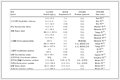
一般来说,比表面积大的矿物提供了更多的吸附位点,对抗生素的吸附能力越强. 表 1总结了3种主要的土壤矿物的比表面积、吸附机制及其对四环素类抗生素的吸附能力[14]. 可以发现,蒙脱石对红霉素的吸附量可达高岭石的3倍[13,15],这主要是因为蒙脱石的比表面积比高岭石的比表面积大30~40倍. 除比表面积外,矿物层间结构的可变性也会影响抗生素的吸附,层间距大的矿物能吸附更多的抗生素. 如蒙脱石的层间距(0.96~1.8 nm)能够动态调节,有研究发现用HDTMA(十六烷基三甲基溴化铵)修饰过的蒙脱石层间距会变大(1.35~1.95 nm),从而提高大分子抗生素的嵌入能力,使其对四环素的最大饱和吸附量可达到296.7 mg·g-1[16],而高岭石(固定层间距0.72 nm)和伊利石(0.6~1.0 nm)因缺乏层间膨胀性,主要依赖表面吸附[13],吸附能力远低于蒙脱石. 同时,大多数黏土矿物和氧化物矿物在环境条件下通常呈现负电荷,能够通过静电作用吸附阳离子型抗生素,吸附量则与其CEC成正比. 比如蒙脱石因其较高的CEC(80~100 cmol·kg-1),具有丰富的离子交换位点,对恩诺沙星吸附量可达到81.9 mg·g-1. 相比之下,高岭石因低CEC(5~10 cmol·kg-1)对恩诺沙星的吸附量仅有25.1 mg·g-1[17].
|
表 1 3种土壤矿物对四环素类抗生素的吸附行为 Table 1 Adsorption behavior of three soil minerals on tetracycline antibiotics |
1.1.2 溶解性有机质
溶解性有机质(DOM)是土壤中的活性有机组分,广泛来源于植物残体降解、微生物代谢产物及土壤腐殖化过程,其主要成分包括腐植酸(HA)、富里酸(FA)和水溶性有机碳(DOC)[18]. DOM主要通过疏水作用、氢键结合及络合作用调控抗生素在土壤中的环境行为[19].
DOM的性质和抗生素的结构决定了它们相互作用的机制及作用强度. 疏水性抗生素易与HA中的芳香族化合物发生非极性相互作用,提高其在水体中的稳定性[20],有研究表明在水-土界面DOM通过降低抗生素的疏水性[21],使其更易溶于水体,从而增加其迁移风险. 但是FA中的羟基、羰基与抗生素分子中的极性官能团能够形成氢键,从而增强DOM-抗生素复合物的稳定性[22]. 比如在DOM存在的条件下[19],四环素更容易与有机质颗粒结合并沉降[23],降低了其迁移风险. 有机质的存在还可能与抗生素竞争吸附土壤矿物表面的吸附位点[24],同时又与无机矿物发生相互作用,减少了矿物成分对抗生素的吸附[25]. 如周永康等[26]研究发现随着HA添加含量的增加,红壤对磺胺甲噁唑(SMX)的吸附量减少,解吸量增大. 不过在这一过程中,DOM存在一个临界含量,只有DOM含量达到临界值时,继续增加DOM含量才会导致抗生素的吸附量下降,如果DOM含量低于临界含量,抗生素的吸附量反而会随DOM含量的增加而增加[27].
1.2 土壤孔隙结构与水力特性的影响孔隙结构影响抗生素的滞留与渗透行为,而水力条件则决定其在土壤中的迁移速率[28]. 土壤孔隙结构通常由宏孔(> 50 µm)、中孔(2~50 µm)和微孔(< 2 µm)组成[29]. 宏孔主要存在于砂质土壤和土壤裂隙中,由于渗透性较强,溶质能够随水流较快迁移至地下水系统[28]. 相反,抗生素在微孔结构的土壤中主要通过分子扩散和静电吸附进行缓慢迁移[30]. 并且一般情况下,高水力传导性土壤(砂质壤土)的CEC较低,抗生素难以被有效吸附,在降水或灌溉条件下抗生素的迁移速率比低水力传导性土壤(黏质土壤)高出2~3倍[31,32],有研究显示氟喹诺酮类抗生素在砂质土壤中滞留时间远低于其他类型土壤[33].
此外,孔隙的不均匀分布会产生裂隙流或优先流,从而导致抗生素迁移路径的不确定性. 如抗生素的优先流现象会导致其绕过高吸附能力的土壤颗粒,直接渗透到更深层土壤甚至地下水系统[34]. Sandin等[29]的实验进一步表明,裂隙发育程度较高的土壤,其抗生素的迁移速率显著快于未受裂隙影响的土壤,这主要与裂隙提供的高渗透通道有关.
1.3 关键环境因子对抗生素迁移的影响作用 1.3.1 pHpH是影响抗生素在土壤环境中化学行为的关键因素,它主要通过调控抗生素的电荷状态,进而影响抗生素的吸附、解吸和迁移能力[35]. 抗生素的酸碱解离常数(pKa)决定了其在不同pH条件下的电荷状态,即以阳离子、中性分子或阴离子形式存在[36]. 例如,四环素类抗生素具有多个pKa值:3.3、7.8和9.7,导致其离子化行为受土壤溶液pH影响显著[14],如表 2所示,不同的pH值下四环素的电荷状态以及在土壤中的吸附机制有明显差异[37,38].
|
|
表 2 不同pH值下四环素类抗生素的电荷状态及吸附机制 Table 2 Charge states and adsorption mechanisms of tetracycline antibiotics at different pH |
由此可见,四环素类抗生素在低pH条件下易通过静电作用吸附在带负电的黏土矿物或有机质上,高pH条件下四环素以阴离子为主,与带负电的土壤颗粒产生静电排斥,吸附量下降. 氟喹诺酮类抗生素也具有相同的变化趋势,在低pH条件下吸附能力增强,在高pH条件下易解吸进入水相[35],在Jalil等[36]的实验中,pH=6.0时,环丙沙星在矿物上的吸附量最高,可达347.8 mg·g-1,而pH=10.0时,其吸附量降至72.76 mg·g-1.
1.3.2 共存离子环境中的共存离子在调控抗生素的吸附、解吸及迁移行为方面起着重要作用,主要通过竞争吸附、络合作用和桥联作用调控抗生素在土壤中的迁移行为[39].
单价阳离子(如Na+和K+)会通过竞争吸附位点减少抗生素在土壤中的吸附量. Conde-Cid等[40]研究发现,Na+浓度升高可显著减少四环素在黏土上的吸附. 相比之下,Ca2+和Mg2+等多价阳离子在影响抗生素吸附时则表现出双重作用. 一方面,它们可与土壤表面竞争吸附位点,降低抗生素的固定能力;另一方面,多价阳离子能够通过桥联作用促进抗生素与土壤矿物或有机质的结合. 比如Ca2+含量的增加促进了四环素与腐植酸之间的络合能力增强,提高了其在黏质土壤中的吸附量[41]. 同时,一些金属阳离子的存在还会影响抗生素的转换机制,比如Fe3+能催化β-内酰胺类抗生素的水解与氧化,加速其降解[42].
阴离子(如NO3-、SO4-和PO43-)在抗生素迁移过程中也起到调节作用[43]. 高含量的阴离子会与抗生素发生络合作用,减少其在土壤颗粒表面的吸附量,比如当环丙沙星(CIP)与腐植酸复合材料共存时,添加NO3-会与CIP发生络合作用,从而降低CIP的吸附速率和吸附效率[44];同时,高含量的阴离子会改变土壤矿物表面的静电环境,从而影响抗生素在矿物表面吸附,比如SO42-由于带有较高电荷密度,能够改变土壤颗粒表面的静电环境,影响抗生素的吸附行为[45]. 部分阴离子会和矿物表面的金属离子发生络合作用,从而减少抗生素的有效吸附位点,例如Zhang等[46]发现PO43-会与矿物表面的Fe3+发生强烈络合作用,使抗生素的有效吸附位点减少.
1.3.3 氧化还原状态氧化还原条件决定了抗生素的降解路径,主要通过不同途径的氧化降解影响其稳定性[47,48]. 在好氧条件下,抗生素更容易通过氧化酶作用或自由基氧化降解[49],例如,β-内酰胺类抗生素在光催化降解过程中,其β-内酰胺环可通过氧自由基发生氧化开环,导致抗生素活性丧失[50]. 并且在光催化过程中,活性氧介导能够通过4种降解途径使使左氧氟沙星(LEV)的功能基团发生修饰,形成稳定的初级降解产物[51].
1.3.4 胶体颗粒胶体颗粒是环境中重要的抗生素迁移载体,能够通过静电作用、表面络合作用和层间嵌入作用吸附抗生素[52]. 环境中的大多数矿物胶体通常带负电,可吸附带正电的抗生素[53]. 抗生素中的羟基、氨基等则可与一些胶体表面的金属离子或含氧官能团形成稳定络合物[54],进一步增强其在土壤中的吸附能力[55]. 一些矿物胶体颗粒还具有可膨胀的层间结构,能够嵌入抗生素,提高其吸附量[56]. 然而以上胶体改变抗生素的吸附能力的同时,也显著增强了其迁移能力[57~59]. 由于胶体颗粒具有高流动性,它们可携带抗生素进行更远距离的迁移. 比如黏土胶体可作为磺胺类抗生素的载体,在饱和多孔介质中显著增加其迁移距离[60]. 铁氧化物胶体使四环素的渗透深度较没有胶体存在的条件下增加了40%以上[61]. 并且由于体积较小且表面电荷相互排斥,胶体颗粒在土壤中迁移的速度较快,因此被其携带的抗生素迁移速度也会加快. 例如在饱和多孔介质中,聚苯乙烯微塑料胶体使四环素在土柱中的穿透速率提高了25%[62]. 因此,胶体对抗生素迁移的影响具有双重性:一方面,胶体吸附抗生素并与其发生络合作用可以暂时抑制其迁移;但另一方面,胶体作为迁移载体可能携带抗生素进行快速迁移,从而加剧抗生素的环境扩散风险.
值得注意的是,当胶体颗粒达到吸附饱和时,其表面结合力会逐渐减弱. 在这种情况下,外界环境因子可能会诱导已经吸附的抗生素发生解吸,使其重新进入水相. Li等[63]研究发现,在微塑料胶体颗粒上,恩诺沙星和甲氧苄啶的解吸率在24 h内分别可达20%~25%,且解吸行为随环境pH和盐度变化而增强. 这表明胶体对抗生素的调控不仅体现在吸附和迁移载体作用上,还存在“吸附-解吸”的动态过程,这使其环境行为更具有不确定性.
1.4 微生物群落对抗生素迁移的影响作用微生物降解是抗生素在自然环境中最主要的去除途径之一,主要通过一系列酶促反应改变抗生素的化学结构,使其失去活性或转化为代谢产物,从而显著影响抗生素的环境行为及迁移能力. 这一过程涉及多种微生物的共同作用,目前常见的几种降解不同抗生素的微生物以及作用机制如表 3所示,微生物对抗生素进行的酶促反应主要依赖于其分泌一系列特异性酶类,这些酶可断裂抗生素的关键结构键,使抗生素失去活性或进一步被代谢为无毒小分子. 此外,许多微生物具备芳香化合物降解通路与氧化还原酶体系,能够降解多种结构复杂、持久性的抗生素[64~68].
|
|
表 3 降解不同抗生素的微生物及其降解机制 Table 3 Microorganisms degrading different antibiotics and their degradation mechanisms |
在微生物降解过程中,抗生素的极性、电荷状态等会发生变化,直接影响了其迁移性. 具体而言,磺胺类抗生素在微生物降解后,极性基团的增加会显著提升其水溶性,进而增强其随水流的迁移能力[69];喹诺酮类抗生素在降解过程中,羧基和酚羟基的暴露降低了其与土壤矿物的结合能力[70],从而增强了其迁移性;吸附能力较强的四环素的降解产物——脱羟四环素因其羟基减少,导致土壤吸附能力降低[71]. 更为重要的是,某些抗生素的降解产物不仅迁移性增强,毒性也会增强. 比如磺胺二甲基嘧啶在降解过程中可能会产生酚类化合物,这类化合物具有比母体更高的毒性[72].
由此可见,微生物降解在降低抗生素环境持久性的同时,也会改变抗生素的结构从而加剧其扩散风险. 这种风险主要源于部分降解产物的极性增加或者土壤吸附性降低,从而使其更易随水流迁移,加剧其环境扩散.
矿物类型、有机质组成和孔隙结构等理化属性通过吸附-解吸和扩散阻滞等机制直接影响抗生素的滞留与迁移,pH、离子强度和氧化还原条件等环境因子则通过改变抗生素的电荷状态、竞争吸附及降解路径,间接调控其环境归趋. 微生物在这一过程中也扮演着关键角色,不仅通过降解作用降低抗生素的持久性,还通过改变其理化性质影响其迁移能力. 然而,土壤中抗生素的迁移行为是多重环境因子协同调控的复杂过程,上述因子在环境中并非孤立作用,而是通过复杂的交互网络共同塑造抗生素的迁移路径与归趋.
2 影响因子的交互作用 2.1 理化因子间交互作用在土壤环境中,抗生素的环境行为受多种因子的协同调控,这些因子通过复杂的交互网络影响抗生素的吸附、降解和迁移行为. pH、离子强度和氧化还原状态是这一网络中的关键枢纽因子,它们不仅独立发挥作用,还能通过协同或拮抗效应改变抗生素的环境行为[73].
2.1.1 pH-离子耦合效应pH和离子共同调控抗生素在土壤矿物表面的吸附与解吸行为,pH主要影响土壤矿物表面电荷分布及抗生素的离子化状态,而离子则通过静电作用和竞争吸附作用进一步影响抗生素的迁移能力[37]. 例如,Wei等[37]通过批量吸附实验发现pH值由酸性升高到中性时,左氧氟沙星溶液中的中性离子或两性离子逐渐增多,难以与土壤中的阴离子良好结合,导致吸附量逐渐减少,但当pH值进一步升高时,左氧氟沙星主要以阴离子形式存在于土壤中,此时高价金属阳离子起到键桥作用,形成抗生素-金属离子-吸附介质三相复合物,增加了抗生素在土壤上的吸附量.
2.1.2 氧化还原-离子协同调控氧化还原条件和离子共同影响抗生素在土壤中的迁移性和稳定性. 氧化还原条件决定了溶解性金属离子的价态,而不同价态的离子对抗生素在土壤上的吸附性产生不同的影响,并且不同的离子价态还决定了金属离子对抗生素的降解效率. 比如在厌氧环境中,金属离子能够与抗生素形成络合物,增强抗生素的在土壤中的滞留效应,Yan等[74]研究发现在厌氧条件下,Fe2+与磺胺类抗生素形成稳定络合物从而抑制其从土壤上解吸,使得磺胺类抗生素的迁移能力下降25%~40%,这可以归因于厌氧条件下Fe2+的络合作用导致抗生素在土壤矿物表面富集. Luo等[75]在可变饱和介质(MnO2)中进行四环素的迁移实验,发现在好氧条件下氧气对Mn2+的表面催化氧化会产生更具反应活性的Mn3+位点,进而提高MnO2对四环素的氧化降解效率.
2.2 胶体介导的复合作用胶体是抗生素迁移时的重要载体,pH和离子强度等环境条件在改变胶体的表面电荷特性的同时还能影响胶体的稳定性,从而改变胶体与抗生素之间的相互作用强度,进而调控其对抗生素的吸附能力以及二者复合物的迁移行为.
2.2.1 pHpH改变导致胶体颗粒表面电位的改变,能够显著影响胶体对抗生素的吸附作用. Lin等[76]通过测量蒙脱石表面的Zeta电位发现随着pH从4.0增加到9.0,蒙脱石胶体表面电荷始终为负且电荷量增加,Zeta电位从-13.9 mV降低至-30.4 mV,对环丙沙星的吸附量也随之减少,解析量随之增加. pH变化还影响胶体的分散或聚合状态,进而调控胶体对抗生素的吸附能力. 在低pH条件下胶体颗粒易发生聚合,大的胶体聚合体更容易与吸附在胶体表面的抗生素一起滞留在土壤中;而在高pH条件下胶体颗粒分散度提高,迁移性增强,能够促进抗生素通过胶体介导迁移进入更深层土壤或地下水系统. Zeng等[77]通过测量不同pH条件下蒙脱土胶体的水动力直径及其与环丙沙星浓度的关系发现,低pH下,胶体粒子发生聚集,对环丙沙星的吸附量较高;高pH时,胶体颗粒的临界凝聚浓度更高,导致其对环丙沙星的吸附受到抑制.
2.2.2 离子环境中的离子从胶体电位、络合作用、竞争吸附及胶体粒径多个方面影响胶体对抗生素的吸附作用,影响作用与离子的性质和含量相关. 单价离子(如Na+)存在会减小胶体粒径,增加吸附位点[78],促进抗生素的吸附;而高价金属离子(如Ca2+)存在的影响更为复杂. 低含量时,离子与胶体以及抗生素会形成三元复合物,可以增加抗生素的吸附量,但是随着离子含量的升高,胶体发生团聚,吸附位点减少,并且离子竞争吸附位点的同时还会与抗生素形成络合物,从而导致抗生素的吸附量减少. 比如在高Ca2+含量、环丙沙星和蒙脱石胶体共存的多孔介质中会形成Ca2+-胶体-环丙沙星三元络合物从而提高对环丙沙星的吸附量,但是随着离子含量的增加,Ca2+与环丙沙星的络合作用在一定程度上削弱胶体对环丙沙星的直接吸附,导致吸附量减少[79]. 值得注意的是,不管是单价离子还是高价离子,当离子强度不断增加到一定水平时,都会竞争胶体表面的有效吸附位点并且导致胶体团聚,从而减少抗生素的吸附[80]. 因此,离子对胶体的影响十分复杂,具体取决于离子种类和离子含量,未来研究中需考虑更加真实的环境背景,从整体上全面解析离子含量变化与胶体的相互作用以及对抗生素的影响机制.
2.2.3 DOMDOM可以与胶体颗粒表面的活性位点结合从而降低抗生素的吸附量. Shen等[81]的研究证实了这一点,在DOM存在的条件下,由于DOM与胶体表面的官能团竞争吸附位点,并且通过络合作用提高了抗生素的可溶性,土壤胶体对四环素类抗生素的吸附能力显著降低. 结合到胶体表面的DOM还能改变胶体的表面电荷、化学亲和力等性质,进而影响对抗生素的吸附. 如大多数DOM带负电,吸附到原本带正电的胶体表面,中和正电荷,从而影响对带负电抗生素的吸附[82].
2.3 微生物-环境耦合作用抗生素在环境中的降解受多种理化因素的调控,这些因素不仅影响微生物的生理活性,还可能改变抗生素的理化性质,从而影响其降解效率. 微生物与环境因子之间的复杂交互作用影响了抗生素在自然环境中的归趋和持久性.
2.3.1 pH-离子协同作用pH与离子是影响微生物降解抗生素效率的重要环境因子,它们往往共同调控微生物群落结构、胞外酶活性以及细胞膜通透性,从而决定抗生素的环境归趋.
pH是影响微生物生理代谢和酶催化活性的关键因素,pH变化可直接影响微生物群落组成、微生物细胞膜通透性、代谢酶的催化效率[83],从而影响微生物对抗生素的降解效率. 例如,猪粪堆肥过程中,pH的降低导致厚壁菌门细菌富集,从而能够增强对磺胺类抗生素的降解[84]. 但Wang等[66]的研究指出,在pH为6.5~8.0条件下,放线菌和假单胞菌的代谢酶活性最高,可有效降解磺胺类抗生素,而在pH < 5.5的酸性环境下,酶活性受到抑制,降解抗生素的效率显著降低,这归因于细胞膜通透性降低以及胞外降解酶的活性受到抑制. 与此同时,离子的存在不仅能直接影响微生物生长,还会通过改变胞外聚合物与抗生素的结合强度来间接影响降解过程. 比如Li等[71]通过在土霉素和Pseudomonas sp. T4(假单胞菌属)混合液体中加入Fe3+,发现Fe3+能够显著提高该微生物对土霉素的降解率(最高可达到81%). 并且,Zhang等[85]的研究发现,当Na+在50~500 mol·L-1之间时,离子浓度越高,磺胺二甲嘧啶在枯草芽孢杆菌的细胞外聚合物质中的结合力就越强,抗生素的生物吸附率也随之升高.
2.3.2 氧化还原条件不同氧化还原条件下微生物活性不同,从而导致微生物对抗生素的利用率受到影响. 例如在猪粪浆中,厌氧条件下(氧化还原电位在-250~-400 mV之间),特定的厌氧微生物(如产甲烷菌、硫酸盐还原菌)占主导,这些微生物的矿化作用是磺胺甲噁唑和氟苯尼考等抗生素微生物降解的主要过程,当氧化还原电位变化时,这些微生物的丰度和活性会降低,进而影响抗生素利用[86]. 特殊的氧化还原条件还会影响特定微生物的代谢过程,在这一过程中,微生物对抗生素的利用率得到显著提高. 比如在锰氧化还原系统中,恶臭假单胞菌MnB-1能够形成锰氧化物,从而降低降解环丙沙星的过程中对微生物有害的DNA促旋酶生成,因此假恶臭单胞菌能够维持细胞活力,进一步提高对环丙沙星的降解率[87].
综合以上论述,多因子交互过程可归纳为“理化触发-胶体介导-微生物反馈”机制(图 2):抗生素的初始滞留由矿物和有机质主导,pH、离子强度与氧化还原状态等理化条件调控抗生素的初始吸附-解吸平衡;胶体颗粒在“吸附介质-迁移载体”之间动态转化,调节其迁移路径;而微生物群落则通过降解及代谢产物的再分配,对抗生素的长期环境行为形成正负反馈. 为了验证该机制在典型场景下的适用性,下一节将以垃圾填埋场土壤-渗滤液体系为例,剖析各作用环节的协同与拮抗特征.

|
图 2 抗生素在土壤中环境行为的影响因素示意 Fig. 2 Schematic representation of factors influencing the environmental behavior of antibiotics in soil |
填埋场兼具高溶解性有机质、强离子强度和显著的氧化还原梯度,能够同时触发协同增强与拮抗抑制效应[88]. 此外,填埋渗滤液中高浓度抗生素与抗性基因的共存使其成为地下水风险的热点区域[89],在实践层面也最能体现本综述所强调的多因子耦合对环境管理决策的重要性.
在垃圾填埋场中高浓度溶解性有机质、可变pH与强离子强度共同塑造了高缓冲、高络合、高竞争的化学环境,显著削弱矿物吸附对抗生素的初始滞留作用. 填埋渗滤液中的DOM富含蛋白类物质、酚羟基、羧基等结构,能够与Cr3+等金属离子形成络合物并且构成胶体体系[90],为四环素、喹诺酮类等抗生素提供额外结合位点从而提高其吸附量,但又因颗粒分散性增强而加速其在含水层中的远程运输[91]. 显著的氧化还原梯度是填埋场的另一关键特征:从好氧覆盖层到厌氧深层,氧化还原电位不断降低,这一变化决定了Fe2+/Fe3+-抗生素络合/解离以及Mn3+/Mn4+-介导氧化的方向[92];再配合阳离子的桥联或竞争作用,呈现明显的“协同增强-拮抗抑制”双向效应. 微生物层面,随着氧化还原条件的变化,优势微生物从好氧微生物(如假单胞菌)变为厌氧微生物(如甲烷菌、反硝化菌)[93]. 在厌氧条件下β-内酰胺类抗生素和磺胺类抗生素的生物降解速率降低,母体药物可长期残留在土壤中,但其极性代谢物易随胶体迁移进入地下水[94],对区域供水安全构成潜在威胁.
综上,填埋场案例证明了本综述提出的三阶段机制在实际场景中的适用性,借助此机制可为填埋场渗滤液危险预警提供依据.
4 展望尽管已有大量研究揭示了抗生素在土壤环境中的行为特征,但相关研究仍存在诸多不足,未来的研究不仅要进一步弥补科学机制上的缺口,还需要结合已有的研究结果推动完善环境管控政策.
4.1 关注实际环境复杂性,聚焦多因子协同的模拟实验现有实验室条件与实际环境差异显著,导致研究结果在实际场景中适用性低. 未来需重视不同空间尺度上环境行为的差异,开展更接近真实环境条件的模拟或原位研究. 同时,需基于农田土壤、湿地土壤等多种典型土壤体系开展验证性实验,以补充外推局限. 在实验设计层面,应从单因素或两因素响应面实验迈向多因素全景设计,以实时-原位表征技术捕捉pH、离子强度、氧化还原条件及DOM-胶体复合体系的协同或拮抗阈值,建立本土化参数库,用于校准不同场景下的迁移预测模型.
4.2 制定基于理化条件差异的区域化管控政策现有政策多以控制环境中抗生素的输入为主,却未充分考虑不同土壤条件下抗生素的迁移风险. 因此,在环境监测与管理政策的制定过程中,应强化环境分区管理:针对酸性土壤、盐碱地和地下水易受威胁的区域,应设置更严格的监测与风险评估要求;环境标准的制定也应结合区域的土壤类型和理化背景,设定差异化的抗生素限值和管控措施,从而提高政策的科学性与适用性.
5 结论(1)土壤矿物组成和矿物结构、土壤水力条件与有机质的存在共同决定抗生素的初始滞留量,随后pH、离子与氧化还原状态的耦合影响抗生素的吸附方式与吸附强度,放大或削弱抗生素的迁移能力.
(2)胶体颗粒表现出“吸附介质-迁移载体”的双重角色:在低pH或低离子强度下主要提供吸附位点抑制迁移;在高pH或高离子强度下则因分散性增强而显著提升抗生素远程输移风险.
(3)微生物降解在环境因子的间接控制下既降低母体抗生素持久性,又因产物极性升高、吸附力减弱而潜在提高迁移风险、扩大环境暴露范围.
(4)未来研究应在进一步揭示多因子交互作用机制的同时,加强与环境治理和政策制定的结合,以实现科学认知、风险评估与管理实践的衔接,从而为抗生素污染的防控和农业可持续发展提供坚实支撑.
| [1] |
苏炤新, 赵传明, 董希良, 等. 我国抗生素环境污染及管理现状[J]. 环境卫生学杂志, 2025, 15(1): 31-37. Su Z X, Zhao C M, Dong X L, et al. Current situation of environmental contamination and management of antibiotics in China[J]. Journal of Environmental Hygiene, 2025, 15(1): 31-37. |
| [2] |
陈丽红, 曹莹, 李强, 等. 中国典型抗生素在环境介质中的污染特征与生态风险评价[J]. 环境科学, 2023, 44(12): 6894-6908. Chen L H, Cao Y, Li Q, et al. Pollution characteristics and ecological risk assessment of typical antibiotics in environmental Media in China[J]. Environmental Science, 2023, 44(12): 6894-6908. DOI:10.13227/j.hjkx.202307034 |
| [3] | Fang L F, Chen C Y, Li S Y, et al. A comprehensive and global evaluation of residual antibiotics in agricultural soils: accumulation, potential ecological risks, and attenuation strategies[J]. Ecotoxicology and Environmental Safety, 2023, 262. DOI:10.1016/j.ecoenv.2023.115175 |
| [4] | Zhu H, He J L, Wu Y M, et al. Assessment of global antibiotic exposure risk for crops: incorporating soil adsorption via machine learning[J]. Environmental Science & Technology, 2024, 58(30): 13327-13336. |
| [5] | Mejías C, Martín-Pozo L, Santos J L, et al. Occurrence, dissipation kinetics and environmental risk assessment of antibiotics and their metabolites in agricultural soils[J]. Journal of Hazardous Materials, 2024, 479. DOI:10.1016/j.jhazmat.2024.135586 |
| [6] | Li S Q, Zhu Y, Zhong G B, et al. Comprehensive assessment of environmental emissions, fate, and risks of veterinary antibiotics in China: an environmental fate modeling approach[J]. Environmental Science & Technology, 2024, 58(12): 5534-5547. |
| [7] | Barathe P, Kaur K, Reddy S, et al. Antibiotic pollution and associated antimicrobial resistance in the environment[J]. Journal of Hazardous Materials Letters, 2024, 5. DOI:10.1016/j.hazl.2024.100105 |
| [8] | Kumar A, Pal D. Antibiotic resistance and wastewater: correlation, impact and critical human health challenges[J]. Journal of Environmental Chemical Engineering, 2018, 6(1): 52-58. DOI:10.1016/j.jece.2017.11.059 |
| [9] | Chaturvedi P, Shukla P, Giri B S, et al. Prevalence and hazardous impact of pharmaceutical and personal care products and antibiotics in environment: a review on emerging contaminants[J]. Environmental Research, 2021, 194. DOI:10.1016/j.envres.2020.110664 |
| [10] | Sun Z D, Hong W C, Xue C Y, et al. A comprehensive review of antibiotic resistance gene contamination in agriculture: challenges and AI-driven solutions[J]. Science of the Total Environment, 2024, 953. DOI:10.1016/j.scitotenv.2024.175971 |
| [11] | Zarei-Baygi A, Smith A L. Intracellular versus extracellular antibiotic resistance genes in the environment: prevalence, horizontal transfer, and mitigation strategies[J]. Bioresource Technology, 2021, 319. DOI:10.1016/j.biortech.2020.124181 |
| [12] | Wang B Q, Xu Z X, Dong B. Occurrence, fate, and ecological risk of antibiotics in wastewater treatment plants in China: a review[J]. Journal of Hazardous Materials, 2024, 469. DOI:10.1016/j.jhazmat.2024.133925 |
| [13] | Shang J X, Huang M J, Zhao L Y, et al. Adsorption performance and mechanisms of tetracycline on clay minerals in estuaries and nearby coastal areas[J]. ACS Omega, 2023, 9(1): 692-699. |
| [14] | Li Z H, Schulz L, Ackley C, et al. Adsorption of tetracycline on kaolinite with pH-dependent surface charges[J]. Journal of Colloid and Interface Science, 2010, 351(1): 254-260. DOI:10.1016/j.jcis.2010.07.034 |
| [15] | Figueroa R A, Leonard A, Mackay A A. Modeling tetracycline antibiotic sorption to clays[J]. Environmental Science & Technology, 2004, 38(2): 476-483. |
| [16] | Mosaleheh N, Sarvi M N. Minimizing the residual antimicrobial activity of tetracycline after adsorption into the montmorillonite: effect of organic modification[J]. Environmental Research, 2020, 182. DOI:10.1016/j.envres.2019.109056 |
| [17] | Hacıosmanoğlu G G, Mejías C, Martín J, et al. Antibiotic adsorption by natural and modified clay minerals as designer adsorbents for wastewater treatment: a comprehensive review[J]. Journal of Environmental Management, 2022, 317. DOI:10.1016/j.jenvman.2022.115397 |
| [18] | Zhou D, Thiele-Bruhn S, Arenz-Leufen M G, et al. Impact of manure-related DOM on sulfonamide transport in arable soils[J]. Journal of Contaminant Hydrology, 2016, 192: 118-128. DOI:10.1016/j.jconhyd.2016.07.005 |
| [19] | Xu Z Y, Yang Z, Wang H P, et al. Assessing redox properties of natural organic matters with regard to electron exchange capacity and redox-active functional groups[J]. Journal of Chemistry. DOI:10.1155/2020/2698213 |
| [20] | Nascimento A L A, de Oliveira Souza S, Guimarães A S, et al. Investigation on humic substance and tetracycline interaction mechanism: biophysical and theoretical studies and assessing their effect on biological activity[J]. Environmental Science and Pollution Research, 2024, 31(13): 20172-20187. DOI:10.1007/s11356-024-32168-6 |
| [21] | Olk D C, Bloom P R, De Nobili M, et al. Using humic fractions to understand natural organic matter processes in soil and water: selected studies and applications[J]. Journal of Environmental Quality, 2019, 48(6): 1633-1643. DOI:10.2134/jeq2019.03.0100 |
| [22] | Li S, Hu J Y. Photolytic and photocatalytic degradation of tetracycline: effect of humic acid on degradation kinetics and mechanisms[J]. Journal of Hazardous Materials, 2016, 318: 134-144. DOI:10.1016/j.jhazmat.2016.05.100 |
| [23] | Liu F, Liu X H, Zhao S N, et al. Photochemical transformations of tetracycline antibiotics influenced by natural colloidal particles: kinetics, factor effects and mechanisms[J]. Chemosphere, 2019, 235: 867-875. DOI:10.1016/j.chemosphere.2019.06.201 |
| [24] |
李余杰. 畜禽粪污中FQs类抗生素的污染水平及在紫色土中迁移转化研究[D]. 重庆: 重庆大学, 2020. Li Y J. Pollution of fluoroquinolone antibiotics in livestock and poultry wastes and its migration-transformation in purple soil[D]. Chongqing: Chongqing University, 2020. |
| [25] |
周永康, 余圣品, 李佳乐, 等. 土壤中抗生素的吸附行为与机理研究进展[J]. 生态环境学报, 2023, 32(11): 2072-2082. Zhou Y K, Yu S P, Li J L, et al. Research progress on adsorption behavior and mechanism of antibiotics in soil[J]. Ecology and Environmental Sciences, 2023, 32(11): 2072-2082. |
| [26] |
周永康. 典型抗生素在红壤及其矿物组分中的吸附与淋溶迁移研究[D]. 抚州: 东华理工大学, 2024. Zhou Y K. Adsorption and migration characteristics of typical antibiotics in red soil and mineral components[D]. Fuzhou: East China University of Technology, 2024. |
| [27] |
李天雨, 闫万洋, 马佑, 等. 溶解性有机物影响抗生素吸附的研究进展[J]. 四川环境, 2023, 42(5): 340-344. Li T Y, Yan W Y, Ma Y, et al. The effect of dissolved organic matter on antibiotics removal by adsorption process: a review[J]. Sichuan Environment, 2023, 42(5): 340-344. |
| [28] | Pessoa T N, Ferreira T R, Pires L F, et al. X-ray microtomography for investigating pore space and its relation to water retention and conduction in highly weathered soils[J]. Agriculture, 2023, 13(1). DOI:10.3390/agriculture13010028 |
| [29] | Sandin M, Koestel J, Jarvis N, et al. Post-tillage evolution of structural pore space and saturated and near-saturated hydraulic conductivity in a clay loam soil[J]. Soil and Tillage Research, 2017, 165: 161-168. DOI:10.1016/j.still.2016.08.004 |
| [30] | Zhi D, Yang D X, Zheng Y X, et al. Current progress in the adsorption, transport and biodegradation of antibiotics in soil[J]. Journal of Environmental Management, 2019, 251. DOI:10.1016/j.jenvman.2019.109598 |
| [31] | Huang X, Zheng J L, Liu C X, et al. Removal of antibiotics and resistance genes from swine wastewater using vertical flow constructed wetlands: effect of hydraulic flow direction and substrate type[J]. Chemical Engineering Journal, 2017, 308: 692-699. DOI:10.1016/j.cej.2016.09.110 |
| [32] | Zhao F K, Chen L D, Yen H, et al. Multimedia mass balance approach to characterizing the transport potential of antibiotics in soil-plant systems following manure application[J]. Journal of Hazardous Materials, 2020, 393. DOI:10.1016/j.jhazmat.2020.122363 |
| [33] | Chen X H, Song Y X, Ling C, et al. Fate of emerging antibiotics in soil-plant systems: a case on fluoroquinolones[J]. Science of the Total Environment, 2024, 951. DOI:10.1016/j.scitotenv.2024.175487 |
| [34] | Park J Y, Huwe B. Effect of pH and soil structure on transport of sulfonamide antibiotics in agricultural soils[J]. Environmental Pollution, 2016, 213: 561-570. DOI:10.1016/j.envpol.2016.01.089 |
| [35] | Rodríguez-López L, Santás-Miguel V, Cela-Dablanca R, et al. Sorption of antibiotics in agricultural soils as a function of pH[J]. Spanish Journal of Soil Science, 2024, 14. DOI:10.3389/sjss.2024.12402 |
| [36] | Jalil M E R, Baschini M, Sapag K. Influence of pH and antibiotic solubility on the removal of ciprofloxacin from aqueous media using montmorillonite[J]. Applied Clay Science, 2015, 114: 69-76. DOI:10.1016/j.clay.2015.05.010 |
| [37] | Wei M X, Lv D Y, Cao L H, et al. Effect of pH value on adsorption of levofloxacin in agricultural silty clay of North China[J]. IOP Conference Series: Earth and Environmental Science, 2020, 474(2). DOI:10.1088/1755-1315/474/2/022020 |
| [38] | Scaria J, Anupama K V, Nidheesh P V. Tetracyclines in the environment: an overview on the occurrence, fate, toxicity, detection, removal methods, and sludge management[J]. Science of the Total Environment, 2021, 771. DOI:10.1016/j.scitotenv.2021.145291 |
| [39] | Wang M M, Ren P, Liu H L, et al. Investigating antibiotics, antibiotic resistance genes in soil, groundwater and vegetables in relation to agricultural field-applicated with lincomycin mycelial residues compost[J]. Science of the Total Environment, 2021, 777. DOI:10.1016/j.scitotenv.2021.146066 |
| [40] | Conde-Cid M, Ferreira-Coelho G, Arias-Estévez M, et al. Competitive adsorption/desorption of tetracycline, oxytetracycline and chlortetracycline on pine bark, oak ash and mussel shell[J]. Journal of Environmental Management, 2019, 250. DOI:10.1016/j.jenvman.2019.109509 |
| [41] | Jiang Y F, Liang X R, Yuan L M, et al. Effect of livestock manure on chlortetracycline sorption behaviour and mechanism in agricultural soil in Northwest China[J]. Chemical Engineering Journal, 2021, 415. DOI:10.1016/j.cej.2021.129020 |
| [42] | Chen J B, Wang Y, Qian Y J, et al. Fe(III)-promoted transformation of β-lactam antibiotics: hydrolysis vs oxidation[J]. Journal of Hazardous Materials, 2017, 335: 117-124. DOI:10.1016/j.jhazmat.2017.03.067 |
| [43] | Li W W, Zhang H J, Lu T T, et al. Effects of divalent metal cations and inorganic anions on the transport of tetracycline in saturated porous media: column experiments and numerical simulations[J]. Environmental Science: Processes & Impacts, 2019, 21(7): 1153-1163. |
| [44] | Urdiales C, Gacitua M, Villacura L, et al. Variable surface charge of humic acid-ferrihydrite composite: influence of electrolytes on ciprofloxacin adsorption[J]. Journal of Hazardous Materials, 2020, 385. DOI:10.1016/j.jhazmat.2019.121520 |
| [45] | Guan X Y, Guo J T, Zhang H, et al. Effect of co-existing cations and anions on the adsorption of antibiotics on iron-containing minerals[J]. Molecules, 2022, 27(22). DOI:10.3390/molecules27228037 |
| [46] | Zhang L, Ji L, Liu X, et al. Linkage and driving mechanisms of antibiotic resistome in surface and ground water: their responses to land use and seasonal variation[J]. Water Research, 2022, 215. DOI:10.1016/j.watres.2022.118279 |
| [47] | Wang H L, Wang W, Jin F H, et al. Pentachlorophenol affects doxycycline and tetracycline resistance genes in soil by altering microbial structure[J]. Ecotoxicology and Environmental Safety, 2024, 271. DOI:10.1016/j.ecoenv.2023.115918 |
| [48] | D'Alessio M, Durso L M, Miller D N, et al. Environmental fate and microbial effects of monensin, lincomycin, and sulfamethazine residues in soil[J]. Environmental Pollution, 2019, 246: 60-68. DOI:10.1016/j.envpol.2018.11.093 |
| [49] | Zhang C J, Zhao Z Q, Dong S S, et al. Simultaneous elimination of amoxicillin and antibiotic resistance genes in activated sludge process: contributions of easy-to-biodegrade food[J]. Science of the Total Environment, 2021, 764. DOI:10.1016/j.scitotenv.2020.142907 |
| [50] | Timm A, Borowska E, Majewsky M, et al. Photolysis of four β-lactam antibiotics under simulated environmental conditions: degradation, transformation products and antibacterial activity[J]. Science of the Total Environment, 2019, 651: 1605-1612. DOI:10.1016/j.scitotenv.2018.09.248 |
| [51] | Jojoa-Sierra S D, Jaramillo-Paez C, Serna-Galvis E A, et al. Levofloxacin degradation, antimicrobial activity decrease, and potential for water disinfection using peroxydisulfate activation by Ag/TiO₂ under sunlight[J]. Water, 2024, 16(17). DOI:10.3390/w16172434 |
| [52] | Yang Y K, Liu J Y, Xue T Y, et al. Complex behavior between microplastic and antibiotic and their effect on phosphorus-removing Shewanella strain during wastewater treatment[J]. Science of the Total Environment, 2022, 845. DOI:10.1016/j.scitotenv.2022.157260 |
| [53] | Du H H, Du J W, Liu F Y, et al. Binding of tetracycline on soil phyllosilicates with Cd(II) as affected by pH and mineral type[J]. Journal of Soils and Sediments, 2021, 21(2): 775-783. DOI:10.1007/s11368-020-02867-x |
| [54] | Hsu L C, Liu Y T, Syu C H, et al. Adsorption of tetracycline on Fe (hydr)oxides: effects of pH and metal cation (Cu2+, Zn2+ and Al³+) addition in various molar ratios[J]. Royal Society Open Science, 2018, 5(3). DOI:10.1098/rsos.171941 |
| [55] | Yang W, Feng T T, Flury M, et al. Effect of sulfamethazine on surface characteristics of biochar colloids and its implications for transport in porous media[J]. Environmental Pollution, 2020, 256. DOI:10.1016/j.envpol.2019.113482 |
| [56] | Zhang H L, Shi M X, Xia M Z, et al. The adsorption mechanism of montmorillonite for different tetracycline species at different pH conditions: the novel visual analysis of intermolecular interactions[J]. Water, 2021, 232(2). DOI:10.1007/s11270-021-05012-7 |
| [57] | Liu M Y, Lu L L, Chen Z W, et al. Ferrihydrite colloid-mediated transport of sulfamerazine in saturated porous media: combined roles of rhamnolipid and solution pH[J]. Colloids and Surfaces A: Physicochemical and Engineering Aspects, 2024, 700. DOI:10.1016/j.colsurfa.2024.134842 |
| [58] | Kulikova N A, Solovyova A A, Perminova I V. Interaction of antibiotics and humic substances: environmental consequences and remediation prospects[J]. Molecules, 2022, 27(22). DOI:10.3390/molecules27227754 |
| [59] | Xing Y N, Chen X, Wagner R E, et al. Coupled effect of colloids and surface chemical heterogeneity on the transport of antibiotics in porous media[J]. Science of the Total Environment, 2020, 713. DOI:10.1016/j.scitotenv.2020.136644 |
| [60] | Zhang H J, Lu T T, Zhang R Y, et al. Effects of clay colloids on ciprofloxacin transport in saturated quartz sand porous media under different solution chemistry conditions[J]. Ecotoxicology and Environmental Safety, 2020, 199. DOI:10.1016/j.ecoenv.2020.110754 |
| [61] | Wang M J, Zhang Q, Lu T T, et al. Colloid-mediated transport of tetracycline in saturated porous media: comparison between ferrihydrite and montmorillonite[J]. Journal of Environmental Management, 2021, 299. DOI:10.1016/j.jenvman.2021.113638 |
| [62] | Zhao K, Gao L, Zhang Q R, et al. Accumulation of sulfamethazine and ciprofloxacin on grain surface decreases the transport of biochar colloids in saturated porous media[J]. Journal of Hazardous Materials, 2021, 417. DOI:10.1016/j.jhazmat.2021.125908 |
| [63] | Li Z C, Meng X, Shi X Y, et al. Adsorption-desorption behaviors of enrofloxacin and trimethoprim and their interactions with typical microplastics in aqueous systems[J]. Sustainability, 2025, 17(2). DOI:10.3390/su17020516 |
| [64] | Yang LN, Hu D H, Liu H L, et al. Biodegradation pathway of penicillins by β-lactamase encapsulated in metal-organic frameworks[J]. Journal of Hazardous Materials, 2021, 414. DOI:10.1016/j.jhazmat.2021.125549 |
| [65] | Sośnicka A, Kózka B, Makarova K, et al. Optimization of white-rot fungi mycelial culture components for bioremediation of pharmaceutical-derived pollutants[J]. Water, 2022, 14(9). DOI:10.3390/w14091374 |
| [66] | Wang S N, Yuan R F, Chen H L, et al. Anaerobic biodegradation of four sulfanilamide antibiotics: kinetics, pathways and microbiological studies[J]. Journal of Hazardous Materials, 2021, 416. DOI:10.1016/j.jhazmat.2021.125840 |
| [67] | Dutta P, Chakraborty A, Amrit R, et al. Biotic remedies for antibiotic pollution: a review on bioremediation strategies[J]. Water, 2025, 236(7). DOI:10.1007/s11270-025-08078-9 |
| [68] |
李胜, 曾晓希, 王格, 等. 四环素类抗生素的微生物降解研究进展[J]. 工业微生物, 2024, 54(5): 13-15. Li S, Zeng X S, Wang G, et al. Research Progress on Microbial Biodegradation of Tetracycline Antibiotics[J]. Industrial Microbiology, 2024, 54(5): 13-15. |
| [69] | Lyu B Y, Manna B, Zhou X Y, et al. Microbial metabolic enzymes, pathways and microbial hosts for co-metabolic degradation of organic micropollutants in wastewater[J]. Water Research, 2025, 276. DOI:10.1016/j.watres.2025.123229 |
| [70] | Thelusmond J R, Strathmann T J, Cupples A M. Carbamazepine, triclocarban and triclosan biodegradation and the phylotypes and functional genes associated with xenobiotic degradation in four agricultural soils[J]. Science of the Total Environment, 2019, 657: 1138-1149. DOI:10.1016/j.scitotenv.2018.12.145 |
| [71] | Li Q, Zheng Y H, Guo L J, et al. Microbial degradation of tetracycline antibiotics: mechanisms and environmental implications[J]. Journal of Agricultural and Food Chemistry, 2024, 72(24): 13523-13536. DOI:10.1021/acs.jafc.4c02677 |
| [72] |
李鑫, 王海芳. 典型磺胺类抗生素在土壤中迁移和降解机制研究[J]. 当代化工, 2024, 53(2): 422-429. Li X, Wang H F. Study on migration and degradation of typical sulfonamides in soil[J]. Contemporary Chemical Industry, 2024, 53(2): 422-429. |
| [73] | Hassan M, Zhu G C, Lu Y Z, et al. Removal of antibiotics from wastewater and its problematic effects on microbial communities by bioelectrochemical technology: current knowledge and future perspectives[J]. Environmental Engineering Research, 2021, 26(1). DOI:10.4491/eer.2019.405 |
| [74] | Yan W F, Xiao Y, Yan W D, et al. The effect of bioelectrochemical systems on antibiotics removal and antibiotic resistance genes: a review[J]. Chemical Engineering Journal, 2019, 358: 1421-1437. DOI:10.1016/j.cej.2018.10.128 |
| [75] | Luo T, Chen T, Cheng W, et al. Impact of water saturation on the fate and mobility of antibiotics in reactive porous geomedia[J]. Environmental Science & Technology, 2024, 58(35): 15827-15835. |
| [76] | Lin Q, Gong J Q, Liu X W, et al. Different co-transport forms of ciprofloxacin with montmorillonite colloids in porous media as affected by pH and cations[J]. Journal of Soils and Sediments, 2024, 24(3): 1124-1138. DOI:10.1007/s11368-024-03716-x |
| [77] | Zeng C Z, Kobayashi M. Charging and aggregation of nano-clay Na-montmorillonite in the presence of ciprofloxacin[J]. Nanomaterials, 2025, 15(5). DOI:10.3390/nano15050389 |
| [78] |
唐颖, 李航, 朱华玲, 等. SDBS/Na+对红壤胶体悬液稳定性的影响[J]. 环境科学, 2014, 35(4): 1540-1547. Tang Y, Li H, Zhu H L, et al. Impact of SDBS/Na+ on red soil colloidal stability[J]. Environmental Science, 2014, 35(4): 1540-1547. DOI:10.13227/j.hjkx.2014.04.049 |
| [79] | Wu Q, Li Z, Hong H, Li R, et al. Desorption of ciprofloxacin from clay mineral surfaces[J]. Water Research, 2013, 47: 259-268. DOI:10.1016/j.watres.2012.10.010 |
| [80] | Wikiniyadhanee R, Chotpantarat S, Ong S K. Effects of kaolinite colloids on Cd2+ transport through saturated sand under varying ionic strength conditions: column experiments and modeling approaches[J]. Journal of Contaminant Hydrology, 2015, 182: 146-156. DOI:10.1016/j.jconhyd.2015.08.008 |
| [81] | Shen S Q, Yang S K, Jiang Q L, et al. Effect of dissolved organic matter on adsorption of sediments to oxytetracycline: an insight from zeta potential and DLVO theory[J]. Environmental Science and Pollution Research, 2020, 27(2): 1697-1709. DOI:10.1007/s11356-019-06787-3 |
| [82] | Philippe A, Schaumann G E. Interactions of dissolved organic matter with natural and engineered inorganic colloids: a review[J]. Environmental Science & Technology, 2014, 48(16): 8946-8962. |
| [83] | Hillman T. Antibiotics, efflux, and pH[J]. Archives of Proteomics and Bioinformatics, 2023, 3(1): 15-18. DOI:10.33696/Proteomics.3.013 |
| [84] |
白国敏, 孙寓姣, 孙钰洁, 等. 磺胺类抗生素的生物降解研究进展[J]. 环境工程, 2025, 43(7): 112-124. Bai G M, Sun Y J, Sun Y J, et al. Research progress on biodegradation of sulfonamides[J]. Environmental Engineering, 2025, 43(7): 112-124. |
| [85] | Zhang C C, Guo J S, Chen Y P, et al. Thermodynamics of the interaction between antibiotics and extracellular polymeric substances within activated sludge[J]. Environmental Technology, 2019, 40(12): 1525-1533. DOI:10.1080/09593330.2018.1426635 |
| [86] | Nightingale J, Carter L, Sinclair C J, et al. The effect of anaerobic pig slurry redox potentials on the degradation of veterinary medicines[J]. Chemosphere, 2022, 296. DOI:10.1016/j.chemosphere.2022.133872 |
| [87] | Zhou N Q, Liu D F, Min D, et al. Continuous degradation of ciprofloxacin in a manganese redox cycling system driven by Pseudomonas putida MnB-1[J]. Chemosphere, 2018, 211: 345-351. DOI:10.1016/j.chemosphere.2018.07.117 |
| [88] | Nguyen T N, Takaoka M, Kusakabe T, et al. Assessing the complexation of dissolved organic matter with heavy metals (Cu2+, Pb2+) in leachate from an old Japanese landfill site using fluorescence quenching[J]. Environmental Science and Pollution Research, 2024, 31(39): 52253-52266. DOI:10.1007/s11356-024-34676-x |
| [89] | Huang F Y, Zhou S Y D, Zhao Y, et al. Dissemination of antibiotic resistance genes from landfill leachate to groundwater[J]. Journal of Hazardous Materials, 2022, 440. DOI:10.1016/j.jhazmat.2022.129763 |
| [90] | Wang H, Yuan Y, Tan W B, et al. New insight into the functional group mechanism and structure-activity relationship of the complexation between DOM and Cr(III) in landfill leachate[J]. Journal of Hazardous Materials, 2024, 466. DOI:10.1016/j.jhazmat.2023.133210 |
| [91] | Malas J, Khoury S C, Tanzillo M, et al. Impact of antibiotics, iron oxide, and sodium sulfate on microbial community composition in laboratory-built municipal solid waste microcosms[J]. PLoS One, 2025, 20(1). DOI:10.1371/journal.pone.0318351 |
| [92] | Liu Z M, Pan L, Hu F P, et al. Advanced landfill leachate biochemical effluent treatment using Fe-Mn/AC activates O3/Na₂S₂O₈ process: process optimization, wastewater quality analysis, and activator characterization[J]. Environmental Science and Pollution Research, 2020, 27(13): 15337-15349. DOI:10.1007/s11356-020-08046-2 |
| [93] | Chi Z F, Zhu Y H, Yin Y. Insight into SO4(-II)- dependent anaerobic methane oxidation in landfill: Dual-substrates dynamics model, microbial community, function and metabolic pathway[J]. Waste Management, 2022, 141: 115-124. DOI:10.1016/j.wasman.2022.01.032 |
| [94] | Ottosen C F, Bjerg P L, Kümmel S, et al. Natural attenuation of sulfonamides and metabolites in contaminated groundwater-review, advantages and challenges of current documentation techniques[J]. Water Research, 2024, 254. DOI:10.1016/j.watres.2024.121416 |