 2026, Vol. 47


2. 流域水生态智能监测预警与保护湖北省重点实验室,武汉 430019
 , ZENG Ling-yu1 , CHEN Chang-shun1 , WEN You-cheng1 , ZHOU Ke1 , XIE Guo-chao1 , ZHAI Wan-ying1,2
2. Hubei Key Laboratory of Intelligent Monitoring, Early Warning and Protection for Basin Aquatic Ecology, Wuhan 430019, China
全氟和多氟化合物(per- and polyfluoroalkyl substances,PFASs)是一类人工制造的化合物,自20世纪中叶以来被广泛应用于工业和消费品领域(如表面活性剂、灭火泡沫、化妆品、食品包装、纺织、皮革和服装等)[1~5],是当前全球最受关注的新污染物之一. 目前,全球生产和使用的PFASs已经超过9 200种,包括传统PFASs,如全氟辛烷磺酸(PFOS)、全氟辛酸(PFOA)和全氟己基磺酸(PFHxS),以及新兴替代产品等[6~8]. 令人担忧的是,由于PFASs的两亲性使其在水环境中有较高溶解度. 过去几十年里,PFASs在水环境中被广泛检出,它们在饮用水、地表水、地下水和海水等几乎所有水体中都普遍存在[9~11]. PFASs的持久性可能会导致人类受到长期的暴露影响,有研究发现PFASs与许多疾病之间存在关联,包括甲状腺疾病、肾癌、溃疡性结肠炎和睾丸癌等[12,13],会给人类健康带来严重威胁.
长江流域经济社会发展速度较快,PFASs生产、加工使用活动频繁,引发环境残留PFASs研究热潮[14,15]. 在长江上游,方淑红等[16]2016年调查了长江支流岷江流域都江堰至长江汇入口13种PFASs(C4~C12)污染特征,检出
此外,由于PFOS和PFOA潜在生物毒性和环境持久性影响,在2009年和2019年它们被列入《斯德哥尔摩公约》,要求全球限制该物质的生产和使用. 我国也颁布了《新污染物治理行动方案》(国办发〔2022〕15号)和《重点管控新污染物清单(2023年版)》,禁止PFOS和PFHxS的生产、加工使用及进出口,限制PFOA的生产和使用. 近年来,PFASs的替代品包括短链PFASs和含官能团的全氟聚醚化合物等被广泛使用,如6∶2氯化多氟醚磺酸(F-53B)、4,8-二氧杂-3H-全氟壬酸(ADONA)和六氟环氧丙烷二聚酸(GenX)等[22,23]. 相比之下,PFOA替代物GenX无法被氧化降解,而ADONA可能具有更小的环境危害,在作为环境友好替代品方面具有广阔的前景[23,24]. 李维彤[25]研究发现黄浦江和太湖沿岸环境介质
目前,关于长江干流PFASs及其替代物的赋存研究仍然缺乏,特别是新政策背景下长江干流PFASs及其替代物的赋存情况尚不清楚且未见报道. 本文以PFASs赋存相对较高的长江中下游为研究区域,沿长江干流布设45个监测点位,于2022~2023年4月和10月开展4次调查监测,系统分析了新政策背景下长江中下游PFASs及替代物的赋存特征,以期为长江流域新污染物治理奠定基础.
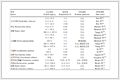
1 材料与方法 1.1 试剂与材料22种PFASs标准品和同位素提取内标标准品均购买于加拿大Wellington实验室,目标物基本信息和方法检出限见表 1. 甲醇(色谱纯)购自上海安谱公司. 乙酸铵(色谱纯)、冰醋酸(色谱纯)和氨水(优级纯)购自Aladdin公司. 超纯水(18.2 MΩ·cm)使用Milli-Q Advantage A10制得. 石英纤维滤膜(0.3 μm,47 mm)购自山东聚凯公司. Oasis WAX 6cc(500 mg)固相萃取柱购自Waters公司.
|
表 1 22种PFASs中英文名称及缩写、CAS号、方法检出限和回收率 Table 1 Chinese/English names and abbreviations, CAS numbers, method detection limits, and recoveries of 22 PFASs |
1.2 仪器与分析条件 1.2.1 水样的前处理
(1)水样加标和过滤 量取500 mL样品,向样品中添加50.0 μL提取内标(13C2-PFOA,加标量为10 ng),使用水样抽滤装置及石英纤维滤膜过滤样品.
(2)固相萃取 使用自动固相萃取仪(AutoSPE-06 Plus,睿科,中国)进行水样的萃取. 依次用6 mL氨水-甲醇溶液(体积比2∶98)、6 mL甲醇和6 mL水活化固相萃取柱. 将过滤后的500 mL样品以4 mL∙min-1的流速通过固相萃取柱,上样结束后,使用8 mL乙酸铵缓冲液(0.025 mol∙L-1)淋洗固相萃取柱,弃去淋洗液. 使用真空泵干燥固相萃取柱10 min,使用8 mL甲醇淋洗固相萃取柱,弃去淋洗液. 使用6 mL氨水-甲醇混合溶液(体积比2∶98)淋洗固相萃取柱,收集洗脱液.
(3)浓缩 使用氮吹仪(KL512J,康林,中国)将洗脱液浓缩并用甲醇定容至1.0 mL,使用0.22 μm尼龙滤膜过滤后待测.
1.2.2 仪器参数采用超高效液相色谱-三重四极杆质谱仪(Acquilty H/TQ-S,Waters,美国)分析样品.
色谱参数如下.
色谱柱:Acquilty UPLC BEH C18,1.7 µm,2.1×100 mm,Waters;延迟柱:Acquilty UPLC BEH C18,2.1 µm,2.1×50 mm,Waters;进样体积3 μL,流速0.40 mL∙min-1;流动相A:2 mmol∙L-1乙酸铵水溶液,流动相B:甲醇;淋洗条件:0~0.3 min,65% A;0.3~9 min,65%~0% A;9~12 min,0% A;12~12.1 min,0%~65% A;12.1~17.0 min,65% A.
质谱参数如下.
离子化方式:负离子模式,燥气温度280 ℃,干燥气流速为6 L∙min-1,鞘气温度340 ℃,化气压力为5×6.9 kPa,电压500 V,喷嘴电压2 000 V;扫描方式:多反应监测模式.
1.2.3 结果计算根据Acquilty H/TQ-S分析结果,采用Mass Lynx软件进行定量分析. 在定量分析过程中,利用每种PFASs的峰面积和提取内标峰面积比值作为响应值,建立标准曲线,设置质量浓度为1.0、2.0、5.0、10.0、20.0、50.0和100 µg∙L-1.
1.3 质量保证与质量控制每20个样品或每批样品(≤20个)做一个空白试验和平行样品,空白测定结果不超过方法检出限,平行样测定结果的相对偏差在±22.5%之间. 样品中PFASs和提取内标回收率控制在54.9%~154.0%(表 1). 使用聚乙烯样品瓶存储,样品采集前,依次使用甲醇和纯水清洗采样瓶,防止引入目标物干扰.
1.4 采样点位与样品存储在长江中下游干流省/市界位置,工业园区或污水处理厂排污口下游,及重要水功能区上中下游选择1~3个断面(据水功能区长度确定断面数量),共45个国控断面,利用“中国环监008”监测船,于2022~2023年4月和10月开展4次监测. 点位布设如图 1所示,按照行政区域划分:湖南段布设6个点位(HN1~HN5和洞庭湖出口D9),湖北段布设12个点位(HB1~HB12),江西段布设5个点位(JX1~JX4和鄱阳湖出口P11),安徽段布设9个点位(AH1~AH9),江苏段布设10个点位(JS1~JS10),上海段布设3个点位(SH1~SH3). 水样采集后,置于4 ℃冷藏保存,14 d内完成前处理分析.

|
图 1 长江中下游监测点位 Fig. 1 Monitoring sites in the middle-lower Yangtze River |
在22种PFASs中,PFNA、PFHpS和ADONA的检出率较低且质量浓度在检出限附近,后续仅对检出率较高的19种PFASs进行分析. 总体来看,4次检出率最高物质为PFBS(100%)、PFHxA(100%)、PFOA(> 96%)和PFBA(> 89%). 检出质量浓度最高物质为PFHxA(141.8 ng∙L-1,江苏段JS9,2022年10月),其次为PFOA(88.3 ng∙L-1,江苏段JS7,2022年10月)、PFDoDA(83.0 ng∙L-1,湖南段HN4,2022年4月)、PFBS(74.5 ng∙L-1,江西段JX3,2023年4月)和PFUnDA(66.4 ng∙L-1,湖南段HN4,2022年4月). 检出
2022年长江中下游各监测点位

|
点位按上下游顺序从左至右依次排列 图 2 2022年4月和10月长江中下游PFASs质量浓度 Fig. 2 PFASs concentrations in the middle-lower Yangtze River inApril and October, 2022 |
2022年
2023年长江中下游各点位

|
点位按上下游顺序从左至右依次排列 图 3 2023年4月和10月长江中下游PFASs质量浓度 Fig. 3 PFASs concentrations in the middle-lower Yangtze River in April and October, 2023 |
与2022年4月相比,2023年4月湖南段的极端
2022~2023年长江中下游各点位不同链长PFASs质量浓度值见图 4和图 5,整体来看,短链PFASs(C4~C6)为最主要成分,具体为PFBS、PFHxA和PFBA等. 其中2022年4月湖南段(HN2、HN3、HN4和HN5)、江西段(JX1、JX2和JX3)和湖北少量点位(HB2、HB4、HB7和HB8)以中长链PFASs(C7~C18)为主. 鄱阳湖出口P11的短链PFASs质量浓度为139.7 ng∙L-1,超出干流上游临近断面958%(JX2,13.2 ng∙L-1). 鄱阳湖水体汇入后,九江下游点位JX3和JX4中的短链PFASs(C4~C6)质量浓度显著上升,自九江段JX4至上海段,检出物质开始以短链PFASs为主. 2022年10月除少数点位(HB7、HB8、JX1和JS7)主要检出物质为中长链PFASs(C7~C18)外,长江干流以短链PFASs(C4~C6)为最主要成分,其中鄱阳湖出口P11(143.7 ng∙L-1)和江苏段JS9(165.8 ng∙L-1)的检出短链PFASs质量浓度分别超干流上游临近断面771%(JX2,16.5 ng∙L-1)和112%(JS8,78.1 ng∙L-1). 2023年4月也主要检出短链PFASs(除JX2外),且呈现从中游向下游递增的趋势,自鄱阳湖水体(P11)汇入后,中下游各点位短链PFASs质量浓度占比为69%~85%. 2023年10月湖北黄冈段(HB9、HB10和HB11)主要检出中长链PFASs,但鄱阳湖水体汇入后,中下游各点位检出物质仍以短链PFASs为主.

|
点位按上下游顺序从左至右依次排列 图 4 2022年4月和10月长江中下游不同链长PFASs检出质量浓度 Fig. 4 Concentrations of PFASs with different chain lengths in the middle-lower YangtzeRiver in April and October, 2022 |

|
点位按上下游顺序从左至右依次排列 图 5 2023年4月和10月长江中下游不同链长PFASs检出质量浓度 Fig. 5 Concentrations of PFASs with different chain lengths in the middle-lower Yangtze River in April and October 2023 |
PFASs的替代品除了短链PFASs外,还有含官能团的全氟聚醚化合物. 在本研究中,PFOA替代物ADONA的检出率较低且其质量浓度在检出限附近. PFOS替代物F-53B质量浓度值如图 6所示,2022年4月HN2和HN4点位出现最高F-53B质量浓度峰,分别为7.0 ng∙L-1和8.5 ng∙L-1,10月湖北段(HB8、HB10和HB12)也存在一定检出F-53B质量浓度(1.1~2.3 ng∙L-1). 除了湖南和湖北5个质量浓度峰值外,F-53B在2023年的检出质量浓度整体高于2022年. 其中2023年10月在HB9(4.9 ng∙L-1)和JX3(1.5 ng∙L-1)等点位也出现F-53B质量浓度峰值.

|
点位按上下游顺序从左至右依次排列 图 6 2022~2023年长江中下游F-35B、PFOS和PFOA检出质量浓度 Fig. 6 F-35B, PFOS, and PFOA concentrations in the middle-lower Yangtze River in 2022 and 2023 |
2022~2023年长江中下游各点位主要检出组分以短链PFASs(C4~C6)为主,且F-53B等PFASs替代物在环境中的赋存逐年增加,说明PFASs污染正向短链PFASs或替代品转移.
2.2.2 重点管控PFASs分析《重点管控新污染物清单(2023年版)》主要针对PFHxS、PFOS和PFOA这3种PFASs的生产、加工使用和进出口做出了限制. 在各监测点位PFHxS的质量浓度范围为ND~1.7 ng∙L-1,在检出限附近(检出限为0.3 ng∙L-1)波动. 因此,重点对PFOS及PFOA的赋存情况进行分析.
2022~2023年长江中下游各点位PFOS质量浓度值如图 6所示. 2022年4月PFOS检出质量浓度为ND~7.6 ng∙L-1,10月仅3个点位(HN1、HB8和JX3)检出. 其中,湖北(HB5,4月)、湖南(HN2和HN4,4月)、江西(JX3,10月)和江苏(JS10,10月)段均出现少量较高质量浓度点,最大质量浓度值为7.6 ng∙L-1(HB5,4月). 2023年73%点位为未检出,仅10月期间湖北(HB11)、安徽(AH5)和江苏段(JS5)有少量点位检出,最大值为1.8 ng∙L-1. 2023年4月PFOS质量浓度明显比2022年4月低. 随着PFOS被限制使用,PFBS作为其短链替代品有越来越多的应用[28],2023年PFBS的检出质量浓度总体高于2022年(图2~3),这说明PFOS异常排放减少,可能与PFASs管控趋严,短链PFASs(如PFBS)和PFASs替代物(如F-53B)的推广使用等因素密切相关.
PFOA来源于塑料橡胶品的乳化、纺织品阻燃纸类表面处理和消防灭火剂等[29],在2022~2023年长江中下游各点的PFOA检出质量浓度见图 6,其质量浓度水平明显高于另外两种管控物质PFOS和PFHxS. 从空间上分析,江西至上海段的PFOA质量浓度明显高于中游湖南和湖北段,呈现下游蓄积趋势. 从时间上分析,2022年10月江苏泰州段JS7、苏州段JS9和上海段SH1的PFOA检出质量浓度较大,最大值为88.3 ng∙L-1. 2023年4月江西段出现极端质量浓度峰值(JX2,63.6 ng∙L-1),10月时2022年江苏段出现的极端质量浓度值消失,说明江苏段PFOA的异常排放可能得到有效控制. PFBA等短链PFASs属于PFOA常见替代物[27],相比于2022年,2023年4月PFBA质量浓度明显更高(图 2和图 3),说明PFOA极端质量浓度值消失可能与PFASs管控趋严,和短链PFASs替代物的广泛使用相关.
2.3 PFASs赋存变化分析 2.3.1 PFASs赋存变化原因分析PFASs来源广泛,除工业排放外,在日常的消费品等中也大量存在,其中污水处理厂是PFASs进入水环境的重要途径[30~32]. 由于传统废水处理工艺在去除PFASs方面效果有限,当进水中含有PFASs相关污染物时,可能会通过出水汇入水环境,因此沿岸各省入江废水排放量与区域内监测点位的
通过对2022年和2023年长江中下游排入干流的污水处理厂废水排放量按省进行统计,发现这两年的废水排放量并未有太大差别. 对各省入江废水排放量与区域

|
图 7 2022年和2023年长江中下游各江段 |
|
|
表 2 2022年和2023年废水量与 |
此外,根据水利部长江水利委员会公布的2022年和2023年长江流域重要控制断面水资源监测通报,2022年4月和10月长江干流宜昌、汉口、大通水文站的月径流量约为300、550、750亿m3和235、275、300亿m3,2023年4月和10月的月径流量约为175、365、570亿m3和400、635、735亿m3. 湖南段点位处于长江干流宜昌至汉口段之间,2022年4月该区段的月径流量高于2023年4月,同期HN2、HN3、HN4和HN5检出
2022~2023年PFASs检出组分Spearman相关性分析如图 8所示,PFBA、PFPeA、PFHxA、PFHpA、PFOA、PFBS和PFHxS等7种组分之间呈现明显的正相关性(0.37 < r < 0.83,P < 0.01). Kaiser等[33]和钟婷婷等[34]研究表明臭氧氧化不能去除PFASs,而是将长链PFASs(≥C8)、前体和一些全氟烷基醚酸转化为短链PFASs,例如PFBA、PFPeA、PFBS、PFHxS和PFHxA等. 张慧等[35]研究表明,羟基自由基氧化可以使河水体中全氟辛烷磺酰胺转化为PFHxA、PFOA和PFHpA等物质. 以上研究暗示着PFBA等短链PFASs可能来自相同或类似的排放源. PFUnDA、PFDS、PFDoDA、PFTrDA、PFTeDA、PFHxDA和PFODA之间呈现显著的正相关性(0.29 < r < 0.73,P < 0.01)(PFDS与PFODA除外),说明它们也可能来自相同源或拥有相似的环境行为,例如作为长链的PFASs可能由油漆油墨助剂、皮革及纸制品整理黏合剂添加的PFASs前体物质氟调醇(FTOHs)氧化形成[29]. PFBA与PFDS、PFBS与PFUnDA、PFBA和PFBS与PFDoDA、PFTrDA、PFTeDA、PFHxDA和PFODA之间呈现显著负相关性(-0.37 < r < -0.21,P < 0.01),可能是因为长链PFASs降解产生PFBA和PFBS等短链PFASs的原因[33].

|
1. PFBA,2. PFPeA,3. PFBS,4. PFHxA,5. PFPSA,6. PFHpA,7. PFHxS,8. PFOA,9. PFOS,10. PFDA,11. F-53B,12. PFNS,13. PFUnDA,14. PFDS,15. PFDoDA,16. PFTrDA,17. PFTeDA,18. PFHxDA,19. PFODA;红色左下向右上方倾斜代表正相关,蓝色右下向左上方倾斜代表负相关,颜色越深椭圆面积越小代表相关性系数绝对值越大;**表示P < 0.01,*表示P < 0.05,无*表示P≥0.05 图 8 2022年和2023年检出PFASs组分的Spearman相关性 Fig. 8 Spearman correlation of PFASs components in 2022 and 2023 |
长江干流相关调研结果见表 3. 2015~2019年期间,长江上游
|
|
表 3 长江流域全氟化合物污染状况调查结果 Table 3 Research results on the pollution of PFASs in the Yangtze River Basin |
3 结论
(1)在2022~2023年间,长江中下游
(2)2022年长江干流从中游到下游局部出现极端
(3)2023年湖南、湖北、安徽、江苏和上海这5省/市排入干流的废水量与各江段内
(4)长江干流极端
| [1] | Wang Z Y, DeWitt J C, Higgins C P, et al. A never-ending story of per- and polyfluoroalkyl substances (PFASs)[J]. Environmental Science & Technology, 2017, 51(5): 2508-2518. |
| [2] | Gluge J, Scheringer M, Cousins I T, et al. An overview of the uses of per- and polyfluoroalkyl substances (PFAS)[J]. Environmental Science: Processes & Impacts, 2020, 22(12): 2345-2373. |
| [3] | Schaider L A, Balan S A, Blum A, et al. Fluorinated compounds in U.S. fast food packaging[J]. Environmental Science & Technology Letters, 2017, 4(3): 105-111. |
| [4] |
王佩, 黄欣怡, 曹致纬, 等. 新污染物共排放对生态环境监测和管理的挑战[J]. 环境科学, 2022, 43(11): 4801-4809. Wang P, Huang X Y, Cao Z W, et al. Challenges regarding the co-emission of emerging pollutants to eco-environmental monitoring and management[J]. Environmental Science, 2022, 43(11): 4801-4809. |
| [5] |
杨欢, 向雅芸, 常文杰, 等. 山东省农田土壤中全氟化合物的含量及来源解析[J]. 环境科学, 2026, 47(4): 2612-2624. Yang H, Xiang Y Y, Chang W J, et al. Concentration and source analysis of per- and polyfluoroalkyl substances in agricultural soils of Shandong Province[J]. Environmental Science, 2026, 47(4): 2612-2624. DOI:10.13227/j.hjkx.202501098 |
| [6] | Guo M M, Wu F, Geng Q Q, et al. Perfluoroalkyl substances (PFASs) in aquatic products from the Yellow-Bohai Sea coasts, China: concentrations and profiles across species and regions[J]. Environmental Pollution, 2023, 327. DOI:10.1016/j.envpol.2023.121514 |
| [7] | Khan R, Andreescu D, Hassan M H, et al. Nanoelectrochemistry reveals selective interactions of perfluoroalkyl substances (PFASs) with silver nanoparticles[J]. Angewandte Chemie International Edition, 2022, 134(42). DOI:10.1002/ange.202209164 |
| [8] | Evich M G, Davis M J B, McCord J P, et al. Per- and polyfluoroalkyl substances in the environment[J]. Science, 2022, 375(6580). DOI:10.1126/science.abg9065 |
| [9] | Kurwadkar S, Dane J, Kanel S R, et al. Per- and polyfluoroalkyl substances in water and wastewater: A critical review of their global occurrence and distribution[J]. Science of the Total Environment, 2022, 809. DOI:10.1016/j.scitotenv.2021.151003 |
| [10] | Mu H X, Wang J W, Chen L, et al. Identification and characterization of diverse isomers of per- and polyfluoroalkyl substances in Chinese municipal wastewater[J]. Water Research, 2023, 230. DOI:10.1016/j.watres.2023.119580 |
| [11] | Zhou Z, Liang Y, Shi Y L, et al. Occurrence and transport of perfluoroalkyl acids (PFAAs), including short-chain PFAAs in Tangxun Lake, China[J]. Environmental Science & Technology, 2013, 47(16): 9249-9257. |
| [12] | Domingo J L, Nadal M. Human exposure to per- and polyfluoroalkyl substances (PFAS) through drinking water: a review of the recent scientific literature[J]. Environmental Research, 2019, 177. DOI:10.1016/j.envres.2019.108648 |
| [13] | Fenton S E, Ducatman A, Boobis A, et al. Per- and polyfluoroalkyl substance toxicity and human health review: current state of knowledge and strategies for informing future research[J]. Environmental Toxicology and Chemistry, 2021, 40(3): 606-630. |
| [14] | Li J, Gao Y, Xu N, et al. Perfluoroalkyl substances in the Yangtze River: changing exposure and its implications after operation of the Three Gorges Dam[J]. Water Research, 2020, 182. DOI:10.1016/j.watres.2020.115933 |
| [15] | Liu T, Qian X, Wang S, et al. Occurrence and transport of perfluoroalkyl acids (PFAAs) in a Yangtze River water diversion project during water diversion and flooding[J]. Water Research, 2021, 205. DOI:10.1016/j.watres.2021.117662 |
| [16] |
方淑红, 李成, 卞玉霞, 等. 岷江流域全氟化合物的污染特征及排放通量[J]. 中国环境科学, 2019, 39(7): 2983-2989. Fang S H, Li C, Bian Y X, et al. Pollution characteristics and flux of perfluoroalkyl substances in Minjiang River[J]. China Environmental Science, 2019, 39(7): 2983-2989. |
| [17] |
杜国勇, 蒋小萍, 卓丽, 等. 长江流域重庆段水体中全氟化合物的污染特征及风险评价[J]. 生态环境学报, 2019, 28(11): 2266-2272. Du G Y, Jiang X P, Zhuo L, et al. Distribution characteristics and risk assessment of perfluorinated compounds in surface water from Chongqing section of the Yangtze River[J]. Ecology and Environmental Sciences, 2019, 28(11): 2266-2272. |
| [18] |
李珍. 长江中游地区湖泊全氟化合物的污染特征及生态风险评估[D]. 武汉: 中国科学院大学(中国科学院武汉植物园), 2019. Li Z. Distribution and risk assessment of perfluoroalkyl substances in lakes from the middle reach of Yangtze River, China[D]. Wuhan: University of Chinese Academy of Sciences (Wuhan Botanical Garden, Chinese Academy of Sciences), 2019. |
| [19] | Tan K Y, Lu G H, Yuan X, et al. Perfluoroalkyl substances in water from the Yangtze River and its tributaries at the dividing point between the middle and lower reaches[J]. Bulletin of Environmental Contamination and Toxicology, 2018, 101(5): 598-603. DOI:10.1007/s00128-018-2444-z |
| [20] | Zheng B H, Liu X L, Guo R, et al. Distribution characteristics of poly- and perfluoroalkyl substances in the Yangtze River Delta[J]. Journal of Environmental Sciences, 2017, 61: 97-109. DOI:10.1016/j.jes.2017.09.015 |
| [21] |
张悦清, 张爱国, 曹莉, 等. 长江流域全氟化合物污染态势与生态效应[J]. 环境监控与预警, 2020, 12(5): 58-67. Zhang Y Q, Zhang A G, Cao L, et al. Contamination status and ecological effects of perfluoroalkyl substances in the Yangtze Basin[J]. Environmental Monitoring and Forewarning, 2020, 12(5): 58-67. |
| [22] | Liu S Y, Jin B, Arp H P H, et al. The fate and transport of chlorinated polyfluorinated ether sulfonates and other PFAS through industrial wastewater treatment facilities in China[J]. Environmental Science & Technology, 2022, 56(5): 3002-3010. |
| [23] | Lei H J, Lu Y L, Wang P, et al. Shift from legacy to emerging per- and polyfluoroalkyl substances for watershed management along the coast of China[J]. Environmental Pollution, 2024, 363. DOI:10.1016/j.envpol.2024.125153 |
| [24] | Zhang C H, Hopkins Z R, McCord J, et al. Fate of per- and polyfluoroalkyl ether acids in the total oxidizable precursor assay and implications for the analysis of impacted water[J]. Environmental Science & Technology Letters, 2019, 6(11): 662-668. |
| [25] |
李维彤. PFOS、PFOA及其前体和替代物在典型环境介质及母婴人群中污染暴露及健康评价[D]. 上海: 东华大学, 2023. Li W T. Exposure and health evaluation of PFOS, PFOA, and their precursors and substitutes in typical environmental media and in maternal and infant populations[D]. Shanghai: Donghua University, 2023. |
| [26] | Liu ZY, Xu C, Johnson A C, et al. Exploring the source, migration and environmental risk of perfluoroalkyl acids and novel alternatives in groundwater beneath fluorochemical industries along the Yangtze River, China[J]. Science of the Total Environment, 2022, 827. DOI:10.1016/j.scitotenv.2022.154413 |
| [27] | Ma D H, Zhong H F, Lv J T, et al. Levels, distributions, and sources of legacy and novel per- and perfluoroalkyl substances (PFAS) in the topsoil of Tianjin, China[J]. Journal of Environmental Sciences, 2022, 112: 71-81. DOI:10.1016/j.jes.2021.04.029 |
| [28] | Meador J P, Yeh A, Young G, et al. Contaminants of emerging concern in a large temperate estuary[J]. Environmental Pollution, 2016, 213: 254-267. DOI:10.1016/j.envpol.2016.01.088 |
| [29] |
李法松, 倪卉, 黄涵宇, 等. 安徽省部分城市土壤中全氟化合物空间分布及来源解析[J]. 环境科学, 2017, 38(1): 327-332. Li F S, Ni H, Huang H Y, et al. Spatial distribution and source of perfluorinated compounds in urban soil from part of cities in Anhui Province, China[J]. Environmental Science, 2017, 38(1): 327-332. DOI:10.13227/j.hjkx.201605019 |
| [30] | Zhao C J, Liu H Q, Cheng D L, et al. Insights into poly-and perfluoroalkyl substances (PFAS) removal in treatment wetlands: emphasizing the roles of wetland plants and microorganisms[J]. Water Research, 2025, 268. DOI:10.1016/j.watres.2024.122702 |
| [31] | Lenka S P, Kah M, Padhye L P. A review of the occurrence, transformation, and removal of poly- and perfluoroalkyl substances (PFAS) in wastewater treatment plants[J]. Water Research, 2021, 199. DOI:10.1016/j.watres.2021.117187 |
| [32] | Vo H N P, Ngo H H, Guo W S, et al. Poly-and perfluoroalkyl substances in water and wastewater: a comprehensive review from sources to remediation[J]. Journal of Water Process Engineering, 2020, 36. DOI:10.1016/j.jwpe.2020.101393 |
| [33] | Kaiser A M, Saracevic E, Schaar H P, et al. Ozone as oxidizing agent for the total oxidizable precursor (TOP) assay and as a preceding step for activated carbon treatments concerning per- and polyfluoroalkyl substance removal[J]. Journal of Environmental Management, 2021, 300. DOI:10.1016/j.jenvman.2021.113692 |
| [34] |
钟婷婷, 林涛, 刘威. 饮用水处理过程中全氟化合物的分布、转化及去向[J]. 环境科学, 2023, 44(5): 2613-2621. Zhong T T, Lin T, Liu W. Distribution, tansformation, and fate of per-and polyfluoroalkyl substances in drinking water treatment[J]. Environmental Science, 2023, 44(5): 2613-2621. DOI:10.13227/j.hjkx.202207056 |
| [35] |
张慧, 王世亮, 余杨. 乐安河河流水体典型全氟化合物的浓度及其前体物的污染贡献[J]. 环境科学, 2020, 41(7): 3204-3211. Zhang H, Wang S L, Yu Y. Concentrations of typical perfluoroalkyl acids and contributions of their precursors in the water of the Le'an River in China[J]. Environmental Science, 2020, 41(7): 3204-3211. DOI:10.13227/j.hjkx.201911121 |
| [36] |
武婷, 孙善伟, 樊境朴, 等. 不同年份太湖水域全氟化合物健康风险源解析对比[J]. 环境科学, 2022, 43(9): 4513-4521. Wu T, Sun S W, Fan J P, et al. Comparison of health risk from sources of perfluoroalkyl substances in Taihu Lake for different years[J]. Environmental Science, 2022, 43(9): 4513-4521. DOI:10.13227/j.hjkx.202111235 |